Category Archives: Welcome

Touch Me…Please!

Although we think of Venus when we think of touch and our body’s response to it, Venus also rules Libra, the sign of relationships. With Mercury retrograde in Libra and this weekend’s Full Moon eclipse on the Aries-Libra axis, it may be worth considering how much we can communicate through touch — and what is not being expressed or heard when we lack touch. This article by Freya Watson first appeared on Elephant Journal. — Amanda P.

By Freya Watson

It was two in the morning and I was awake again, tossing and turning under the quilt with a restless yearning. My body had been used to being held, loved, stroked and pleasured, and it was suffering withdrawal symptoms.

Freya Watson

Freya Watson

I’d been separated — and celibate — for almost a year and was badly missing intimate physical contact. Don’t get me wrong. It’s not that I couldn’t find a massage therapist or a casual partner. I’d had plenty of massages, but none of them quite hit the spot.

And casual partners weren’t exactly abundant at the time, for some reason. It wasn’t sex I was after, anyway — it was loving touch. The kind of touch a new lover naturally showers on their beloved in the early days of exploration and wonder.

I knew what I needed and was willing to ask, but finding it was another story. Luckily the dry period didn’t last long, though, and pretty soon my body was again feeling that happy glow that comes with being touched with love.

In the years since, when I take time off writing to see clients for healing, I’ve noticed how common it is to see people whose whole energy is begging, ‘touch me — please!’ Not that they’re necessarily aware of it, or looking for me to touch them. It’s just that they may not have had intimate contact with another person in years, and may have even forgotten how to allow themselves to be touched. Even if they’re in a relationship and sexually active, it doesn’t necessarily mean they are experiencing true intimacy and loving touch. Sex and intimacy don’t always go together. I wonder how many people go through adult life without being properly touched?

Our bodies are built for connection. Not just a casual hug or hand on the shoulder.

We’re built to thrive on love, and intimate touch is a natural physical manifestation of love. And by intimate touch I mean the kind that says ‘I’m right here, fully present with you, in this moment,’ rather than intimacy that is just about genital contact. It’s an intimacy which can be shared with anyone we love, not just sexual partners. Studies have shown that the cells in our bodies expand when they feel love and contract when they feel its opposite, and our ability to use our touch to transmit that energy to another is an innate gift which we all carry.

Modern society is moving further and further away from touch as a natural, integrated part of everyday life.

To fill the gap, we have created services that people buy and sell, but it’s not that same and we’re losing touch with our own natural ability to bring healing and pleasure to those close to us.

Massage is needed in the world because love has disappeared. Once the very touch of lovers was enough. A mother touched the child, played with his body, and it was massage. The husband played with the body of his woman and it was massage; it was enough, more than enough. It was deep relaxation and part of love. But that has disappeared from the world. By and by we have forgotten where to touch, how to touch, how deep to touch. In fact touch is one of the most forgotten languages.” ~ Osho from ‘Hammer on the Rock’

Reawakening that ability for loving touch can be one of the simplest and most beautiful gifts to ourselves and our loved ones. At its most basic, just showing up and being willing to touch someone with the intention of bringing healing or love can be a comforting experience for another. And sometimes it’s as easy as that. We may shy away from placing soothing hands on an aching back or stroking a tense head, thinking drugs or a doctor are more efficient, or not wanting to spend the time. Surprisingly, though, it can be all that’s needed to shift a mood, lighten discomfort, or unlock a deeper emotional layer that’s ready to be cleared. More importantly, touch connects people and increases that sense of trust and love in the world in a way that doctors and drugs struggle to do.

In essence, reclaiming our ability to lovingly touch another — whether child, friend or lover — can be as straightforward as practicing the following four qualities. The more often we practice them, the deeper our touch can go.

Clear intention. Be clear about why you want to touch another and stay focused on that intention. Are you intending to create a sense of well-being? Or pleasure? Or comfort? Whatever it is, be clear in your mind about it before you start. As an experiment, ask a friend to close their eyes and try two variations of the same touch — stroke their arm once while thinking of your favorite movie, and then a second time while intending that they feel your love. Then ask if they noticed any difference.

Love. It sounds simple to say ‘love the one you’re with’ but it’s not always that easy to access a feeling of love for someone at the drop of a hat. So find another way in to the energy — twiddle that internal dial until you find that feeling of love somewhere inside (try music, or the face of a lover, or the memory of a warm summer’s day). Use your mind or senses to find a catalyst that can bring you back to a deep feeling of love, then refocus the energy on the person you’re with.

Presence. You can’t hear what another’s body is trying to say to you if your mind is busy, so bring that mind fully into the moment! Focus on the sensation of touch, or on synchronizing your breathing with the person you’re touching, if you need to have something to keep the mind busy. Being present brings a stillness, and intuition reaches us through that stillness.

Trust. Trust that you can bring a sense of well-being and love to another by touching them. Trust that somewhere deep inside, you know how and where to touch them. Then follow your instincts, get on with it and see where it leads you.

Feelings of pleasure and well-being aren’t just for the lucky one who’s being touched, either.

The beauty of feeling another opening under your touch and discovering the depths that can be hidden in the body brings with it a deeper connection to the mysteries of life as well as a sense of profound gratitude for this simple gift. So find a partner and get touching! Then teach your kids.

Freya Watson describes herself as a writer, lover, mother and female mystic. A respected author and teacher, she bases much of her work on how we ground our heart-felt truths into the everyday experience of relationships, work and family. Freya’s books are on Amazon, and she is currently lying low while she works on several volumes of fiction. You can also find her on Facebook and read more on her blog.

Live Call-in Planet Waves FM — Asheville, NC Plus Mercury Retrograde and Saturn in Sagittarius

Use this link if you’re listening on an iOS or mobile device. Download MP3.

Dear Friend of Planet Waves:

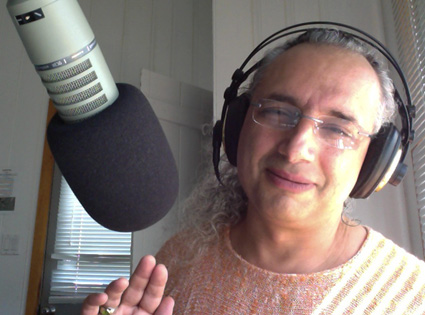
Tonight I will be hosting a live, call-in edition of Planet Waves FM. I’ll have additional information about the total lunar eclipse in Aries, and open the airwaves to discussion. Please forward this email to anyone you think might be interested.

Join Eric Francis broadcasting from Montauk, New York for a special live edition of Planet Waves FM tonight at 9 pm EDT.

Topics might include the current astrology (the equinox, Mercury retrograde in Libra, Mercury square Pluto, Saturn in Sagittarius, Saturn square Nessus, and of course the total eclipse).

I will also open up the phone lines for discussion of the Waking Life coffee house scenario unfolding in Asheville.

And sure, let’s talk about Pope Francis visiting the U.S. if that floats anyone’s root beer.

The call will take place at 9 pm EDT. Dialing information is below my signature. You may also listen live on the internet.

The whole world is invited. Here are other time zones: Thursday 3 pm HST (Honolulu), 6 pm PDT (San Francisco), 7 pm MDT (Boulder), 8 pm CDT (Chicago), 9 pm EDT (New York), or Friday 2 am BST (London), 3 am CED (Paris), 4 am EED (Warsaw), 9 am AWST (Perth) and 11 am AEST (Melbourne).

Continue reading

A Dismal Day Out

It is man’s fate to outsmart himself. — Message by Jenny Holzer at Dismaland

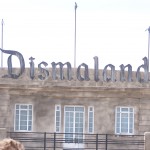
“He’s not a great artist,” the taxi driver said as we approached Banksy’s latest exhibition — a ‘bemusement park’ set in an abandoned Tropicana factory, right by the sea. Whatever you might think of that statement, the next one definitely rings true: “It’s his ideas.”

horsemeat

The horsemeat scandal, illustrated. All images by Amy Elliott.

In case you’ve never heard of the very British institution that is Banksy: he’s a long-active street artist, whose real identity is unknown — presumably to evade arrest for all the graffiti.

His “ideas” as portrayed in his work show a satirical and thoughtful mind, consistently alive to the human struggle. This, far more than the question of his identity, gives him a fascinating quality.

I’d reached the seaside UK town of Weston-super-Mare, near Bristol, at about 1pm. Rather suitably, one of the train connections I took, packed out like the Tube at peak time, was termed “The Misery Express.” On a day like today, it seemed to me just part of the adventure.

To a certain extent, when faced with a Banksy, it’s evident how the work is going to be expressed: cleverly, offering a clear message and something to think about, but clouded just a little in mystery: just enough to involve you, keep you intrigued. Dismaland follows this pattern; but in 3D, as a massive collaborative effort, and if possible with even more chutzpah.

Everything I had heard promised was there. The security scanners in cardboard, courtesy of Bill Barminski, were flanked by annoyed ‘guards’ who would not let you through if you were smiling; once inside, the performer-stewards were indeed cross, grim, or sullen by turns. The buildings were dull and appeared shoddily-painted.

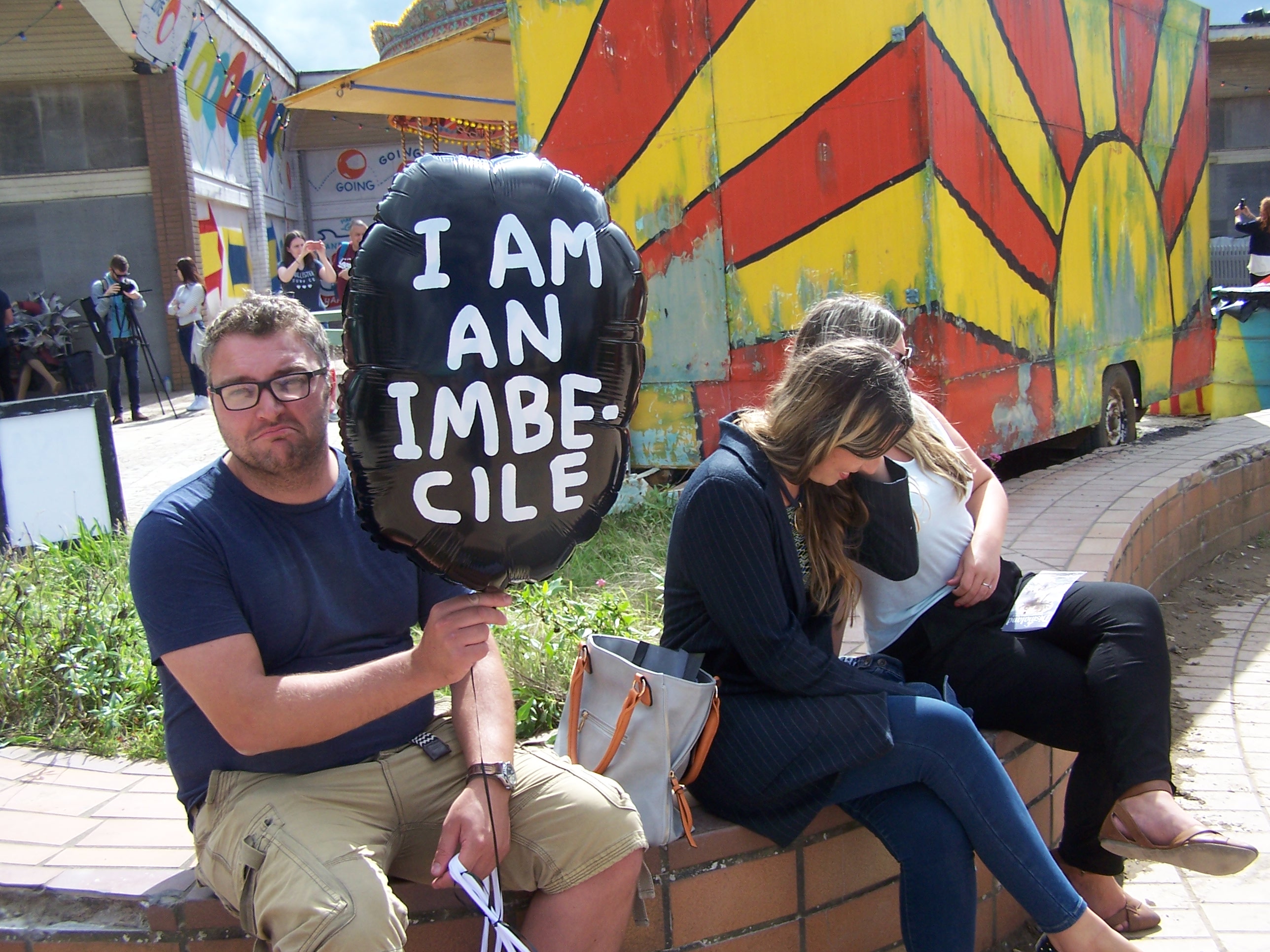
An obliging visitor holding a Dismaland balloon.

An obliging visitor holding a Dismaland balloon.

The layout was a twisted take on a day out at the beach, complete with ultra-slow Caribbean music over the loudspeaker: a pretend paradise in a virtual prison yard.

Occasionally the music would be interrupted by a little girl’s voice, as if for an announcement, except it would be an unusual, thoughtful phrase created by Jenny Holzer, such as: “Being alone with oneself is increasingly unpopular.” Black souvenir balloons, by David Shrigley, proclaim in stark, bold capitals, “I am an imbecile.”

Banksy has signed a group of artists from across the world, many unknown, who each brought their unique insights and creations. Dystopian it might be, but Dismaland is a wonderland of art. Potentially among the most recognizable were Mike Ross’s Big Rig Jig, Michael Beitz’s distorted picnic benches and Damien Hirst’s pickled unicorn. Other notable contributions were Huda Beydoun’s images of Saudi women (with Mickey Mouse silhouettes), Jenny Holzer’s thoughtful billboard texts, and Ronit Baranga’s mutant crockery.

Jimmy Cauty’s incredibly detailed model of a town in the moments after a riot, called “Aftermath Displacement Principle,” is judiciously placed prominently in its own room at the end of the gallery section. Featuring 3000 tiny handmade police, the model has had to be updated because, according to Cauty: “amazingly, in 2013 people weren’t going around staring at their phones all the time and now they are.”

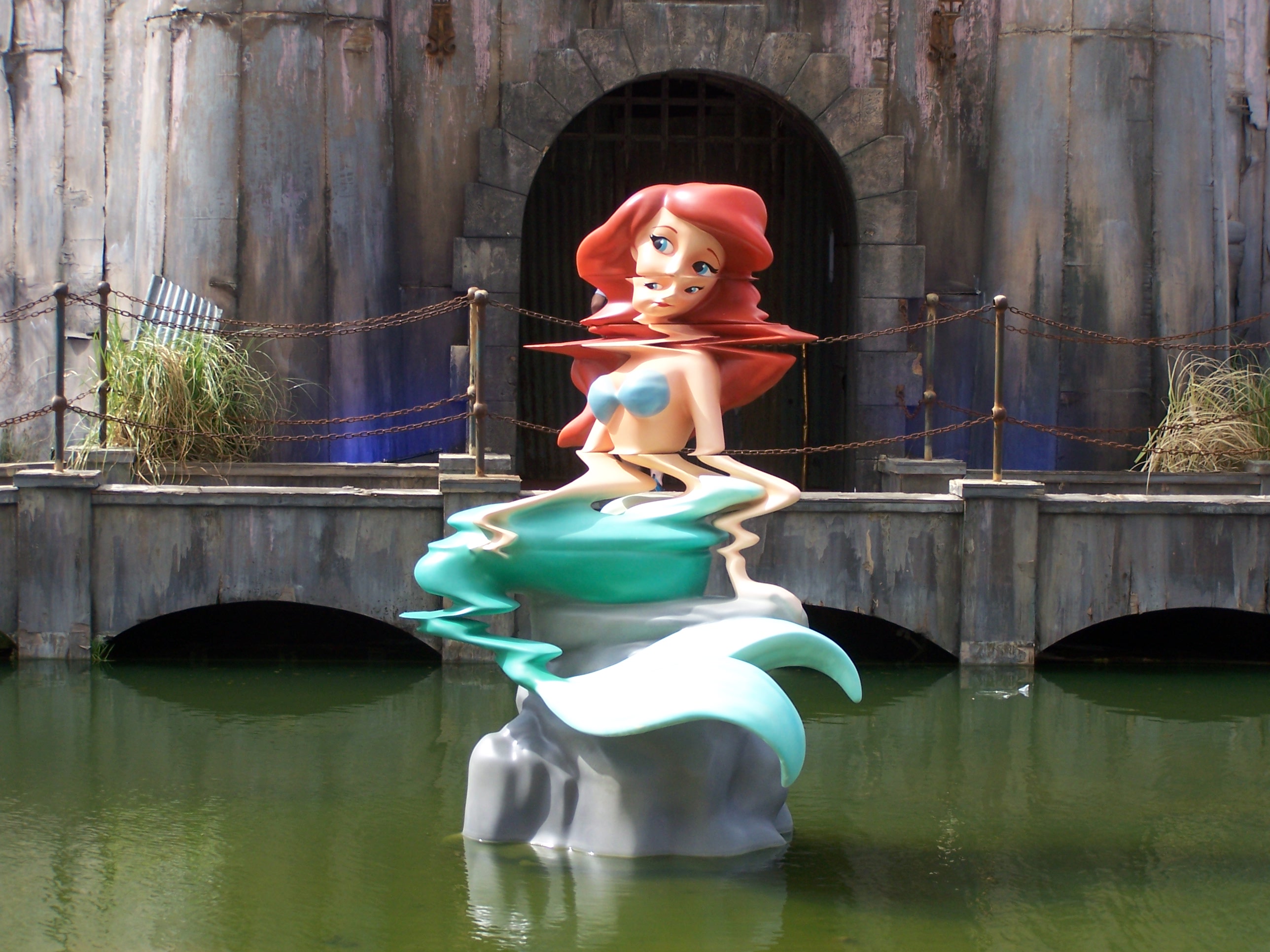
mermaid

A Disney-esque mermaid. With a difference.

The ‘amusements’ were both thematic and distinct: a caravan (camper van), adorned with a NASA sticker, reworked to rotate around the people inside as they sit still.

There’s the merry-go-round on which one of the horses is replaced by a person in a surgical mask with boxes labeled “lasagne” — a reference to the horsemeat scandal of two years ago. The mini-golf is the mini-Gulf; the name says it all, as do the scattered oil barrels.

And then there’s the boat pond: a Banksy contribution, in which the remote-controlled boats are either over-filled with refugees or populated by police. It’s a brilliant satirical piece; and in these days when the drowning of Aylan Kurdi is still fresh in our minds, it seems invested with extra poignancy.

The ‘cinema’ is a big screen set on a trailer, with deckchairs and stone steps for the audience to sit on. A huge image of David Cameron, champagne glass in hand, smugly overlooks the area. The screen shows a loop of short films, chosen by Banksy; amusingly, one of the inclusions was the hilarious “F*ck That” satirical guided meditation. (By the way, anyone with creative aspirations should immediately see this video by Cernuto and Glass.)

The famed centerpiece, the Disney-esque castle containing the overturned princess coach, is perhaps less of a feature than has been touted. There is little to see, except the sculpture itself by the light of perpetually flashing cameras.

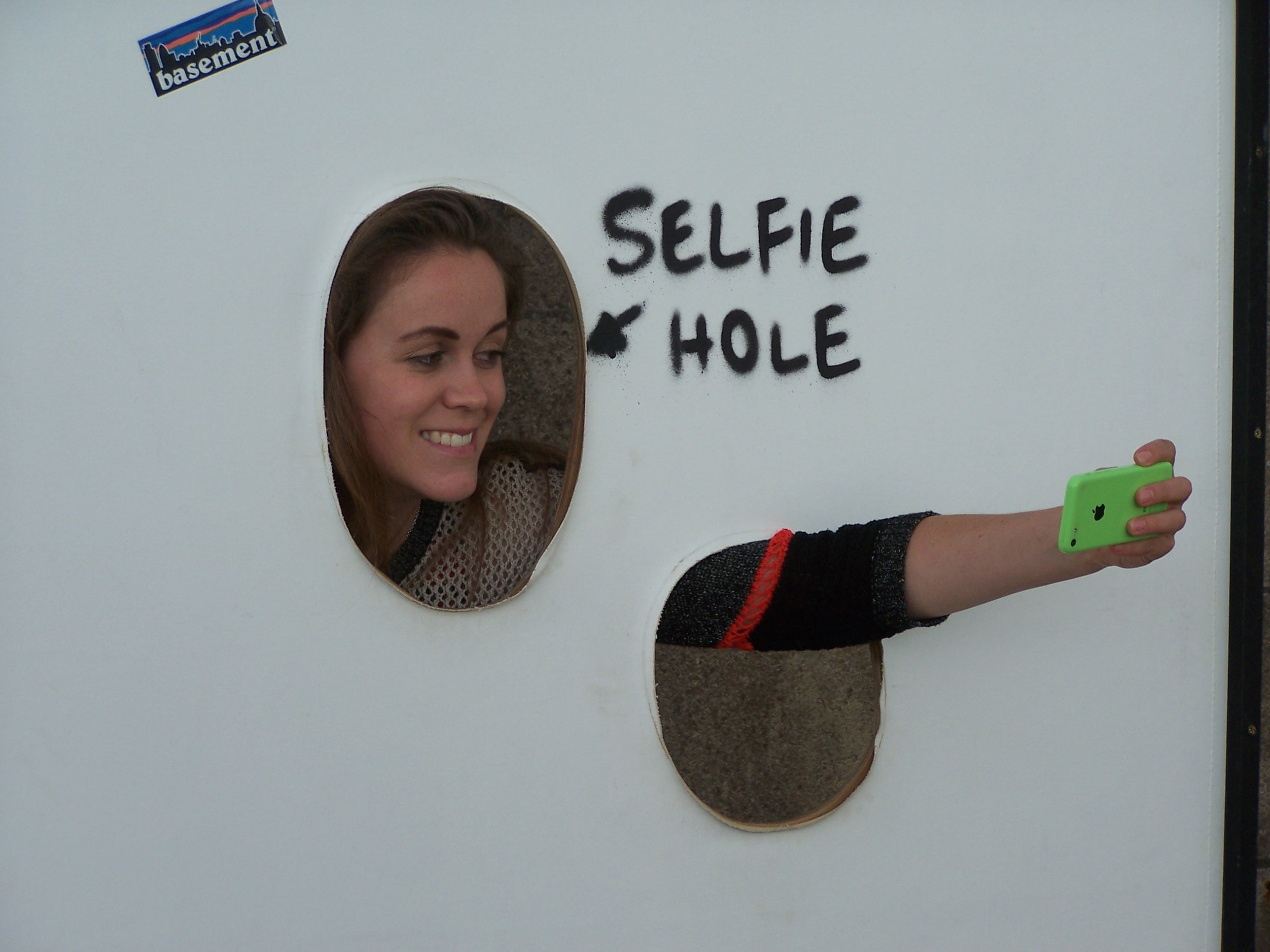
selfiehole

Satire for our times.

One suspects that given the theme park’s title, this piece is here purely out of obligation. Much more congenial is Guerilla Island.

This is where the activist in Banksy is given full play. Not so much in the water slide shaped like a capsized armored police vehicle, as in the billboard with statistics on deaths while in police custody. Then there’s the tent packed with banners and protest signs, from campaigns past and present. The UK Independent Workers’ Union has a stall here, giving visitors the opportunity to take positive action.

As you leave, you pass through the inevitable gift shop — a satire on just about every tourist attraction going — with real enough Dismaland T-shirts and posters. And, of course, shop dummies giving the one-finger salute.

This description of Dismaland is necessarily incomplete, because there were so many wonderful things to see. The attention to detail is superb. Every stained wall, every exposed piece of wiring, every lick of paint — or absence thereof — seems meticulously engineered to create the dystopian world Banksy and his collaborators have brought to life.

I had a good laugh with one of the bartenders over the disappointed review by Jonathan Jones of The Guardian.

It is clear that some have failed magnificently to appreciate just how brilliant Dismaland is.

3amigas

Henye, Faye and Charmaine from North London, who helped me navigate the queues. Thanks, ladies!

Everyone I spoke to was full of its praises, with one visitor describing it as her “perfect day out.” The folks on the union stall also expressed bewilderment at the desultory and muted media coverage the park has received since its opening.

It’s not, I suppose, entirely surprising that big media would wish to suppress someone who is so obviously an anti-establishment figure, an outspoken rebel. But the studied avoidance is not only intended for Banksy, it seems, but Dismaland itself.

The blatant allusions to the Disney empire have served to create the assumption that the theme of the park is merely taking, so to speak, the Mickey. Banksy has had to deny this by press release. But the actual contents give a very different and much more serious message — a grave reflection on the current state of the world, with specific references to David Cameron’s Britain.

Banksy has been quoted as saying that theme parks should have bigger themes. In Dismaland he has manifested that idea in the superlative. At first you smile at the clever jokes and the artificial sourness of the performers. Then the seemingly dispersed, more significant concepts sew themselves together. What results is a complete picture: how off-the-rails consumerism, media fabrications and abuses of power relate to the war-torn landscapes of the Middle East, the destruction of the environment and many, many innocent deaths.

Now that’s dismal. But there is always hope for better, especially when the aware take action and protest. As the child said over the loudspeaker, “Push yourself to the limit as often as possible.”

If you live in the UK or happen to be visiting there this week, Dismaland will be open through Sunday, Sept. 27. Ticket information and other details are available here.

The Vicar of Christ Visits The Christian Nation

Pope Francis I is coming to town this week. As we open the doors of Congress and the United Nations to welcome him, the theme of the questions we ask inevitably is: “How are the Papacy and the Catholic Church responding to the world as it now exists?”

Pope Francis will be arriving in an America, which some here call a “Christian” nation — but ironically, right now we’re a country in midst of ramping up its presidential campaigns on platforms that would make Jesus facepalm.

Donald Trump’s candidacy minted itself on Day One as anti-Hispanic immigrant, and it has grown its base of right-wing racists because of it. We’re still not certain of Hillary Clinton’s veracity when it comes to emails, but what concerns us more is her connection to big money lobbying interests in Washington DC, which have a Kraken’s tentacle-hold on US politics.

Whenever Jeb Bush says his brother “kept us safe,” we cough out “ISIS” as a direct result of the chaos that ensued when Dick Cheney’s Halliburton and other military corporations profited in billions of government money, while under contract purportedly to rebuild Iraq, but not doing a damn thing other than making Iraq a worse mess.

Trump’s racism is not new. It’s ongoing in this country, and its current upswing has had years of build-up and acceptance from the recent past. The vehement anti-Muslim rhetoric grew in the media in the wake of 9-11. The birther movement –- questioning Barack Obama’s “otherness” — arose just before President Obama first took office; and the outright racism against African Americans was sanctioned through speech, practice and policy, starting with the halls of Congress.

We call ourselves a Christian nation, going so far as to re-write the history of America’s Deist Founding Fathers who were children of the Enlightenment and who believed in the separation of Church and State. Yet, as a result, we have become far less tolerant –- less Christ-like –- in the process.

We’ve recently seen displayed some very un-Christ-like behavior by clerk Kim Davis of Rowan County, Kentucky. Her Christian beliefs not only prevented her from allowing gay couples to marry, but also stopped her staff from issuing licenses as well.

Then there’s the arrest of Ahmed Mohamed, a 14-year-old high school student in Irving, Texas, for bringing his science project –- a home-made clock –- to school. This prompted school authorities to call the police to arrest Ahmed because: 1) he’s a Muslim and 2) there is no number two.

Ahhhhmerica: what would the Pontiff say?

Thursday’s address by Pope Francis to a joint session of Congress should be an interesting political and spiritual marker, but not of the Papacy’s evolution; rather, ours. The Christianists and Intolerati are getting blowback from recent events — in response to Ahmed’s arrest in Irving, Texas; and eye-rolling impatience that Kim Davis just DO-HER-JOB-ALREADY after serving time in jail for contempt of court. I may or may not be the only person feeling a shift taking place, but I get the feeling that perhaps our intolerance threshold is at peak and the only way next is a downward slope. Digging out my old school-girl rosary beads, I pray this is so.

With the Pope’s arrival, the Democrats may wince at the Republicans timing their vote to defund Planned Parenthood around the time of the Pontiff’s speech, yet the Republicans will most likely feel the sting of the Pope’s concern over the “economy of exclusion”, also known as global income inequality, as well as his climate change activism. Both parties should take a back seat when it comes to the “pay to play” politics that is killing democracy here and in poorer countries wholesale across the planet.

Remember that it was Pope Francis who instigated talks between Cuba and the US, defrosting 60 years of cold relations between two countries, and leading to the US re-opening its embassy in Havana earlier this summer. It’s the Pope whose liberation theology beliefs were forged from being a priest in Latin America during a time of intense and painful revolutionary struggle. It is this Pope who is questioning the closing of borders in Europe during the Syrian refugee crisis — a crisis caused in large part by our Western wars for profit. It is the Pope who leads and concerns himself with a global flock of 1.3 billion people, world-wide.

Maybe the question we should really ask when Pope Francis I touches down in America is: “How is the United States responding to the world as it now exists?” Who is more in touch with this turning world and all its people? The Pope or us? What are we doing about it? Perhaps Congress and the rest of the country should brace itself not for a pat on the back but for a sermon that needs to be heard by an errant flock — Christian and otherwise.

Morituri te salutamus

Morituri te salutamus — “We who are about to die salute you” — is chanted by gladiators before the Emperor as they enter into battle, to fight until the last one is standing in the pits. Which brings me to the Republican Party’s presidential debate last night at the Reagan Library.

I am somewhat of a political junkie. I get worked up when the wheels start rolling on the American political process. American Presidential campaigns can be an exciting and aggravating process to watch as we try to winnow down our choices for who is going to sit in the Oval Office. But if you know what you’re watching out for, it can be quite fun.

It was especially fun for me in 2008. We were at long-last about to say goodbye and good riddance to the Bush-Cheney regime, and elect the new: new party and new face in the White House. And truth be told, even with all their faults, mistakes, broken promises, and all the baggage of the awful office that is the American Presidency, we didn’t do too badly.

Yet today I feel helpless watching the Republican Party presidential debates. I started by covering the first one last month sponsored by Fox News as a joke, which it was. Continuing with last night’s debates sponsored by CNN at the Reagan Library in Simi Valley — except for some minor team additions — not much has changed.

When we look back to assess what really happened at last night’s Republican debates at the Reagan Library, we shouldn’t focus too long on the “gotcha” remarks that score points over a 24-hour news cycle; or analyze how much blood CNN news personality Jake Tapper was drawing between Carly Fiorina and Donald Trump — or for that matter everyone else on stage and Donald Trump, since his remarks insult and demean anyone in America he thinks of.

We know there’s nothing there in the substance of the show. And it is a show. The debates are elimination duels. With 16 contenders you can imagine why. Yet the way we’re conducting the elimination process didn’t help much.

Last night reminded me of gladiatorial spectacle: words are swords and spears to throw; candidates attack and try to eliminate each other; beating their chests to show their cred on controlling women; running corporations; scapegoating Muslims and Mexicans; hating the gays, the Supreme Court, Planned Parenthood and Obama. All the convenient bugaboos that trigger amygdala (lizard brain) reaction by Republicans in America, which is unfortunately a measure of success for a Republican presidential wanna-be. So far, the only casualty remains former Texas Governor Rick Perry.

This candidate ‘refining’ through debate is equivalent to the imperial ‘thumbs down’, only this time the thumb is by the people in the debate hall and the network applause meter. On top of that, each candidate has staffed the seats of the debate hall with as many of their supporters as possible — to give the audience applause more boost for their chosen politician while on camera. I’ve watched this happen first-hand. The cards are already stacked for the show. It’s been that way for years.

Do we know anything else about these people that would make you envision them tackling the weighty problems that go through the doors to the Oval Office every day? No? Thought so. Entertainment value now weighs more than the future.

Which is probably another reason why Donald Trump remains in the race. His outrageous remarks on the campaign trail are just the right amount of mass distraction. It’s the political equivalent of CNN’s ongoing coverage of Malaysian Airlines flight 370. Furthermore, why would we give a shit as to what your Secret Service nickname would be when we’re not sure you wouldn’t shit yourself when given the red button to push, or if you’d have the intelligence not to use it? Why do we even ask these things?

The way that news networks conduct campaign coverage like it’s “Dancing With the Stars” is costing us democracy. And whoever came up with the ‘candidate we most likely want to have a beer with’ criteria — the criteria used to help elect George W. Bush and Dick Cheney, one of the worst administrations in the 21st century — should be ostracized on a deserted island, forever.

That Vice President Joe Biden was able to get a more human picture himself out there in an interview with Stephen Colbert than in a CNN debate (though he didn’t do too badly there, either, in 2012) should say volumes on the circus American news coverage of politics has become. Why aren’t the news cameras interested in looking more closely?

I am sick of the polarization of our politics. Even as a Democrat, I am interested in hearing what the Republican side has to say. I recall conservatives having some sensible ideas when it came to government. I guess those people are gone, or drowned out.

We have incredibly high-end technology to monitor and scrutinize the movements and words of every last candidate, yet we have failed in making sure the audience these candidates are wooing are informed enough to make wise decisions as to whether they should lead us. That is mostly intentional, and we have discussed why that is here and elsewhere many times before.

I guess the rest belongs to us in demanding more than what we’re getting in the news networks’ coverage and their efforts on behalf of the public’s interest, like with these debates this next year. Given the state of the planet and its people, this is no time for games or game shows. The future, should we choose to accept it or even care to know about it, begins now.

Everyone is Welcome

@AnandWrites: 70 yrs. after 1945, Americans are debating how to mass-deport 11 million residents, while Germans are welcoming 800,000 political refugees.

Everyone is welcome. That is what the sign on the verdigris-colored lady on that tiny island off the coast of New York City means. And by looking at all of us, everyone — with the exception of the Native-born who have been here millennia before Europeans arrived — came from elsewhere. We are the great social experiment of the modern world. An amalgam of races, languages, religions and cultures edging towards each other under one country. And yet the world is moving faster, and more countries are experiencing that same type of cultural pressure.

The “edging” of cultures has never been happy or peaceful. But that struggle is part of the dynamic that makes the US the strange creature that it is: often violent, resistant to change, xenophobic, yet with time, ultimately accepting and embracing the differences. As long as there’s work for everyone and enough to go around, we end up coexisting in a cautious peace.

My immigrant story may be like yours. My father was made a citizen when Hawaii became a state. He brought over my mother from the Philippines and by marrying an American citizen, mama became naturalized, having to register every year.

I grew up surrounded and raised by Filipino uncles from my mama’s family, and the other “uncles” — an extended family of Filipino men who left the islands in the 1920s because jobs were more plentiful overseas. They worked in the agribusiness as irrigators for the lettuce and strawberry fields in the Salinas Valley.

My Uncle Frank — one of the first Filipinos to arrive in Northern California as a farm worker — rose to become a labor contractor, which in his day meant he would drive a large green bus down to the border south of San Diego — a 14 hour trip — to pick up “braceros” — farm workers to work the fields up north. There was little to no immigration control those days. Everyone looked the other way. Frank was so successful at procuring labor that he rose up in the ranks of company management, bought a house in a nice part of town and became quite wealthy.

Since both of my parents had to work to help pay the bills for two growing children, my day care was first with my grandfather. When he died in 1961, my dad and his Mexican kitchen assistants took over. My early childhood was spent in my father’s kitchen, where he cooked three meals a day for over 200 men during the height of the growing and harvesting system. There were no office jobs for my father in Northern California like the one he had in Hawaii, where he worked as housing manager for the Dole pineapple company. In California, he was a former executive who was doing kitchen work at $2.50 an hour.

As a child, I had no idea of what it meant for my father to be doing this kind of hard work. I only knew him to be a very intelligent man working in a very hard job. But I also loved the sights, sounds and tastes of the kitchen. I experienced the “feel” of excitement of the hungry men, waiting in line anxious for my father’s famous pozole — a stew of pork, hominy, onions, garlic and tomatoes.

I remember the lines of men who crawled over to my father’s truck late Saturday morning in the lettuce fields. Because everyone was hungover from their Friday payday partying, the smell and taste of menudo — a tripe stew typical in Mexico for a hangover cure — was deliciously welcome relief.

I grew up brown in a town where the majority was white. Mostly they were of Portuguese and Yugoslavian descent who came the late 19th century and the early part of the 20th. My parents admonished both me and my sister to speak only English in the house. And my interest in reading — particularly my father’s books by Robert Graves — helped me advance my understanding of English, making me capable of using big words in early grade school, and knowing what they really meant.

To this day, whenever I eat alone in a restaurant, I feel most comfortable in a table or counter seat closest to the kitchen. Close to the hum of the kitchen staff predominantly from Mexico and Guatemala — now here in California. It’s the language and the sound of these men and women at work that provides me a strong connection to my home, my history and my place in this present-day world.

The men working on my plate are no different than the ones who worked with my father in his kitchen. With each plate I receive I am grateful, trusting it, because I know where it comes from, the soul put into it, and remember the struggle it took for them to get here to make this plate of food for me to eat, because it was also our family’s struggle. I always tip too much.

Migration is part of human experience on this earth. As we witness Syrians in mass exodus escaping civil war, we watch the various reactions from different countries as they attempt to assimilate or deny entire populations into their countries. This is not the first time this happened on the planet, nor will it be the last.

Our current bout with xenophobia against Mexicans and other Latin immigrants who, like me, have gained a foothold and a powerful, credible presence in this country on every level — that is the marker of how far we’ve come since my childhood and the days when undocumented immigrants was standard business practice. It still is. Donald Trump’s rhetoric is painful, but a blip in our history. He is just one more hurdle to jump in a line of hurdles that will inevitably come, be discussed and argued, and ultimately dismissed with the full acceptance of theirs and all our place in time in this country.

War, economic pressure and climate change will create more mass migrations to safer places, bringing their cultures and languages everywhere, including here. The Syrians are experiencing what we experienced before in previous generations. Their immigration is sudden and massive, like the Europeans in the late 19th and early 20th century. And like them that came before, they will also be in need.

This has been the history of the planet since civilization began. It’s not just our borders, but borders everywhere that will be affected; this time through the whiplash created by our ways of doing business, conducting wars against other governments and continuing our absurd war on drugs, as well as how we’re treating the earth.

Like my story, the determination of political and economic refugees to survive in a foreign land and to keep a hold on their cultural identity is what they’re bringing to other shores in the developed world. Our challenge in this rapidly-changing planet remains to face this without fear of them, or of not having enough for ourselves to share. There is always a way to open the door, always a way to say “everyone is welcome.” Call me naive, but there has to be. This smaller, more pressured world gives us no other choice but to share.