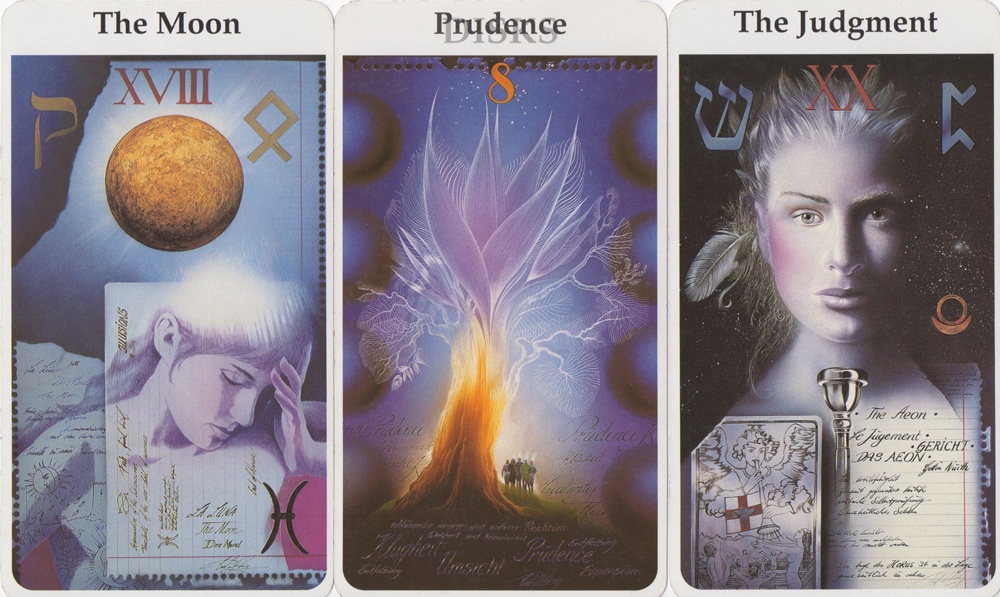
Another week, yet another two major arcana cards — this time surrounding a card from the minor arcana at centre, the Eight of Disks.
Matters of the Soul remain at the fore, this time grounding into a particularly practical, physical experience that is asking you for your due care and attention. But first let’s look at what brought you to this point by seeing what underpins it.
The Moon, Eight of Disks, The Judgment from The Röhrig Tarot deck, created by Carl-W. Röhrig. Click on the image for a larger version.
The Moon at left represents the foundation to the Eight of Disks, most likely being part of your near past. The words that I can decipher on the card read as follows:
“End of karma,” “final trial,” “Examination of the subconscious,” “Threshold of the new level of awareness,” “Illusions.”
The Moon signals a time that seems to be defined by a lack of clarity. On the one hand, this can be confusing: the conscious mind wants to make sense of what, to it, feels nonsensical. It is hell-bent on using its familiar language to construct meaning around what seems to defy meaning — much in the same way that you will see things in the shadows under a moonscape that you cannot quite make out. In this light, you have entered the borders of dream-time. Reality feels permeable, edges seem fluid, the impossible a little, or a lot, more possible.
If you insist on continuing to try and make sense with your daylight faculties, it’s much like insisting on speaking French in Japan and believing you will not only be understood, but that you, too, will be able to understand others. Not so. What The Moon asks of you is to throw out your familiar, intellectual way of communicating with the outer world, and instead sink into your inner world, the spaces between, and flow with a new rhythm.
Your inner eyes, trained as they are on shadow, will inevitably start to become used to what had eluded you when you were insisting on your tried-and-tested means of analysis. This ‘language’ is heart- and body-based; it bypasses thought; it comes to you in feelings, impressions, sensations, inklings and prickles. It brushes against you when your back is turned; it breathes warm air on your neck; it whispers when you’re the quiet, receptive denizen of negative space.
It comes to you in the gaps.
What’s interesting to me this week, is that this intuitive communication that has taken place is now causing a shift in your material world. Like The Moon, the Eight of Disks speaks of a sense of ‘between’ — though while The Moon’s ‘between’ is a fully formed state with its own language, the Eight of Disks’ ‘between’ is a stage of moving from disincarnate into incarnate reality.
Seen another way, in the recent past you received some kind of psychic blueprint for a project, an object, or a situation that has the potential to be wholly tangible. Handle it with care, though, my friend: it is still fragile, its intricate structure a vessel for something that lives and breathes. Give it time and care to grow and expand in a way that feels natural. Feed it, water it, speak to it — in other words, pay attention and respond to what it asks for, and what it asks of you.
You are not doing this alone, nor is the outcome just for you. It is not a vanity project, and it is worth shifting out of that mode of relating to it if it feels you’re being drawn that way. Yes, you have been integral in its birth and will remain integral to its growth — though it might be a whole lot bigger, and involve more people, than you are at first imagining.
Finally, you will see that it is in some way connected to the breakthrough and call to action that was embodied in last week’s reading: The Judgment, at centre just six days ago, is here and coming up on the right, the near future. This is what I wrote about The Judgment then:
“Hint: get out of your own way. There is nothing else you need to do. There are bigger forces at work than you alone, and they are the driving factors. To push is to add unnecessary fuel to an already kinetic situation. To resist is to look into the eyes of an angel and mistrust what you see. There is no need to fight; the weapons were laid down some time ago. It is time to listen, to hear what is being spoken to you through the trumpet-blast of your own awakening.”
That trumpet blast will be heard again in the next few weeks — the second wave of your awakening to some aspect of yourself. It feels like the contractions through a birth canal — or a re-birth canal.
And that hint still stands true: get out of your own way.
Tend carefully to what you’re creating in the Eight of Disks, and surrender the need to try and control anything else. The wisdom of the angel in The Judgment asks not for your active assistance in your awakening. Instead, keep your eye on what you know, and where you know you can make a difference.
Look to what is emerging in your world — it will be tangible, something you can name. This is not the time to leave an unprotected plant outside if an unexpected frost might hit; this is not the time to turn your back and ask for what you have brought through to fend for itself, when your participation with others in its evolution is an integral aspect of the experience. Participation isn’t a behind-the-scenes factor right now; it is one of the principal roles you’re (all) playing.
There is change possible here; devote yourself — your love, your dedication, your mettle, your ability to ask for help and to receive it: these will stand it, and you, in good stead. Because, here’s the secret: it, and you — all of you — are inseparable. Knowing that, how can you do all of you justice?
What is your next move?
Astrology/Elemental correspondences: The Moon (Pisces), Eight of Disks (Sun in Virgo), The Judgment (Pluto)
If you want to experiment with tarot cards and don’t have any, we provide a free tarot spread generator using the Celtic Wings spread, which is based on the traditional Celtic Cross spread. This article explains how to use the spread.
With both Mercury and Mars in Cancer opposing Pluto, and the Sun in Cancer, too, the sky is emphasizing our emotions. That’s not always comfortable. In this article originally published by Charlie Glickman on his website Make Sex Easy, he offers some grounded tips on how to turn toward the feelings in ways that strengthen intimate relationships. — Amanda P.
By Charlie Glickman
As a sex & relationship coach, I get to see people while they’re in the middle of some difficult situations. I’ve mediated couples during arguments. I’ve worked with people when they’re stuck in their triggers. I’ve talked with folks who were in the middle of their emotional reactions. And over and over, I’ve witnessed how much energy people put into trying to avoid the feelings.
Charlie Glickman
It can show up in a lot of different ways. Sometimes, someone will try to explain their feelings or their partner’s feelings away. They’ll say “it’s not so bad.” Or “if you just understood what I meant, you wouldn’t feel like this.”
Other times, they’ll get nitpicky about the exact sequence of event in order to prove that the other person shouldn’t be feeling that way. And then, there are the times when someone will get angry about their partner’s emotions and lash out.
What all of these kinds of responses have in common is that they’re attempts to make the difficult feelings go away. We do that because we’re uncomfortable with the emotions, we don’t know what to do with them, and we want our partners and ourselves to feel better. The two most common motivations in these moments are that we want to support our partners and we want to not feel our own discomfort. (I’m leaving out the folks who deliberately try to make their partners feel bad or who gaslight them. That’s abusive, and it’s a very different thing.)
The irony is that when we try to make the difficult feelings go away, we usually do the exact opposite: we make our partners feel worse and we add fuel to the situation that’s creating our discomfort.
So here’s a much better response: turn towards the feelings.
Turning towards the feelings means making room for them, validating them, and giving your partner permission to feel them. It doesn’t mean that you’re agreeing with their interpretation of events. It means that you understand that their feelings are real, wherever they come from. Here’s an example:
If you’re feeling angry with me because it was your birthday and you didn’t get a card from me, I can say, “I can see that you’re feeling really hurt and angry about this.” I can say that even if I did send a card but it hasn’t arrived yet. Or I can say that even if I know that part of your reaction is because your family ignored your birthday again and you’re feeling triggered. Turning towards the feelings means that I acknowledge how you feel, no matter where the emotion is coming from.
This is important because when we’re in a highly emotional state or when we’ve gotten triggered, we don’t process information well. We’re literally in an altered state of consciousness. Or to put it another way, our brains can only run a certain number of apps at a time. So when the “big feelings” app gets opened, we have fewer resources to think and talk about the situation. We can’t do effective problem solving until we’ve soothed the emotions.
The first step towards that is to acknowledge them. That tells your partner that you see how they’re feeling and that their emotions get to have their space. It doesn’t work if you jump to problem solving or trying to explain why your partner shouldn’t have those feelings because when you do that, you’re sending the message that you want the emotions to go away. That either makes the feelings get louder in an attempt to get the attention they want, or it makes them hide and turn into resentment. (Protip: nothing destroys a relationship faster than resentment.)
It doesn’t take a lot to acknowledge the feelings. Here are some useful phrases to try (X = the emotion that’s going on):
I can see that you’re feeling X. Thank you for letting me know.
It looks to me like you’re feeling X. Is that what’s going on?
This seems like a really difficult situation. I can see how much X you’re feeling right now.
I totally get how this situation is bringing up a lot of X for you. I’m glad you told me.
I know you’re feeling a lot of X. That looks really difficult and uncomfortable.
Do you see how there’s nothing in any of these examples that would come across as saying that the feeling is something to change or get rid of? That’s how you start to turn towards the feelings.
In some situations, the person who’s triggered will be able to find their words pretty quickly. But at other times, the emotions need some support and some space to go through their trajectory. As the feelings get soothed, they’ll start to soften and get smaller, which makes it easier to be able to think and talk clearly about the situation.
It takes a lot of practice to make room for someone’s emotions without taking responsibility for them, getting defensive about them, or trying to make them stop. I’m a big fan of the book Taking the War Out of Our Words: The Art of Powerful Non-Defensive Communication, though there are plenty of other great guides. It can also help to have a therapist or a coach guide you through the process a few times. It’s easy to get off-track when you’re trying something new and I’ve seen how valuable it is for my clients to have me there to keep them headed in the right direction. Once you’ve had some success with someone acting as your training wheels, you’ll find your balance and will be able to do it on you own with more grace.
Another piece of turning towards the feelings is allowing them to be present, whether you think that they’re reasonable or not. You can still make room for the emotions even if you think that your partner is overreacting, they’re misinterpreting the situation, or they’re triggered by some other experience. Once the feelings have gotten the attention they need and have been soothed, you can have a conversation about what caused them and what to do with them. You still need to be able to have that talk without getting defensive about it, but it’s a lot easier when the emotions have had their say.
It’s also important for the person who’s been triggered to be able to talk about their experience without attacking or blaming. Saying “I feel like you’re a terrible person because you forgot my birthday” is, in fact, blaming. The feeling might be anger, sadness, or abandonment. The interpretation is that it means that they don’t love you or that they’re a bad person. Wrapping the interpretation up in an “I feel” statement doesn’t make it less of an attack. It just makes it a passive one. If you want your partner to turn towards your feelings, you need to take the risk of being vulnerable with them. Attacking or blaming them makes it harder for them to be there for you. It’s far more effective to say, “I feel really sad and hurt that you forgot my birthday,” even if it’s scarier.
Turning towards the feelings can be a little intimidating at first. If it’s new to you or your partner, there may be a backlog of old emotions that come tumbling out. It can seem like all it does is stir things up more, but if you make room for them over time, those past feelings will calm down. When there’s a backlog, all it means is that you need to go back and take care of them.
One of the fascinating things about emotions is that they have no sense of time. If they’ve been ignored or set aside for a long time, they’ll come out just as fresh as if the original event just happened. Feelings exist in the present, so it doesn’t matter if they were caused by something years in the past. As far as the heart is concerned, the feelings are just as real as if they were caused five minutes ago. So turning towards them is the same process, no matter how long they’ve been waiting their turn. And just as with present-day emotions, they’ll start to calm down once they’ve had their space.
If turning towards the feelings is new for you, it’ll probably take some time to feel confident in your abilities. And if your relationship has a history of blaming or attacking each other, or if you try to explain the emotions away, you’ll have some learning curves. There might also need to be some conversations to clear old patterns out and learn to trust each other. It won’t happen immediately, but it usually doesn’t take long to start seeing progress. Once you build some momentum, you’ll probably be amazed at how quickly things change.
If you’re looking for some help to make that happen, I offer coaching sessions over Skype or FaceTime as well as in my Oakland, CA office. Get in touch with me and let’s talk about how I can be of service to you and help you figure out how to make things easier.
*******
Charlie Glickman, Ph.D., is a sex & relationship coach, a certified sexuality educator, and an internationally acclaimed speaker. He’s certified as a sexological bodyworker and has been working in this field for over 20 years. His areas of focus include sex & shame, sex-positivity, queer issues, masculinity & gender, communities of erotic affiliation, and many sexual & relationship practices. Charlie is also the co-author of The Ultimate Guide to Prostate Pleasure: Erotic Exploration for Men and Their Partners. Find out more about him and his coaching services on his website.
It was difficult to know which story to focus on today, given a frenetic news cycle offering so much selection. There’s the ever-expanding clown car of the Republican presidential field that squeezed in union-killing Wisconsin Governor, Scott Walker, this week; the President smacking a former FOX Reporter on the snout with a rolled up newspaper; an official in San Francisco calling out FOX News in no uncertain terms; and the response to the possibility that fictional American hero, Atticus Finch, was more a man of his times than an idealistic Freedom Rider. And that’s the short list.
Getting a sure grip on the topic is a primary exercise on my Friday mornings, since I start to dig under that banner, tapping bits of information I’ve collected over the week and scooting around the web in search of more. Once I’ve got the general theme — and have invited Spirit in to ensure that what ‘needs saying’ gets said — then I bring my gaming skills to the project. I play Mahjong with the news, looking for the connections. In truth, all the topics above are connected in one big sociopolitical game board.
Most people have a game they prefer, perhaps a guilty pleasure, that is the equivalent of white noise, a mind-clearing, heart-calming exercise. Mine is Mahjong in various forms, always solitaire. If you don’t know the game, it’s simple enough. The board offers hundreds of tiles piled upon one another. The goal is to find pairs, eliminating them to reveal another layer of tiles and more pairs. The games I prefer are timed, the gamer racing to beat the projection. When my granddaughter was younger she was fascinated.
“How do you find them so fast, Grammie?” she asked.
My answer satisfied her. “You pick off the easy ones first and then you unfocus your eyes, just a little, to see the patterns.” Turns out that’s a valuable life skill.
So let’s pick off a few tiles, shall we? This week John Kerry made up for prior political stumbles by securing a deal with Iran, along with his place in history. House Leader John Boehner has indicated that the agreement “blows his mind,” that such an arrangement is “wrong for America,” and that his party will do everything in its power to stop it.
The warmongers are beside themselves that they might miss an opportunity to further their agenda, especially as the President has threatened to veto any attempt to kill the agreement. Lindsey Graham has his panties in a twist, doing an Aunt Pittypat impression that — especially for a presidential candidate — just ain’t pretty, making me grateful we were spared another run by his co-hawk buddy, John McCain. Essentially, this is a smack-down between the neo-conservatives and the neo-liberals (which is why so many of us think there is no difference between parties).
Thanks to Dubby and his pal Uncle Dick Cheney, we mostly know what a neo-conservative is: someone dedicated to free market capitalism and international (for profit) interventionism (a 21st century form of colonialism). A term used less often, neo-liberalism, more often describes our sitting president’s temperament, if not entirely his policies: someone dedicated to the free market who by-passes traditional liberal doctrines and seeks progress by pragmatic means. There’s our first pair, then — the free market.
I’m sure that somewhere on our news board, we’ll find tiles that more explicitly define those doctrinal issues. Privatization of government, for instance, is also shared by the neos, as is hostility to safety nets or ‘socialist’ policy. Apparently you can slap the prefix ‘neo’ — a.k.a. new — on ideology of self-interest as old as the human species in order to put lipstick on that pig. This, I suppose, is the essence of marketing itself, blindsiding the public for ultimate profit. See how the tiles connect?
Hillary 2.0 is consistently more neo-liberal than Obama, and that’s easy enough to track. Although she’s come out in favor of the Iran deal, she recently wrote a letter to a large donor regarding the perception that Israel is practicing apartheid in Palestine, seeking input on how to put that image to bed, especially considering the growing wave of anti-Semitism in Europe. This follows an earlier pledge she made to be a better friend to Israel than Obama. Hillary just can’t win with real progressives on this one. It’s difficult to embrace anti-nuclear diplomacy with Iran and still support a nation so completely (and hysterically) at odds with such a venture. Harder still to avoid the truth that perhaps the world wouldn’t accuse Israel of apartheid if they’d quit practicing it.
Now — perhaps courting ire — let me once again insist that there is a difference between the parties, their purpose and tradition. The Pubs’ purpose is simplicity itself: kill government. I found a quote recently, attributed to the #occupy movement, that makes their tactics obvious as well, and if you squinch your eyes just a bit, the pattern will come into view:
First they create the mess.
Then they do everything possible to keep others from fixing the mess.
Then they blame others for the mess they created.
Then they propose the same policies that created the mess in the first place as the way to fix the mess they created.
First they create the mess. In 1953 — the Eisenhower years — the CIA succeeded in toppling the democratically elected Iranian Premier, a dedicated nationalist whom the U.S. feared would befriend their Cold War nemesis, the Soviet Union (an action for which Madeleine Albright and Bill Clinton issued an apology in 1997). They then re-installed the West-friendly Shah of Iran, who rewarded them by signing over 40 percent of Iran’s oil fields to U.S. companies. (My uncle from Oklahoma was in management with one of the big oil companies, lived in Tehran for a few years and loved to tell the story of how he and a group of friends taught the Shah and his family how to square-dance. I’m not kidding. This is still a family point of pride.)
Money and military aid poured into Iran for thirty years until, in 1979, anti-American protest grew into theocratic militancy to bounce the Shah out and seize the U.S. embassy, holding as many as 60 hostages for 444 days. If Carter bungled the situation initially, along with a failed rescue attempt, then Reagan — ever the showman — capitalized on Jimmy’s apparent ‘softness’ to catapult into power.
Carter had come to an agreement with the moderate Iranian President Ban-Sadr over the release of the captives, held by radical students, but the Ayatollah Khomeini, consolidating power, made a covert deal with Reagan’s campaign to withhold any positive resolution until after the election. The hostages were released just moments after Reagan’s inauguration and less than six months later, Ban-Sadr was overthrown by the new theocratic government. (You may not have heard about this betrayal of democratic principles, but you’ve surely heard the term “October Surprise.” This is a reference to down-low negotiations that turn the tide of an American election).
All of us remember when our Dubby described Iran as the major player in an “Axis of Evil.” By the nature of the beast, there can never be an agreement among adversaries that does not depend upon intense negotiation, trade offs, and verifications, and CERTAINLY no agreement if we refuse to talk to the opposition at all.
Dub’s position — that we never negotiate with terrorists (but we can sell them arms on the sly, yadda ad nauseum) — put up a wall on any diplomatic activity for much of a decade. Although seemingly oblivious to the religious schism between the Shia and Sunni factions that divide the Mideast, the Bush administration launched Shock ‘n Awe, resulting in a destabilized region and handing Iran a number of options about how to renew influence in a newly fractured Iraq.
Neocons everywhere, along with an eager Netanyahu, have been sure for over a decade that there would be eventual strikes against enrichment facilities. Imagine their disappointment when the black guy won, and that now — against all odds — he’s secured an actual agreement in Vienna.
Isn’t this cause for celebration? Can’t we welcome a win/win, even if it’s less than perfect, and isn’t it possible that Israel will benefit from a plan to verify, verify, verify? Buried under trivia and details we’ll find the ancient tiles of conflict and tribal intrigues, the same ones that colored the Cold War blood-red and attempt to keep us in the zero-sum game.
Clearly, there is plenty of hysteria over the ‘naïve’ action of this administration and the Western accord to bring a nuclear arms race under control. There is plenty of it reflected in Republican commentary, and if you need to wallow in it, go over to FOX News where there is a level of angst on display that would make even a drama queen blush.
There seems no actual intelligence involved in soliciting Dick Cheney’s opinion on this accord, given his dismal failure at predicting the result in Iraq, but it was Hannity, after all, that invited this comment that the agreement “… will, in fact, I think put us to closer to use — actual use — of nuclear weapons than we’ve been at any time since Hiroshima and Nagasaki in World War II.”
Be afraid, my dears. You know the mantra that drives us. Be very afraid! I swear, someone must — MUST! — define FOX network as not just a vehicle for propaganda (as happened in San Francisco) but a major source of hate speak. Tuning in today, my son and I briefly listened to zealots screech about open-carry options in order to defend against the inevitability of attacks from radical Islamists (presupposed in Chattanooga) and decided if we were forced to arm ourselves, it would likely be in defense of those very hotheads speaking.
Fear is still leading the way in the Iranian deal, of course. In whatever world we inhabit, the ‘enemy’ is not only mandatory, but demands respect and attention. Both the Ayatollah and Obama urge caution on the particulars of a final arrangement, and so, until Congress has its say and there are further assurances from Iran, the deal is still just ‘on the table.’ But, as Eric mentioned in his podcast, there is plenty of corporate profit at stake, which creates issues for politicians who are suddenly looking at renewed access to oil. We are distressingly predictable, are we not?
We must continue to look for patterns, connect the dots. Saudi Arabia doesn’t want a nuclear Iran, and Israel doesn’t want a nuclear Iran, and somehow — odd partners, it seems — that’s a connected pair of tiles on the board, requiring further assessment. FOX pundits yelping like excited hounds over the need for more guns match the tiles represented by this front page of The New York Times, as chronicled by Digby yesterday. And Obama’s pardoning a prisoner who received a life sentence for pot lines up with the tile that reports a 90-something-year-old Auschwitz guard receiving four years in prison for being found complicit in 300,000 deaths (although a little late in the game).
Here’s another thought, the one that lingers in my mind and has since the beginning: how is it that we think we can, or even should, deny a sovereign nation nuclear capacity? Is the Nuclear Club just for those with a long reach and big budget? L’il Kim doesn’t think so. And why aren’t we huffing and puffing about Pakistan, clearly a danger seldom discussed?
There is threat here but not the obvious. It is threat to an old system that must fade if we’re to survive. Where would an old War Horse like Netanyahu be without an enemy? How would the conservatives keep their voters in line without an enemy? How could the evangelicals raise money and keep political influence without an enemy?
Certainly we must all mind the awesome possibilities of nuclear misuse, and surely it’s in the best interests of those who want to rid the world of nukes to curtail them, but who decides who gets a nuke and who doesn’t? As a representative of humankind, I’m not happy that North Korea has nukes and a developing delivery system, but neither am I happy that we have a technically flawed and all-too-human system of our own.
So where’s the virtue in all this? Is Iran the most threatening enemy? Or is it FOX News, a danger from within? Are the guys selling weapons to ISIS the problem, or is it the errors that allowed an insufficient background check to arm Dylann Roof? Perhaps it’s the notion that we can kill an idea and take vengeance on wrongs done us? Or could it be that the challenges of a 21st century world call for a higher level of consciousness than we’ve displayed lately?
While we should prepare ourselves for strident rhetoric and a continued campaign for militarism on the right as well as from Israel and her defenders, if we are to be part of the solution rather than the problem, we need to speak for peace and defend diplomacy. We must propose the spiritually mature concepts of forgiveness and reconciliation.
We need to keep picking off the tiles hiding the darker energies of old paradigm aggression that keep violence in the forefront of our thoughts and our politics. As Pogo the possum said, “We have met the enemy and he is us.” Until we get on to ourselves, the question of who can or who can’t arm, shoot, kill is moot — it’s us.
Paris-based photographer Danielle Voirin travels the world and documents her experiences in photographs. She takes street photography and photojournalism a shade beyond even art, to the level of mysticism. You may see more of her work on her website DanielleVoirin.com, or her alt website, DaniVoirin.com.
Among those of you fortunate enough to own real property (buildings and/or land), many are required to pay taxes on that property. In many cases, the municipal subdivision that levies the property tax calculates the amount due based on the assessed value of the property in question. Sometimes the property owner and taxpayer has appropriate reason to pursue a reassessment of that value.
A similar scenario comes to mind when assessing the astrological context of Venus’ first ingress to Virgo this year, shortly after 6:38 pm EDT (22:38:09 UTC) on Saturday.
Because of an impending retrograde, Venus will enter Virgo twice in 2015. The second time will be on Oct. 8 (or Oct. 9, depending on your time zone) after Venus is once again in direct motion, and back up to its usual speed of about one degree per day again.
Among the things distinguishing Saturday’s first Venusian ingress to Virgo is that the apparent motion of Venus will be unusually slow. Indeed, by the time Venus commences retrograde motion on July 25, it will have traveled less than one half of one degree into Virgo.
When any object or calculated point is all but stationary while in the process of changing the direction of its apparent motion, it has an implication. Implied is an appropriate time to take a closer look, review, and maybe even revise. Any planet at retrograde station in particular insinuates that it is appropriate to slow down and either evaluate or reevaluate its manifestations in the world.
Among the earthly expressions of Venus is the broad subject of values. The fact that Venus rules the fixed earth sign of Taurus clearly indicates that tangible property and its evaluation are well within the astrological jurisdiction of Venus. Libra is also ruled by Venus, however, and the values represented by Libra are very different.
As the cardinal air sign cryptically identified by a glyph representing balance-beam scales, Libra appropriately corresponds with intangible values. Among those intangible values are justice, fairness, balance and reciprocity. Just like tangible values, those which are intangible are sometimes appropriate to reassess.
The key word here is “appropriate.” As an adjective, it’s a word which necessarily implies a certain quality of understanding, maturity and judgment as regards to the context and specificity of a person, place, situation or action. Interestingly, as a transient verb “appropriate” can also mean taking or designating something of (usually tangible) value, often for a specific purpose.
Either way, the two-week period from Saturday’s Virgo ingress until Venus returns to Leo in retrograde, just after the Full Moon of July 31, implicitly supports either appropriate — or appropriated — assessment of all the values you now employ in making decisions and taking actions, while direct motion prevails. After retrograde motion commences, you may find reassessment of the same to be in order.
Some of those values might have been in place for you for a very long time. Some possibly even originated long before you were born. You may also have strong attachments to some of your values, even to the extent that the very prospect of assessment or reassessment feels like a threat to your very existence.
Nonetheless, that’s the idea — bringing yourself to assess and reassess everything and anything you value, while also learning that doing so will not have dire consequences. You even might think of Venus’ first ingress to Virgo as initiating a time when you have a chance to reevaluate (and even redefine) what “appropriate” (as well as “value”) means for you.
Indeed, if you can bring yourself to push the envelope of your own principles, boundaries and attachments, Venus’ first foray into Virgo this year could result in more personal evolution than some people experience in a lifetime.
So don’t feel threatened should you be provoked (or invoked) to move beyond custom or comfort zones for the remainder of this month. Rather, consider how you might learn something. After all, the very exercise of putting all of your values out there on the table does not obligate you to change or surrender anything. Experimenting with the idea that you could make such changes, on the other hand, can only result in new ideas.
And let’s face it, if ever there were a time when new ideas are at a premium, it’s got to be now.
Anish Kapoor is this year’s invited contemporary artist at Versailles. His installations will be on display until November 1st. Here his Sky Mirror stands on the plateau between the chateau and the gardens.
Paris-based photographer Danielle Voirin travels the world and documents her experiences in photographs. She takes street photography and photojournalism a shade beyond even art, to the level of mysticism. You may see more of her work on her website DanielleVoirin.com, or her alt website, DaniVoirin.com.
At the risk of appearing to reinforce dismissive stereotypes about women, the following image might help you to get a handle on some of the current astrology, which is still in effect after last night’s Cancer New Moon: the planets seem to be indicating a kind of ‘cosmic PMS’ that you might be noticing in yourself or others.
Even when the waves are small, riding them takes skill and awareness. Photo taken at Higgins Beach, Scarborough, Maine, by Amanda Painter.
Or, at least, the potential for that sort of experience is there, especially if you (or someone you interact with) ignore inner reactions before they get expressed.
Now, before you write off the current astrology as not applicable to you because either ‘you’re not like that’ or you’re not a woman, please consider a few things. First: according to astrology, we all contain an inner feminine and inner masculine, thanks to the archetypes of Venus and Mars. We each also contain an inner androgyne (androgynous self), thanks to Mercury.
Second: one of the prevailing aspects today involves a Mercury-Mars conjunction in a feminine (or receptive) sign, Cancer. They’re exactly opposite Pluto (named after a male god) in another receptive sign, Capricorn.
Third: we’re all ruled by our hormones, to some degree. We associate testosterone with men and aggression (there’s Mars again), but women have it too: for both sexes, it’s key to libido. Estrogen and progesterone regulate women’s menstrual cycles (associated since ancient times with the Moon, which rules Cancer), but men’s bodies also produce those two hormones.
You’ve written about the 6th house before in that funny piece about waiters, so I’m sending you question about the 6th house again, hoping you’ll answer it online.
I’ve read the older astrologers saw the 6th house from the ascendant as being the house of service and ‘unfortunate’. Do you think there’s any truth to that? What do you think about that as a way of explaining why we are often disinclined to offer help or volunteer? — Das Servitor Sue
Das Servitor!
Okay, first off — volunteering is generally an 11th house activity; friends helping friends. But what sort of help they might offer shows up in the 6th.
Here’s a question: what’s the difference between ‘service’ and ‘servitude’? A: Economics and Attitude.
The 6th house has a history as a troublesome or ‘unfortunate’ place, sitting there as it does under an angular house. It’s unable to be like the 7th house, who is an equal, a peer, to the 1st house.
Assuming you read the chart counterclockwise, the 6th looks up at the 7th, and (if dissatisfied with their lot) develops resentment. “Why am I not as good as she?” he wants to know. “Why do I always have to wash the dishes?” he whines.
Besides feeling like servants here, the 6th house also describe the kind of ‘help’ we want (volunteer or otherwise). Impatient? Noble? Idealistic? Folks with a 6th house emphasis frequently find themselves giving a hand no matter their station, whether they want to or not.
Inequalities implied in this House might seem easier to accept when viewed through a pinkish haze of Ye Olden Dayes, when a moderately well-off family had a least one servant or apprentice around; or in royal households where the idea of servants and service got handed down like ancestral Qing Dynasty soup tureens. Folks at least gave some credit to the claim that everyone had a proper place in the chain of being-ness. It was cold comfort for most, but the prevailing worldview. Your place might be the 6th house. Sorry chap, but it’s Servant City for you.
Today we feel differently about the 6th, and like to emphasize the transitional nature of life there. It’s less a final judgment of drudgery and more a self-improvement zone. We learn to jog here, take Pilates, walk our dogs, and brush our teeth. All you need is a hot, up-tempo playlist and a Fitbit! If we only take care of the little things, we can become more adaptable, more powerful, more profitable.
Which is only part of the story.
The 6th is still sitting under an angle and a cadent (or falling) house, making it obscured and weaker. Imagine in an age before electricity, the dim, twilight hour after the Sun sets. Not the right time, surely, to start projects or set out to see the neighbors. It’s a quiet hour or two where we do the washing up and finish the homework. The time, like the horoscopic house, lacks force and so we find ourselves only able to act in small ways here, even if we want big gestures.
If occupied by aspirational planets in active signs (like Capricorn or Aries), those planets will more likely feel stuck, held down, or held back, like a kid who keeps jumping on the furniture well after bath time. The resulting contrast between the nature of the planets and the role of the house/hour may feel insurmountable, or at least a big pain in the derriere unless they link elsewhere in the chart and find an outlet.
Saturn (though hardly a candidate for aspirationalism) is an interesting example here. Saturn in the 6th seeks comfort from routine and ‘stability’. He fears standing up or standing out, so rarely aspires to middle management or his own company, unless he overcomes that fear. So for most folks it’s a grumbling scene: all effort takes effort with Saturn in this house. Even Saturn feels stuck here.
And thus, for a variety of reasons, Attitude creeps in. When you get ‘attitude’ you’re feeling the 6th house as ‘servitude’. Work is seen as enforced effort. This is where we get the sullen sales clerk, or the ‘soulless’ cubicle wage slave, convinced that nothing they ever do will make a big mark on the world. They see the boss as someone who plays around, as they toil all day. And because the 6th is hidden from the 1st and 7th houses, neither the Seller nor the Buyer of a product typically sees the efforts of the 6th house person.
Servitude as the 6th house experience denies some degree of personal volition and suppresses individuality. Servitude feels like cogs in a machine. Sadly, even most post-post-Industrial ‘work’ also fits this description.
How? Servitude also denies peer relationships of equal standing and comparable investment in a venture. Economics are key. Without equal financial stakes, the 6th house person is not an equal partner in the relationship or bargain. Servants were not masters, slaves were not owners; and the typical cubicle-dweller or retail staffer is reduced to the role of quiet disruptor, a Bartleby the Scrivener, whose only bargaining power or aggression is some passive variant of, “I would prefer not to.”
Can you see how, for some, this experience de-motivates them enough to disconnect from pleasurable and satisfying service in their communities — or even simple generosity! They ‘slave’ away all day; somebody needs to serve them now!
Service, however, is a complex matrix of 6th house work/craft, plus 9th house inspiration, and 12th house surrender to the wide, Piscean fish-eye lens of the Everything. Service comes from a place of conscious offering, and is not resentful of the effort. True service recognizes the dignity of everyone and does not seek to distinguish value between parties based on economic strengths or advantages.
Service understands proportion and scale, and thus is wider than the 6th house experience, which can’t see the forest for the trees. People who successfully serve see their offering as one stroke in a large tableau of human experience, and aren’t intimidated or diminished by the scale of the picture. This is why many teachers, for example, still feel their work is important and personally satisfying despite the disadvantageous, onerous (and often dangerous) conditions of their work.
However, let’s not confuse this attitude of Service as a paycheck-free platform of personal dedication. Teaching is not volunteerism, not by a long shot: teachers are trained professionals, as are many people who see their work in the context of service to others. Service is an attitude and perspective, but it is still effort and craft (6th house).
While the 6th house can never shake its weaker position in the chart, our modern life (at least our modern middle class values of personal advancement and opportunity) has recast this place in the horoscope as a scene of self-improvement and personal adjustment. Today, it seems, you can choose: is your 6th house an active agent of your craft, health or purpose, or the place where you’re caught in the crossfire between the slings and arrows of life?
However, if you have few (or no) opportunities for personal economic advancement and opportunity, if you’re continually struggling for rent and down to your last ramen packet, what’s the 6th house to you? Most likely, servitude without the veneer of middle-class choice.
So I answer your question by saying this. Your relationship to the 6th house is colored by your daily experience: if your daily work feels degrading and spiritually impoverishing, your 6th house is a depressive drudgery and there’s likely little left in your empathy tank for extra-office community service. Rather than helping others, you’re looking for a little help, yourself.
Whatever a person can do to improve the quality of that daily experience can only help them address the imbalance of personal power within their own lives. This imbalance is often hinted or stated in the 6th house, or by its ruler. So perhaps a talk with an astrologer is due if you know someone who feels powerless.
That said, I’m keenly aware that much astrological advice is implicitly written for a middle class audience. As we see the economic power of the middle class erode worldwide, will the old 20th-century-based middle class 6th house assumptions about self-improvement for the sake of opportunity persist? Or will we declare this area returned to its explicit, older designations of servitude and slavery?
In the future will the 6th house describe our relationship to Artificial Intelligence? Household robots? Neuro-genetic homeopathic medicine? Will you walk into a doctor’s office and your physician check that moment’s 6th house for the nature of your persistent headaches?