Paris-based photographer Danielle Voirin travels the world and documents her experiences in photographs. She takes street photography and photojournalism a shade beyond even art, to the level of mysticism. You may see more of her work on her website DanielleVoirin.com, or her alt website, DaniVoirin.com.
The luminaries (Sun and Moon) will share the same degree of Cancer, and the same degree of longitude in the sky, shortly after 9:24 pm EDT tomorrow (01:24:19 UTC Thursday) as if to demonstrate how efficacious astrology really is. All you need to do is break it down. First off, when the Sun and Moon come together like that, it is called a New Moon.
Every New Moon begins a new cycle of lunar phases culminating in a Full Moon about two weeks later, and ending in another New Moon about two weeks after that Full Moon. So a lunar cycle from New Moon to New Moon is about four weeks long.
Each New Moon is named after the sign in which the Sun and Moon conjoin. Thus, this will be a Cancer New Moon. For astrologers the sign Cancer is distinguished in part by its ruling ‘planet’ — the Moon.
Finally, every New Moon is unseen because its illuminated side is the side facing away from the Earth, the so-called ‘dark side’. Every New Moon is also unseen because of its longitudinal proximity to the Sun, lost in the solar glare as it briefly moves through the sky alongside the Sun. The quality of being unseen, however, does not mean without consequence. The combined gravity of the Sun and Moon on the same side of Earth is quite consequential, as seen indirectly in the ocean tides.
By occurring in Cancer, the implication is that this impending Cancer New Moon will take place where the Moon’s astrological symbolism is strongest. Among other things, the Moon represents the form of consciousness sometimes referred to as the unconscious. Some of the more prominent qualities associated with the unconscious are intuition, emotion, security issues, comfort issues, your childhood, and the sort of dreams usually (but not always) experienced while sleeping.
Not every Cancer New Moon is the same. During most years there is only one new Moon in Cancer. In the roughly 12 months that usually elapse between one Cancer New Moon and the next, everything else on the zodiac (and in the sky) keeps moving. The same can be said for events on Earth. That’s how every Cancer New Moon has it own unique astral and earthly context through which the usual associations of a New Moon in its ‘home’ sign are expressed.
This year, that context is extraordinary. Late tomorrow (or early Thursday, depending on your time zone) this year’s Cancer New Moon will feature some striking tangible and symbolic correlations taking place at the same time.
Among the tangible correlations will be the location of a space-faring robotic device and the status of a large system created by (and influential for) humans here on Earth: the world economic system. Included in the array of symbolic correlations will be an uncanny alignment of planets, which either implicitly or explicitly correspond with the tangible correlations.
Take that robotic device, for example. Known as New Horizons, it was launched from Earth in 2006, back when astronomers counted Pluto among the nine planets (along with Mercury, Venus, Earth, Mars, Jupiter, Saturn, Uranus and Neptune) in the solar system.
At long last, New Horizons is making its closest flyby approach to Pluto today, opening a new cycle of space exploration, and roughly concurrent with the Cancer New Moon. That sort of timing can’t be ignored, especially if you factor in other, also concurrent events. Nor can the fact that Pluto (and New Horizons) will be unseen be construed to indicate no meaning.
Factor in what has become almost by default a world economic system. It is a system through which the hopes, dreams, security and safety of every human being are unavoidably and undeniably interconnected, although often in unseen ways. Now, and also concurrent with the Cancer New Moon, that system (which has evolved almost unconsciously) is confronted with a flood tide of unprecedented questions and problems — which will probably and ultimately require a new beginning of some sort to resolve.
Finally, take look at the astrology of this impending Cancer New Moon. Also in the sign Cancer with the conjoined luminaries are two planets that often correspond with economic themes for astrologers: Mercury and Mars. What’s more, as if to emulate and sing in refrain with the luminaries, Mercury and Mars will be precisely conjoined (to the degree) at the time of the Cancer New Moon. In addition, the Mercury-Mars conjunction will be precisely (also to the degree) opposing Pluto’s position in Capricorn.
Among other things, an opposition can be said to represent a confrontation seeking a resolution. You can’t make this sort of stuff up. In addition, there is the third planet often associated with economics — Venus. At the time of the Cancer New Moon, Venus will literally be on the cusp of changing signs from Leo to Virgo.
For astrologers, a planetary sign change indicates a new beginning, much as a conjunction does. If all that is not enough, once Venus does enter Virgo it will remain in the first degree (what you might call its new horizon) for about two weeks while in the process of stationing retrograde. Venus will then return to Leo (where it is today) just after the Aquarius Full Moon on July 31.
All of that astonishing and indisputable correlation and more will be part of the Cancer New Moon. All of that exquisite and amazing timing will also be part of this luminary conjunction. Finally, there are bound to be unseen but consequential events taking place behind the closed doors of economic power, as well as up in the vicinity of Pluto.
Much as with the data we await from a spacecraft even now flying past Pluto, nobody can predict with credibility what those consequences will be or what they will ultimately mean.
But if you have ever doubted that astrological events do in fact correlate with events in your life, this particular Cancer New Moon (which will take place while many of us are sleeping and dreaming) should be enough to put your doubts to rest.
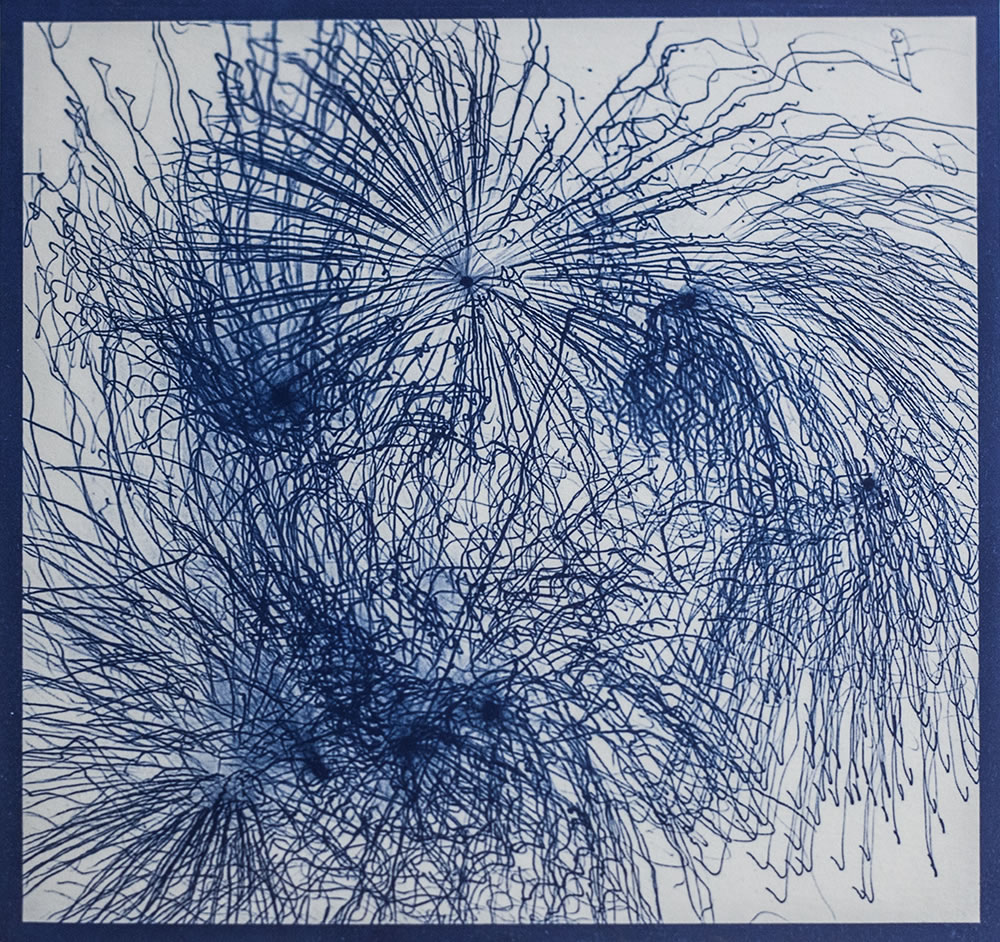
Fireworks in Annecy, printed in negative as a cyanotype. Celebrating Bastille Day, July 14th, the anniversary of the beginning of the French Revolution.
Paris-based photographer Danielle Voirin travels the world and documents her experiences in photographs. She takes street photography and photojournalism a shade beyond even art, to the level of mysticism. You may see more of her work on her website DanielleVoirin.com, or her alt website, DaniVoirin.com.
There are some interesting correlations and mathematics in this week’s reading.
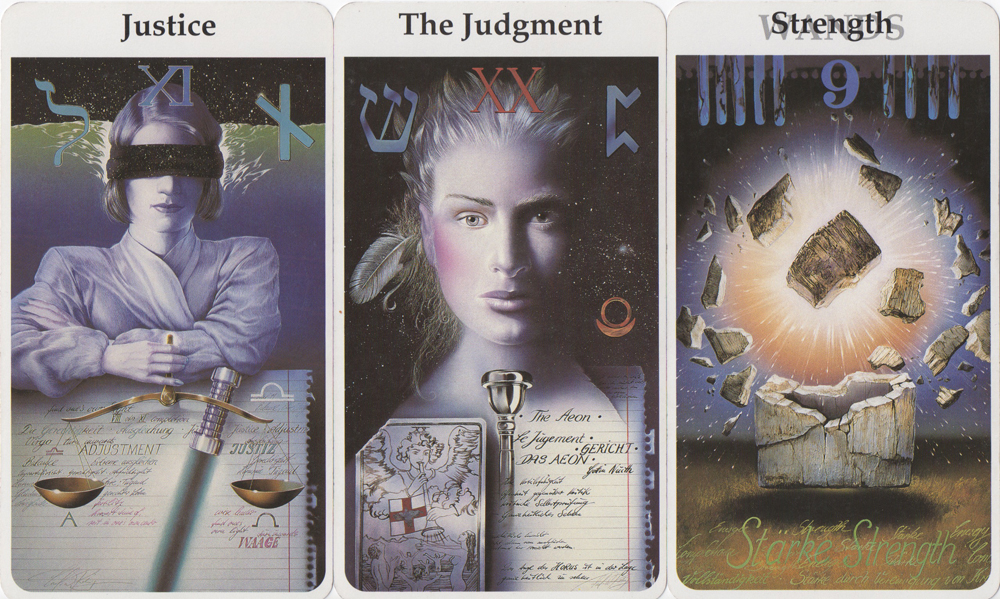
First, like last week, the first two cards belong to the major arcana, with a minor — this time Wands — to the right of them. We are riding on a theme here, and my sense is that this week is a particular evolution of something that is not new, but is starting to shift into new territory.
Justice, The Judgment, Nine of Wands from The Röhrig Tarot deck, created by Carl-W. Röhrig. Click on the image for a larger version.
Second, Pluto appears at the centre in the form of The Judgment, just as it moves to centre-stage in the news: the New Horizons space probe is due to fly past the dwarf planet tomorrow, July 14, 2015. One headline sums up the synchronicity: “Pluto to give up its secrets.”
Or, is it that the influence of Pluto is giving up your secrets?
Numerically, the number “two” is underscored in both readings. Here, Justice is card 11, The Judgment is card 20, both cards adding up to 2 (1+1 and 2+0). The High Priestess from last week, as card 2 in the major arcana, is making another visit this week, but in a different guise: the accompanying book to The Röhrig Tarot explains that the figure in The Judgment is The High Priestess — only this time, with her eyes open.
The liminal feminine, inward-looking, in the past (as the High Priestess to the left of last week’s reading), is now present, here right now, and calling others to their own awakening — as she is calling you to yours. You are turning your inner vision outwards. This is further reflected in the contrast between the angel and the blind-folded figure of Justice who sits in the recent past.
Finally, nine (from the Nine of Wands) is the difference between XX (The Judgment) and XI (Justice). This is all leading you somewhere.
It is leading you to the point of breakthrough. Are you able to recognise the call to action and shift that fortified, entrenched way of acting — the one that, quite frankly, has started to bore you, and everyone else, to tears — so that you give yourself enough space to a) see a way through and b) get yourself there?
Hint: get out of your own way. There is nothing else you need to do. There are bigger forces at work than you alone, and they are the driving factors. To push is to add unnecessary fuel to an already kinetic situation. To resist is to look into the eyes of an angel and mistrust what you see. There is no need to fight; the weapons were laid down some time ago. It is time to listen, to hear what is being spoken to you through the trumpet-blast of your own awakening.
It is time to look into the eyes of that angel and feel the steadfast, compassionate inevitability of your own exposure.
They say that Justice is blind. And, you know, that blindness served a purpose. It sifted out what was no longer necessary; it weighed up a situation and guided you in a particular direction (you might not have had much choice about it). It also gave you the time to honour the path not taken. The blindfold denoted an unwillingness to be swayed by sentiment or subjectivity. Justice brought you to where you are now — at the feet of an angel. And she is not blind. She sees everything. She sees you, fully; and, through the reflection of her eyes, you have a rare moment: to see more of yourself than you had heretofore thought possible.
To see more of yourself and to stand present in that knowledge, neither attacking your reflection nor turning away from it.
The eyes of an angel.
Imagine the power that is generated in that moment — an instant of recognition, the removal of what felt impenetrable. Simply because you realise that the way you’ve always seen something is not the only way to see it. What would our world be like if we acted as if nothing existed over the horizon? Now imagine what the world would be like if the choices you had were not limited to the ones you’ve made in the past.
Deciding to see differently is seldom enough to achieve different sight. Right now, though, the forces at work are such that a shift in perspective is within reach. You just need to get out of the way. No, you can’t put conditions on it. No, you cannot control it. No, you are not able to stipulate what you deem acceptable to see and what you’d prefer to remain concealed. No, there is no need to hide anymore.
The magic of an invisible world stands poised to reveal itself. It has only seemed like magic because it defied your sense of what was possible. Until now. Until now.
Astrology/Elemental correspondences: Justice (Libra), The Judgment (Pluto), Nine of Wands (Moon in Sagittarius)
If you want to experiment with tarot cards and don’t have any, we provide a free tarot spread generator using the Celtic Wings spread, which is based on the traditional Celtic Cross spread. This article explains how to use the spread.
Paris-based photographer Danielle Voirin travels the world and documents her experiences in photographs. She takes street photography and photojournalism a shade beyond even art, to the level of mysticism. You may see more of her work on her website DanielleVoirin.com, or her alt website, DaniVoirin.com.
I recently managed to procure a good amount of time off from all of my jobs, and having space to decompress and hit the reset button has been rad. The first few days were spent in revelry with friends in celebration of the last three Grateful Dead shows. Then, the shows were over, and just as I was wondering what reading materials would accompany me to my seven-day tour of Seattle’s glorious parks, I fell back into an old, glorious pattern: post-apocalyptic and dystopian young adult fiction and re-visiting all of the apocalyptic non-fiction from my grad school days.
Photo by graywacke/A Landing a Day
Yes, this is how my mind decompresses.
Having spent three years studying the psychology of apocalyptic thinking in terms of images, I’m fascinated by the trends I see in pop culture that point to increasing consumption of these memes.
This past week, I’ve watched episodes of “The Last Ship,” “Between,” “The Strain” and “Ascension,” most of which deal with some kind of “the virus killed everyone but us” kind of plot line. I’ve also read three young adult books written in recent years that are basically the same thing.
The other day, while sedating myself with the white noise of waves at my favorite local sandy beach, I began flipping through my favorite book about apocalypse, Dreaming the End of the World: Apocalypse as Rite of Passage by Michael Ortiz. Ortiz’s basic idea is that the foundation for apocalyptic thinking has its roots in Mesopotamian culture, as urban reality became exalted above or against the wilderness.
We are currently in a phase of technological realization of these myths, characterized in Judeo-Christian mythology by the battle between the Messiah and the Beast, images of which moved from the mythic to the literal with the single, terrifying and — Ortiz would say — ecstatic image of the mushroom cloud. What began as mythology reflecting an inward process of descent, destruction and resurrection has been concretized in a mythic image imprinted in the collective imagination.
In that sense, Ortiz would say that apocalyptic initiation is about waking up from self-destructive imperatives. Sounds so neat in that little phrase, but this can be harrowing work.
I wonder a lot about the ways in which mass culture is saturated with apocalyptic imagery, and whether this facilitates our “waking up” or compounds the fears that are already being repressed. There is a mystery to the “dream at the end of the world,” and to the apocalyptic imagination, that can become addictive. Not only do we have access to TV shows, movies and books laying out fictional accounts of post-apocalyptic landscapes, we have real world correlates and the images to go with them as well.
We can see the effects of ecological degradation, including assuredly human-caused effects. We know that bioterrorism is real. And we spend vast amounts of energetic reserves ignoring the fact that Fukushima is still leaking, and that nuclear reactors are peppered across the landscape.
Apocalyptic imagery is majorly seductive, and Ortiz puts out a warning that we need to use caution because, as he says, “the myth of apocalypse seeks to enthrall us into an epic fiction with very real consequences. Beware the fascination with what is larger than life, this vulgar passion play that would crucify the world.”
Astrologically speaking, I’m fascinated by generational themes in terms of outer planet transits. I’m currently paying a lot of attention to my Pluto in Scorpio clients (born roughly 1983 to 1995), namely because they’re the ones who come to me the most often. Although dealing with the wounds of living in “apocalyptic” times isn’t unique to this generation, they are a group that is, from my point of view, here to heal some of the deepest, most shadowy places of the soul, and they are being asked (or have chosen) to do so as they are coming of age on shaky ground.
The tension of having that apocalyptic consciousness blooming inside of you while at the same time trying to “be an adult,” settle into a career, get married and have children can be intense, even more so when one is individuating and actively trying to seek out the soul’s calling. The constant bombardment of images and articles at every turn can leave us in a state of perpetual numbness or overwhelm that makes it very difficult to do soul work at the level that is probably necessary.
Although many individuals have clearly existed in recent history who have done great things to steer the course of humanity away from the concretized apocalyptic myth, this is a generation that gets to attempt to individuate away from the self-destructive imperative. In that sense, I think that the glut of apocalyptic media can be a helpful outlet for coping and releasing some of the inner mayhem, so long as its seductive qualities don’t take over.
I’ve also been thinking a lot about this last cycle of Saturn in Scorpio, as I’ve mentioned twenty thousand times. It feels to me as if this transit has been asking us to take responsibility for a lot of psychic, and often physical, deep cleaning. I often think that this transit is doing some of the legwork for Pluto’s entry into Aquarius in the not-entirely distant future, an event that happens round about the same time Saturn is in Aquarius. Whatever was birthed or surfaced during Pluto’s time in Scorpio in the ‘80s reaches a crisis point, or first quarter square, in Aquarius. Perhaps Saturn is offering us an opportunity to re-work culturally ingrained apocalyptic thinking patterns.
What would that look like? Well, Ortiz speaks of the apocalyptic rite of passage as being about the awakening of compassion in a dark time. As apocalyptic mythology collided with and helped to sculpt Judeo-Christian myths, those who did not believe in the “One True Word” of god were cast into the role of the other — as someone who does not exist, has no rights, and is not quite human until they convert, saving their soul from eternal damnation.
What does a conversion to compassion for oneself and all others look like? What comes to mind for me is what I often speak of when I see Pluto in the 12th house of a chart, with the 12th house’s resonance with Pisces pointing towards a kind of culmination point for the journey of the soul, which is represented by Pluto.
Pluto in the 12th house to me speaks of a deep need for forgiveness. It reminds me of the need to go into our own suffering, to face the places where we are the most wounded and offer compassion to ourselves first, right there in the face of the shame, guilt and fear that might arise. From that place of internal compassion and unconditional love of self we can extend the same to others.
Of course, we have to watch for compulsive tendencies, as Pluto can represent compulsion, and the Pisces/12th archetypes can speak to martyrdom and self-sacrifice. But there is something about facing those deepest, apocalyptic-feeling fears, and then going to dance it out — say, at a friend’s house for the last three Grateful Dead shows — that is cathartic, and more importantly, regenerative. The creativity that comes from regeneration seems to be exactly what is being called for now.
Educator/therapist Prana Regina Barrett’s journey to using more inclusive language in her workshops holds valuable insights for all of us — not just teachers of Tantra or sexuality workshops (but if you are one, we’d love to read your thoughts). This piece was originally published on Decolonizing Yoga and republished here with the author’s permission. — Amanda
by Prana Regina Barrett
My husband and I have been sharing Tantra workshops worldwide for many years. Despite the historical heterosexual paradigm that Tantra has held, we haven’t practiced such a limited perspective on sexuality or gender in either our personal lives or in our teachings. And in keeping with this, we promote our workshops to all genders and sexual orientations.
Prana Regina Barrett
Because Tantra’s primary principle refers to balancing “masculine” and “feminine” energy within, those are the terms we used for many years. Knowing that this language may not fit the experience of the transgender community, we were careful when it came to teaching partner yoga practices that can be applied during lovemaking.
We made it clear to our students that partners should feel the freedom to choose whether they want to be in the traditionally male or female role. This seemed to work fine until last year, when a transgender man chose to study with us.
As it turned out, it wasn’t our language used when sharing these practices that turned out to be the hardest challenge for him. Instead it was the seemingly benign practice of dividing our group into male and female sharing circles. Because he knew that his fellow students were unaware of his history and gender identity, our student went along with the flow and sat with the rest of the men in the men’s circle.
Later, however, when we shared as a whole group, he revealed to everyone both the fact that he is a transgender man and also that, despite passing as male in society, he felt like he didn’t belong in either circle. At the break, his act of coming out had such a strong effect on his emotional body that he was crying and uncontrollably shaking. First our assistant and then I needed to provide skilled trauma soothing to help him to come back into balance.
We did a good enough job that he continued Tantra studies and completed our teacher training. Throughout the training, I would find myself in situations where I knew I was using insensitive language and would have to ask him for the best words. He was forgiving and helpful, and he was also challenged sometimes to find the right words to use.
He has agreed to let me share his story and has participated in the writing of this article to bring awareness and sensitivity not only to Tantra teachers, but to all practitioners who are unaware that there could be someone who identifies as transgender among their students or clients. As part of his final project, our student gave us a lesson on how to be sensitive to the transgender community when teaching.
I have included some of that information here. And although I wrote this article primarily for sex and Tantra educators, it includes language that is helpful to all who are teaching the general public.
One of the first things we need to do, as sex and Tantra educators, is train ourselves to drop the terms “masculine” and “feminine” and instead use descriptive words such as soft, gentle, nurturing Earth energy, and strong, assertive, active Sky energy.
We need to do this to acknowledge the reality that we as teachers may not always know the gender history or identity of our students. Although in this case our student had revealed to us his transgender male identity in his application, it could have been the case that he did not. Or there could be someone in your class who is questioning or transitioning their gender, or does not conform to the gender binary assumptions of “masculine” and “feminine.”
Thus when teaching, and this applies to all teachers, always assume that someone in your class does not want to be identified as “female” or “male.” Instead of saying “The woman to the left,” use some other non-gendered identifier, such as “The person in the blue shirt.” This small change could make a huge difference to that person.
As you may have picked up on already, the term “transgender” covers a broad spectrum of people. It includes not only those who are questioning their gender and those who have changed their appearance, but also people who do not fit the gender binary. There are very helpful articles already written on the correct vocabulary to use. One of the best online resources is GLAAD’s tips for allies.
It is always best to steer clear of labels. Follow the lead of each individual and their self-determined identity. Use the pronouns and adjectives that they use to refer to themselves. Do this regardless of your judgments about their physical appearance.
On offering men’s and women’s circles, after in-depth discussion and some feeling of loss, my husband and I have switched to sharing sexuality as a whole group. We had been focused on the value of single-gender circles when it came to sharing sexual concerns associated with having male and female reproductive systems, like erectile disfunction or low labido that can be a symptom of menopause. Yet there is even greater value when people of all genders and sexual orientations share sexual concerns as a whole group. After all, we often share sex together, so why not communicate our concerns to one another in a peaceful, open and honest circle? In my experience, this is most inclusive and beneficial for all.
Our society bombards us with advertising and other propaganda that displays a narrow perspective on sex, and for transgender people in particular these images often do not match up with their physical or emotional reality. This can result in obstacles to sexual engagement and to the ability to orgasm. Healing from the trauma this inflicts can be a slow journey. The subtle sexual energy circulation and connection that Tantra provides can help. Making your workshops, classes and private sessions welcoming to the transgender population is a valuable service and can make a huge difference in an individual or couples’ sexual health and life.
I know, it’s a huge shift and it takes intentional monitoring and adjustment of the language you are using, but it’s important. It also allows you to reach more people who could benefit from your teachings. When you do it enough, it becomes natural. This is how cultures evolve.
Prana Regina Barrett, BS, MIA, E-RYT, CYT, author of Lighter: Living Tantra, is the founder, lead educator, and yoga therapist at Tantra to Love™, a private practice and school offering private sessions, workshops, sacred union ceremonies, and retreats worldwide, as well as the Tantra to Love™ Lifestyle Immersion and 60-hour Educator Certification Program. She has created the audio podcasts Self Love: Gentle and Restorative Asana Flows with Photos of Poses. Gina is currently offering workshops called Balancing Energy with Yoga and Qigong worldwide. She has been facilitating playful, transformative, and engaging workshops for 30 years while creating a safe container for physical and emotional transformation. Her websites are: tantratolove.com and pranaheals.com.
“Those who will not reason, are bigots, those who cannot, are fools, and those who dare not, are slaves.”― George Gordon Byron
What a fascinating week it’s been. Too close to the trees, we’re lost in a forest of confusion and anxiety, with fingers pointed, blame assigned, and fear spreading like wildfire. Backing off to get the longer view, there appears to be a prominent theme: money equals power which, turned 180, means poverty equals powerlessness. Reminds me of the Repeal Citizens United buttons I made last week, that read: if money equals speech, then the poor have no voice.
The long view makes it plain that there is a war on democracy being waged by a few, a rich and powerful few. Those who argue that there is no difference between the two political parties in this nation can point to the glut of money necessary to campaign for, win and hold a position in Congress, greasing the skids within the confines of an establishment system that seems to run not on the higher concepts of public service but on money and access to same.
I won’t debate the obvious, but I will argue that there is only one party making any attempt to remedy the problem, and by the slimmest of margins. Some choose not to look or participate, and others choose to bitch and not participate. Since we — thus far — can’t even seem to get enough people together to elect one of the truly progressive, perhaps recent criticism of Bernie Sanders’s Faustian deal with the Dem party, rather than running as an Independent, is more smoke than fire. Those who pitch that it’s all or nothing limit the chance for anything. I’d rather change the tenor of the whole country by educating it on actual principles and policies than create another failed experiment like Nader’s.
The Good Book’s admonition about the love of money being the root of all evil seemed to color the week’s affairs. Staring down an unflinching Merkel, who can’t have missed world criticism for her compassionless stance, Greece blinked. Despite their defiant vote, they will accept meager assistance with their debt in exchange for further austerity that can offer no respite from a downward spiral into misery.
Any onlookers with historical perspective might note that if German debt had not been forgiven after the war, Germany would not be in ascendency today and Merkel would not be the leader of the Euro-pack. But history is just conjecture these days — much as science is only one opinion among many — and common sense, it seems, is singularly uncommon.
The economists I admire — the same ones that Sanders mentioned as possible cabinet members: Stiglitz, Krugman, Reich — all tell us that more austerity can only cripple any chance Greece has to grow out of its troubles and into prosperity, which seals the fate of the island home of democracy. Americans should pay attention. We have a similar problem with the cretins in Congress who can’t wait to punish the powerless while bamboozling the simple and unwitting into believing it’s what Jesus would do (if Jesus sold snake oil and had an account in the Cayman’s).
The tumble of currency (under suspicious circumstances) has been well tracked by Eric in his superb offering this week, linking what happened in China and Greece and the New York Stock Exchange. Monetized things are usually connected — some transactions more mysteriously than others — which seems to buttress the notion that the market is Gawd-like, even given to tantrum much like the Old Testament Yahweh (who had to practice for awhile before sending down Gawd v. 2.0 to be born in Bethlehem).
Perhaps that’s why we can’t convince ourselves to go back to the separated-church-and-state period after FDR regulated banks that gave us a stable, predictable monetary system. Remember that our most prominent judge just lately accused us of hubris by asking who we thought we were, making the argument obvious, if unsaid: humans shouldn’t meddle in Gawd stuff. And money is America’s religion.
While all men want to be free, some want to be free to think what they want, and other men want to be free from the burden of free thought. These men seek freedom through slavery.”
― Jarod Kintz, 99 Cents For Some Nonsense
Yes, the U.S. urged Merkel to give a little in order to save the EU, but let’s not give ourselves a pass on compassion. Puerto Rico, which is an American commonwealth, has buckled under its debt of $70 billion, accrued while the pharmaceutical houses, enjoying huge tax breaks, set up industry on the island. When the tax break expired, the factories moved, leaving Puerto Ricans to hold the bag. Hoping to restructure the debt, the Puerto Rico government is pleading with Washington to be given the right to file for bankruptcy, so far denied. This is our own Greek look-alike, putting Puerto Rico into a similar downward spiral that will take a generation to resolve, if not more. The muddle of politics in the U.S. seems tone-deaf to this crisis among hard-working people of good faith.
And there’s the crux of it. “Of good faith.” We do not consider people with these kinds of monetary problems ‘of good faith.’ Our brains have been conditioned to think that those who struggle, who fall behind, who fail in their quest to achieve what we’ve long considered the norm, are nothing but losers. We’ve been trained to impose class distinctions on those whose performance isn’t shiny and bright, up to snuff.
We have been schooled to think they’re “them.” Oh, but how quickly, my dears, they can become us!
The public is too eager to believe that all Greeks lived well beyond their means — Aesop’s fiddling grasshoppers to the industrious EU ants — and had no intention of paying back their loans. Similarly, white America is unthinkingly confident that the ghettos — purposely created by policies of graft and racism, and sustained by the opportunistic attitudes of the moneyed elite — are filled with dangerous ‘takers,’ uninterested in actual work if welfare, drug sales and theft are available, necessitating our most stringent policing efforts.
We’ve been programmed, since St. Ronnie the Reagan made up his mythical (and nameless) black Welfare Queen, to think of the poor and the disenfranchised as lazy, no-account self-promoters, sucking off the public tit — which is us regular well-meaning types who “play by the rules.” (YIKES, I despise that rules business, I wish the left would quit repeating it. Anyone who plays strictly by today’s rules is DESTINED to fail! Some days I’m glad I’m too old to be in the thick of it.)
In Ferguson, Missouri, we saw ministers and citizens come together as peaceful, thoughtful activists to walk the streets during daylight, but all we talked about were the angry kids who shouted insults and threw rocks after dark. In Charleston, South Carolina, we are gob-smacked by the talk of grace and forgiveness directed toward young killer, Dylann Roof, by the black Christian community and agree that the racist flag he was photographed holding remains a symbol of hatred, but think a three-year term of incarceration for the young woman of color and her white co-activist who took down the Confederate battle flag flying over public grounds at the statehouse is probably justified because — well, you know — lawlessness, anarchy, chaos! (Sign a petition to drop charges here.)
Yes, it seems that the United States is just bursting with tit-suckers, good-for-nothing under-employed whiners who do not contribute tangibly to their society. Jeb Bush recently told complainers that they needed to work more hours (while, I presume, eating cake) even though statistics indicate that Americans already spend more hours on the job than any other modern industrialized nation. Jeb’s people backtracked later to indicate that — oh, no! — Bubba didn’t mean people with REAL jobs, he meant part-time takers (strike that) workers! You know, those people at Wal-Mart, Burger King, Target and every other low-paying service job out there.
“Congress shall make no law abridging the freedom of production and trade…”
― Ayn Rand, Atlas Shrugged
This is that same Jeb! Bush of the seriously suspect money trail and business deals we’re talking about, the one whose SuperPAC just announced a 103 million dollar total for the quarter, setting a record. All together, his campaign has raised $113 million plus change, more money than Romney spent on his entire primary in 2012. What do you imagine he promised his funders in order to raise that kind of cash, dearhearts? Whose back will he scratch to become ’45’ to Poppy’s ’41’ and Dubby’s ’43’? I’ll bet it won’t be ours.
The adolescent Randian creed of greed above all else has become the cancerous growth on liberty’s bum. The Kochs have declared that they want the entire Environmental Protection Agency dumped, et al. (I presume Jeb! is taking notes.) THINK about that. Corporate CEOs are, by law, uninterested in protecting the environment if it impedes the ability to grow the profit margin for themselves and their investors. That ALONE proves that corporations aren’t people. People would care whether their babies could breathe and drink clean water.
This is the environment we’re talking about, an already badly compromised system that has given us half a year of the hottest temps on record. This is about the survival of a species: OURS. THINK about the hubristic ambition of one elite, self-centered, bat-shit crazy family of gazillionaires making a planetary decision for us all that can only hasten our extinction!
Yes, there are adult voices out there trying to counter the money boys. Who would have thought the Catholic Church would be among them? On a tour of South America, the Pope is speaking frankly about the kind of top-down plunder that rogue capitalism has produced. The southern portion of this continent has been previously harmed by North America and Francis took that head-on when he spoke of the world economic order impoverishing third world countries by using them to provide raw material and cheap labor.
Getting medieval, the Pope quoted a fourth century Bishop who called the unfettered pursuit of money “the dung of the devil,” because you can always count on a religious cleric to remember history like it was yesterday. And while I don’t know how that quote played with Bolivians, I suspect it pissed off some corporate devils here at home. Best of all, it begs the question of money and ethics, an examination of which is LONG overdue.
“You can’t hold a man down without staying down with him.”
― Booker T. Washington
This constant bickering between philosophies, between countries, continues to loop — repeating, unending — the one thing that never seems to change. It’s what ACIM calls ego-speak, the attack/defend that never ceases in the threatened mind. Logic doesn’t work to convince the right, and disdain and disenfranchisement don’t move the left. I think that’s probably because we’re doing it wrong. We can’t use the same ego-speak that got us in this trance to wake us up, but we don’t need to cloister or get to an ashram to make some change in how we think about it.
The answer to our problems isn’t more money, which has taken on disproportionate influence and laid a veneer of empty affluence and competition over our lives that strips away our basic human instinct to nurture and protect one another. The psychology that’s needed to remedy this problem requires the same kind of dynamic we found both fascinating and improbable as articulated by the relatives of the Charleston shooter. We are slaves to fear, we can only liberate ourselves with love.
You know — we know — it doesn’t need to look like it does today. We know there’s another way to look at all this, but it takes maturity and compassion and, ultimately, patience. Anger over the retirement of the rebel flag shows just how much we’ve not addressed, forgiven or put in proper perspective in this nation — and some would say that this unsolved question of slavery is our Original Sin.
The punitive mindset of Merkel’s EU, and our own nation’s disregard for the wellbeing of the 99%, are symptomatic of how NOT to solve these problems. Our love of money has created an internal poverty that has hobbled our humanity, while our fear of losing the competition that keeps us powerful and respected is nearly pathological. We must re-invest ourselves, not in stuff or gain, but in one another.
Rather than make this piece longer, let me invite you to read a Mother Jones article entitled What If Everything You Knew About Disciplining Kids Was Wrong? I worked in education for a lot of years and it didn’t take long to realize that if you could get a kid to like you, you could open up their world for them, pour in the information that would expand their possibilities, but first, you had get past their defenses. You had to face — and help THEM face — their demons.
While this article — which qualifies as a weekend read — is mainly about education and how to reorient problem children, the psychology is relevant to most problems we face with one another today. This is how to break the loop, how to encourage change, how to help develop new neural pathways for improved behavior. This is a strategy applicable to most things we care about, and well worth your time.
Our investment of love and caring for one another lifts both the caregiver and the one requiring care. There isn’t a ‘better’ or more authoritarian person in this scenario, just one more willing to remain open. In Illusions: Adventures of a Reluctant Messiah, Richard Bach wrote “You teach best what you most need to learn.” We are blessed as we bless others — truly the Art of Service and survival skill of the 21st century — and if, indeed, we can’t hold a man/woman down without staying down with them, then the converse is also true: we can’t lift them up without rising with them.
We are enslaved to those things that hold us in fear and, from a spiritual point of view, fear is that thing that keeps us earth-bound. If we’re to fly, we need to cut those ties to fear that keep us tethered in dysfunction and self-doubt. If we knew how wonderful we were, we wouldn’t waste time defending unlovingness. Here’s another quote from Illusions, one that helps us expand our self-assessment and calm our apprehension. Make it your mantra this week and see if it doesn’t reduce your level of anxiety while striking off some sparks in your soul:
Learning is finding out what you already know. Doing is demonstrating that you know it. Teaching is reminding others that they know just as well as you. You are all learners, doers and teachers.
We are all of it, my dears, learning to fly — and all of it is divine!