Category Archives: Columnist

Five Stages, Reviewed

There have been many times over the last fourteen years when national atrophy, zealous leadership, and political hijinks pushed reality into the surrealistic zone, creating — in me, at least — a mixed bag of response that Dr. Elizabeth Kübler-Ross would have recognized as the five stages of grief: denial, anger, bargaining, depression and acceptance. I have experienced them all and sometimes on the very same day, one after the next ( a.k.a. lather, rinse, repeat.)

Political Blog, News, Information, Astrological Perspective.

By Judith Gayle | Political Waves

Even now, denial and depression occasionally alight like a butterfly, tickling my psyche for just an instant, then flickering quickly away. Bargaining and acceptance linger at the back of my mind, threads of sane and proven technique woven into analysis of any given situation, awaiting assessment. Like time itself, the emotions prompting these states do not always seem to be sequential, and most of them don’t last long in my household except for that second one: anger. Am I pissed? Oh, you bet! As I was writing this, my son checked in to ask if I had my topic yet. I told him I did, it’s “What The Fuck Is Wrong With People???”

In order to enjoy any kind of calm, grace-filled emotional space at the end of the day — clearing our minds of useless information and preparing ourselves to enter a healing, often informative, dreamscape — I think it’s important to feel everything that has presented itself for our attention during the day. Granted, allowing these feelings takes a certain mindfulness, as most of them are as unwelcome as a stream of ants at a picnic. I’m not talking about that moment in the day when we over-react to stimulus, like throwing a shoe at the cat as she digs in a flower pot, but rather a purposeful instance in which we lift some distressing bit of information into focus using balanced intellect and higher mind, defanging it in the process of clarification, and marking it for further investigation and/or activism.

And while I believe in and practice positive thinking and affirmation, I don’t recommend them ‘to a fault,’ screening out all other factors. Avoiding the avalanche of sad, distressing or challenging news we hear on a daily basis often becomes less self-protection than an act of self-sabotage, creating a habit of resistance like a hardened callous, insulating us from reality. And — slowly and surely, event after event — isn’t that how we achieved this version of our increasingly surreal America, to start with?

I know, much of what is happening in the world is dreadful, disturbing the even flow of emotions and events we favor, but in this long-anticipated time of social evolution we can expect no less. Yet even so, with unavoidable change upon us, our human intellect still requires some reason to run toward it, eager to experience something new, or conversely, a visceral response that informs us that the direction we’re moving in only mires us more deeply in what needs renewal. Following up that first impulse, pro or con, with thoughtful investigation and realistic analysis must come right behind — unless it doesn’t, unless we shove it under the rug. I suppose that’s where my WTF rant begins and ends, starting with, “What part of unavoidable do we not understand?”

With one dead and two infected — a total of only three citizens, nationwide, mind you — it’s Ebola 24/7 on television news, and I’m not talking about the irrational (and disturbingly racist) babble that’s going on over at FOX NewsFOX is the channel that proposed those immigrant kids on the bus this summer were carriers of leprosy, TB, cholera and plague, after all. Hardly a stretch to imagine the kinds of things they’re saying about Ebola now. And no surprise that I’m hearing echoes here in the Pea Patch, from seniors who can’t seem to utter the word Ebola without adding something disturbingly ignorant about that black guy in the White House, or others “of his kind.” Those who say racism isn’t at work in the underpinnings of this Ebola scare need to come spend an afternoon with me.

A House panel raking CDC Director Thomas Fieden over the coals this morning took border-closing hysteria to another level. The rationale behind keeping flights and flyers under scrutiny of CDC personnel is designed to prevent the possibility of people using alternate routes to sneak over the borders in search of better healthcare; an administrative choice between some control, no matter how flawed, and none at all. The howlers don’t care, as long as fear works to feed the political machine.

Many of the questions put to the director called for speculation, and Fieden answered truthfully, saying he didn’t know and couldn’t say. This caused a CNN panel to invite viewers to go on Facebook with their response to queries over whether or not Fieden should be fired. WTF? Fire one of the few people who has the international expertise to either understand or manage a deadly viral outbreak? What’s wrong with you, CNN? What kind of thought is THAT to plant in public consciousness?

Makes about as much sense as ‘firing’ experienced career politicians only to replace them with people who do not understand the system they’re charged with working within, or the ramifications of, for instance, refusing to fund the government (the same one we’re all bitching about not responding to the Ebola crisis quickly enough to suit our needs). That kind of behavior has been called, over many decades, “jumping from the frying pan into the fire,” and “cutting off your nose to spite your face.” Amazing, isn’t it, that we’ve been practicing this kind of irrational response so long, we’ve created time-honored idioms to cover it, yet we still do it every chance we get?

The burgeoning bubble of panic finally pushed the White House to name an Ebola Czar to head up the crisis. The man awaiting announcement — Ron Klain, former chief-of-staff to both Biden and Gore — has an excellent reputation in organizing and implementing programs, and should provide some confidence in government response if not become the ‘face’ of that healthcare expertise, as would the reassuring visage of a Surgeon General. That position is still unacted upon, some 18 months late, thanks to the National Rifle Association’s lobbying efforts to silence Obama’s candidate, who considers two million or more yearly emergency room visits for assault (according to the CDC,) the majority involving weapons, a danger to our national health.

In other news, while Pope Francis feels it’s time to open his arms to the queer community, his recent remarks regarding gay folk has apparently created a mushroom cloud over his bishops’ sensibilities, particularly the English speaking ones. When the Pope said that homosexual unions can often constitute a “precious support in the life of the partner,” the Vatican was obliged to issue a ‘new translation’ that mollified the objecting clergy, which now reads ” … valuable support in the life of these persons.” This opens the door for discussion of the church accepting civil unions, as well as making space for homosexual parishioners, although the Pope’s commentary about “welcoming homosexuals” has now been changed to “providing for homosexual persons.”

Those whom the Pope wants to draw in, the bishops choose to distance from, and in order for these latest recommendations to be approved and discussed among dioceses around the world, two-thirds of the bishops must approve them. Me, I’m thinking Pope Frank needs a food-taster. While most of the rational world celebrated his remarks as an example of the Catholic Church catching up with the 21st century, when I told a priest-friend I was worried about Francis, he nodded and said he figured somebody was surely mixing the poison in the back room.

I don’t want to be overly critical here, but what part of “closet cases” do these Vatican princelings think we don’t already know about? Anybody remember “Judge not least you be judged?” Or is that only in the Protestant version of the Bible? Not that Protestants are any less parochial, as witnessed by evangelicals who have joined ‘pro-family’ Catholics in calling the Pope a betraying heretic for his progressive — and dare I say, Christian — leanings. They have accused him of teaching ” … that there are positive and constructive aspects to […] mortal sins.” One group used a word I had not heard before: homoherisy. Did they just make that up? And we thought the Taliban was scary!

A church that is teetering on irrelevance should probably be a little less radical, don’t you think? And there it is, there, at this point in history: to refuse to evolve from the old fundamentalism of an earlier age is a sure sign of radicalism. Those who cannot embrace progress and change are doomed eventually to wither and die. It is simply the way of all living things.

This constant pressure of conservatism that refuses to acknowledge what the majority not only wants, but already lives  — day in, day out — doesn’t just grind away at us, it angers us. Trying to keep one’s intellectual balance while seemingly surrounded by those whose fear and self-loathing threaten to banish those of us who refuse to repress ourselves to the corn field takes a toll.

And if you’re in one of those states where every other television or radio commercial is political, spewing lies about the state of the nation and/or the promises of this or that political figure, your nerves are probably as frayed as mine, so if you go outside and howl at the moon, find yourself breaking dishes rather than washing them, or charring dinner rather than cooking it, know you are not alone. This too shall pass, but — I fear — not without pissing me off.

People want to close the borders to strangers, blame the agencies that are trying to contain this outbreak, and scare the pants off each other, telling tales of pandemic and loss. If this is what we’ve got with one death, what will happen with thirty? The last flu considered a pandemic was H1N1 in 2010, in which there were over a quarter million hospitalizations resulting in over 12,000 deaths. Did we come unglued then? Did we close the borders? Did we blame black folk?

It turns out that the Pope’s ‘compassion’ is a liberal trait, not something to brag about. The church is miffed at its new leader for being too kindly to suit the traditionalists. Every time I think of what the church did in Spain during the Inquisition, I get pissed. When I think of what it did in Ireland during the last century — rent Philomena — I get pissed. When I think of what it’s still doing, cloistered in its exclusive same-sex club, I get really really pissed. Can we see the darkness there, reflected in ourselves? And if we can, then why do we still empower these people?

The conservatives are set to take over both houses of government. We’re just weeks away from losing any ability to stop them from attacking all of the things we’ve managed to accomplish in these last years, not to mention those things we’ve tried to protect. This is — to quote Joe Biden — a big fucking deal. Why aren’t we raising hell about this? It’s just establishment politics so it doesn’t matter what happens next? Really? REALLY?

Feeling dismay, even anger, isn’t the end of the story, of course; it’s just the beginning. Once we have that warning flash, we’ve been given information about something that requires further action of some sort. That’s much of what our plight is about — too many flashes, too few options about how to handle them or what to do next, even if we find the time. So let’s go back to that list of five responses once again, linear as designed: denial, anger, bargaining, depression and acceptance.

Those of us on the progressive side of the fence are no longer in denial about what we’re facing. Our challenge is to get those who do not think as we do to face reality while there’s still some hope of remediating our growing problems. Some of us think we can change minds; others of us have simply given up.

The second of the five, anger, comes and goes, so it’s best to learn how to handle it. Anger works as catalyst, focusing our attention, but it isn’t a place to dwell unless we want to physically disintegrate with too much adrenalin, too much toxin. Treat anger as if it’s a pressure cooker, needing a jiggler to allow for escaping hot air. Then jiggle away, as needed, while investigating the cause of the emotional storm (likely leading to unaddressed fears). Unless we explore our anger, it owns us. Better the other way around.

Bargaining is only an issue if we’re bargaining with some other human who can actually affect the situation at hand. Dems can’t bargain with Pubs, for instance, despite the meme that talented political leadership can bring anyone to the table, a fantasy politico’s like to repeat. Those days are gone, memories of them scribbled in the margins of the Pluto/Uranus playbook. Besides, the bargaining Kübler-Ross was speaking of was an exchange of some kind with God when facing our own mortality. That may still play in traditional religious thought, but as our understanding of God has begun to morph, so has our understanding of the alchemical changes within ourselves that are required for bodily healing, as well as intuitive meditations dealing with the concept of death. Bargaining seems to me that place where we come to terms with reality.

Depression? Seems a natural consequence of facing dire circumstances, although I can’t help but think the many pharmaceutical solutions prescribed to relieve anxiety work to our detriment. The amount of drugs taken in this nation to eliminate stress is frightful, and I’d bet my piggy bank that they most often cause as many problems as they solve. Chronic depression, as opposed to circumstantial bouts of depression, is tricky and very often ignored, exacerbated by the environmental toxicity of food, air, water we must all endure thanks to rampant capitalism, poor national foresight, and misunderstanding of both metaphysics and the natural world.

Then there’s that last one: acceptance. Now there’s something to aspire toward. Think of it as sanity. That’s how Eckhart Tolle considers it when he says, “What could be more futile, more insane, than to create inner resistance to something that already is?” To simply accept where we are now, while vowing to do all we can to change it into something more acceptable to the whole of us requires some self-mastery, and an on-going understanding of the emotions that flood us from moment to moment, demanding our full attention.

For those of us who view the politics of the moment with trembling, let’s remember that we’re poised on an election in a few weeks that hangs on a mere 500,000 votes. That’s what Howard Dean said in a fund-raising e-mail the other day, and I believe him. He’s one of the few politicians I know who doesn’t lie for a living. So much of the next two years depends on this election, it’s fearsome to think about, and yet, when we do, we just shrug our shoulders. Nothing we can do about it, right? Election’s being bought by the highest bidder, with hundreds of millions in play.

But Howard thinks that turning out the vote is the answer, as do many historians who know that mid-terms get too little public attention. And because the races are so tight, Dean believes there’s a possibility to keep the Senate if volunteers will spend some time contacting liberals — likely working women — reminding them just how critical their vote is. His organization, Democracy for America, has set up a phone bank, put together phone lists and training, and has asked for people to commit to a few hours making calls. Since my understanding is that this is not cold-calling, eliminating the likelihood of reaching hostile Republican voters, this doesn’t sound too painful. If you have any interest in this project as the clock ticks down, go to his website and get the particulars.

While the Kübler-Ross model speaks to a process of grief and loss, there are ways to break the hold each of those emotions has on us, but it requires us to DO something. This nation seems to be stuck in morass, lethargic in the face of disaster. Being part of something we believe in relieves much of that internal emotional rollercoaster, releasing us from inertia.

Maybe that’s what’s wrong with people! Maybe they haven’t had enough exposure to being part of something more interesting than just taking care of themselves. When our choice is between self-interest or doing something for the betterment of us all, have we had the experience of feeling like we’re contributing something truly important? Like what we do matters? In order to experience our humanity, we need to do something for others, do something to help. We need to open our arms to things that keep us empowered and in the moment, encouraged and encouraging.

Encouraging others to lend a hand at this important moment in history is the kind of person-to-person experiment that can change everything. That’s the kind of activism that can help dispel anger and depression, that accepts the fluidity of the possibilities and understands that what we bring to the moment changes the outcome.

When we open our hearts in acceptance of one another, when we offer our time and effort in advancement of what blesses all of us, we learn to leave fear behind, replaced by purpose. Perhaps what’s wrong with people is they don’t realize that their only job, here on planet Terra, is to love and be loved, leaving no one out. And maybe that’s the sixth stage that moves us from the grief of dying into the sunlight of living, the one that heals us all.


Proceed and Continue — Mars and the Comet

On Sunday at about 2:28 pm EDT (18:28 UT), comet 2013 A1 Siding Spring will make its closest approach to Mars — a special moment while proceeding in a long continuum. All told, the implication for you is to give each moment its due, even as you proceed and continue in your life.

len-wallick-logo

Siding Spring will pass within less than 140,000 kilometers (87,000 miles) of Mars, which is about one-third the distance between Earth and the Moon. That’s a special moment, but only one moment in a long process during which Siding Spring has taken billions of years to find its way to the inner solar system.

After Sunday, comet Siding Spring will continue on, not to pass this way again for about a million years. Mars will also continue in its familiar orbit and through its long process of astrological conjunctions in Sagittarius, which Eric described last month.

At the time Siding Spring is closest astronomically to Mars, several of those astrological alignments with Mars in Sagittarius will be very near exact (to within less than one degree), as will an auspicious aspect from Venus in Libra.

Most exact will be the Sagittarius conjunction from Mars to Quaoar, an object orbiting the Sun out beyond Pluto. Eric has referred to Quaoar as “one of the more profound points” Mars will be conjoining with during its first passage through Sagittarius since October and November of 2012.

Nearly five years ago Eric correlated Quaoar with the long process and continuation of “family patterns” and your own connection with creativity itself.

Perhaps the enhanced awareness brought by Siding Spring’s one-off conjunction with Mars, combined with the words you are now reading, will function to make you more conscious of this particular biennial merger of Martian energy and Quaoar’s symbolism.

Perhaps your enhanced consciousness will (as Mars would have it) motivate you to intentionally apply your own energy toward resolution of a long-standing family pattern (or two), and your own relationship with creation so as to make it a bit easier to proceed and continue with your life henceforth. That’s how things have the potential to work out based on what Venus will be doing on Sunday.

For when Siding Spring makes its closest brush with Mars, Venus will be within hours (and within less than one degree) of its closing sextile to Mars. As such, it will be the last major aspect between Venus and Mars before their next conjunction on the Aries Point this coming Feb. 22.

Sunday’s closing sextile from Venus to Mars will be exact early Monday at 1:18 am EDT, 5:18 UT. Given how aspects to and from Mars tend to be most emphatic prior to exactitude, however, the timing with Siding Spring could not be better.

Sextiles, a separation of 60 degrees on the zodiac, are (in the words of Robert Hand) “a time when you can act with little resistance from outside circumstances.” In other words, a relatively easy time is indicated for Sunday if you can find it in yourself to take it easy.

Given how aspects between Venus and Mars inherently correspond with relationship, Sunday will also be a great time to relax and have a little fun while you act in concert with others to resolve burdensome issues interfering with the process and continuation of relationships. That is, provided your inside circumstances permit.

Indeed, your inner circumstances will be the crucial factor regarding what Sunday’s profound, once-in-a-million-year conjunction of comet 2013 A1 Siding Spring with Mars represents for you.

It would be a shame to spoil that moment by choosing to focus on fear, dread or other heavy thoughts. It would not help you to proceed and continue with your life if you were to ignore the opportunities indicated by Quaoar, Venus and other objects aligning with Mars as Siding Spring passes this way but once.

Yes, the world has some serious problems to resolve at this time. Nevertheless, it’s important to distinguish between actual problems and fear of problems — especially if it is only internal circumstances that make the difference.

It’s even more important to realize that every moment in your life passes this way but once, just as a certain comet will on Sunday. Why not make that moment the best you can make it, then continue and proceed with every moment thereafter? If there’s anything to astrology, you should.

Offered In Service

Len is available for astrology readings. You can contact him at lenwallick [at] gmail [dot] com.

Mercury-Sun, Mercury-Venus in Libra: Insights and Art

By Amanda Painter

Thursday, Oct. 16, Mercury reaches the midpoint of its current retrograde, heralded by its conjunction to the Sun in late Libra (exact at 4:40 pm EDT / 20:40 UT). So if you’ve been finding communication and technical issues to be challenging, take heart that the retrograde is halfway over.

Given that this Sun-Mercury conjunction also coincides with the approximate midpoint between eclipses, continue to stay open to whatever insights have been coming into view, especially about past patterns of relating to others. No matter how uncomfortable the surfacing of these insights — I realize that some people are dealing with a lot of challenging material right now — they are valuable; perhaps even more so than usual for their potential to help you make new choices and set new patterns going forward.

Almost simultaneously with Sun-Mercury, Mercury also makes a conjunction to Venus in Libra (exact tomorrow, Oct. 17, at 1:55 pm EDT / 17:55 UT). Mercury-Venus offers “refinement of consciousness,” according to Isabel Hickey — though with Mercury retrograde, that may apply more to your inner self-perceptions.

Mercury-Venus can lend optimism; but Mercury conjunct the Sun can indicate a blind spot in understanding, or a lack of awareness of one’s biases. So, you might find that optimism clearer-sighted as Mercury and the Sun separate.

Continue reading

Many Returns — Last Quarter Moon

Returning is the motion of the Tao. Yielding is the way of the Tao. The ten thousand things are born of being. Being is born of not being.
— Lao Tsu

Both the timing of and aspects from tomorrow’s Last Quarter Moon at 22+ Cancer will imply the many things a return can be. Most notably, there will be indications of how a theme of return will probably be expressed somehow for more than just you in more ways than just one.

len-wallick-logo

A return can just as easily be a beginning, or a midpoint, as a conclusion — although conventional use of the word “return” often unequivocally assumes the latter in error.

Another, non-linear perspective can emphasize returning taking place continuously on an axis, in a center, or at a circumference where initiation and completion concur in simultaneity — just as viewing a lunar eclipse from the Moon means “seeing every sunrise and every sunset in the world, all of them, all at once.”

Then again, returning can describe reciprocation and/or exchange, calls and/or echoes, progress as well as reversal, either balancing or tipping points, and thresholds as often as reconsiderations.

As with all lunar last quarters, the aspect between the cardinal Libra Sun and cardinal Cancer Moon tomorrow will be a closing square. So called because the two luminaries will be at their last separation of 90 degrees (a square aspect), after returning from a Full Moon opposition a week before, and before closing in on a New Moon conjunction a week later.

In the case of this particular Last Quarter Moon, we will also be midway between the Aries total lunar eclipse of Oct. 8, and the Scorpio partial solar eclipse on Oct. 23.

Beyond being precisely between eclipses tomorrow (and beyond any recent memory) we will simultaneously be very near the temporal midpoint of a Mercury retrograde. Mercury is recently returned from Scorpio; the midpoint of the retrograde will come with Mercury conjoining the Libra Sun on Thursday.  

We are at the same time approaching a threshold represented by the cross-quarter point between the Libra equinox and Capricorn solstice.

Extrapolating further, we are also within spitting distance of being halfway between Pluto entering Capricorn (twice) in 2008 to begin our current era (as defined by Uranus and Pluto in a continuous cardinal square aspect between 2012 and 2015), and Uranus leaving Aries for Taurus in 2018 to initiate yet another era as yet undefined.

In addition to temporal midpoints, the tension inherent in tomorrow’s closing square aspect between the Sun at 22+ Libra and the Moon at 22+ Cancer will be echoed by complementary major and minor aspects from the luminaries to Mars, Saturn and Eris.

The Sun tomorrow will be consciously endorsing Mars at 22+ Sagittarius with a fluently interactive sextile of 60 degrees. Meanwhile, the Moon will simultaneously be feeling an awkward and uncomfortable quincunx (150 degrees of separation) mismatch between its own passions and Martian desire.

Reciprocally, the Cancer Moon at last quarter will be firmly feeling the flow of achieving (at 120 degrees of separation) an unusually sober and stable water trine to Saturn at 22+ Scorpio.

Meanwhile, the sentience of the Libra Sun will be all but blind to any correlation with Saturn’s formal predilections because of the thorough mismatch of element, quality and polarity between adjacent signs represented by a semi-sextile’s separation of 30 degrees.

Finally, Eris, which provoked a reconsideration of the entire solar system after its discovery in 2005, will be at 22+ cardinal Aries tomorrow. That means Eris will be exactly (to the degree) opposed by the Libra Sun while just as precisely squared by the Cancer Last Quarter Moon.

The combined aspect from the Sun-to-Moon-to-Eris will be a T-square, returning us to the years immediately preceding 2012. At that time, Saturn’s traversal of Libra exchanged the same combined aspect first with Pluto and then Uranus. Saturn then yielded (as is the way of the Tao) to retrograde Mars, which returned once, and again over the same arc of Libra to do the same, before yielding to Mercury — which is even now returning to do the same.

All while Uranus and Pluto continue their series of seven returns to precise square aspects extending from 2012 into next year. All leading up to tomorrow’s theme of recursive temporal and reminiscent spatial returns, and the single theme that correlates all forms of return — motion and yielding.

It’s the motion of complementary principles into and out of tension, yielding the reciprocation and exchange between being and not being, which defines how your life correlates with all things.

That’s where you will be tomorrow, along with all things, no matter where or to what you return. If you can but be at least somewhat aware of the vantage point tomorrow’s lunar last quarter affords, you will have lived it well.

If you can build on your awareness, and find your own way to move with and yield to what looks for all the world like an unprecedented moment by rejecting the unequivocal while also embracing the continuity of return to your own place among the “proverbial ten thousand things,” what follows for you may well be profoundly, (and probably indescribably) in kind.

Offered In Service

Len is available for astrology readings. You can contact him at lenwallick [at] gmail [dot] com.

The Weekend Tarot Reading — Sunday, October 12, 2014

By Sarah Taylor

I think what I’m most proud of is being able to recognise opportunities, when they happen, when they’re in front of me. It’s a kind of instinct.

— Dominic Miller, musician

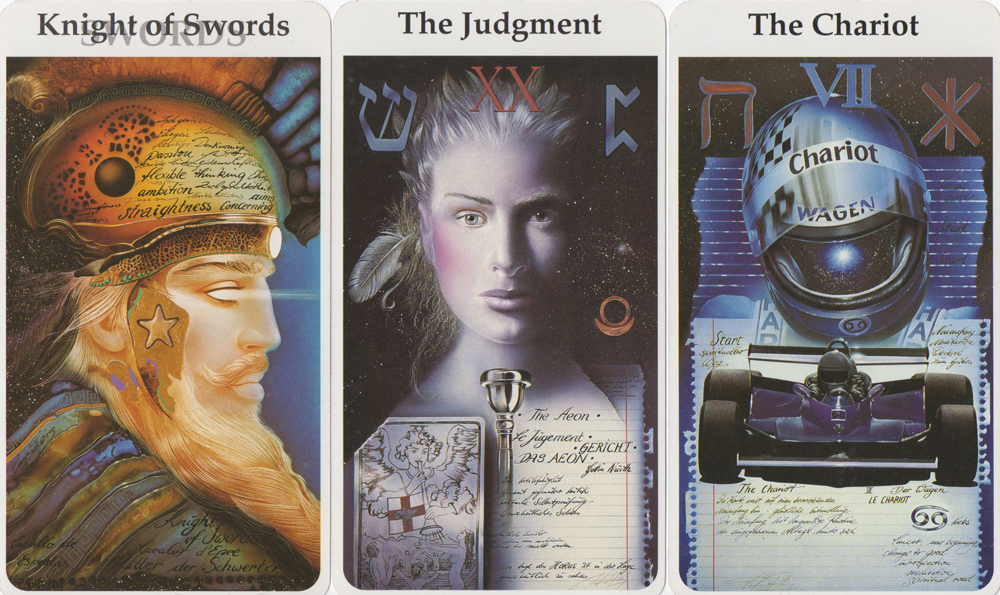
When I look at the Knight of Sword’s crown (that is, the crown of his head — though, like a regal crown, this is also the seat of his power), I tend to see what I have come to understand as an eclipsed Sun.

knight_swords_judgement_chariot_rohrig_sm

Knight of Swords, The Judgement, The Chariot from the Röhrig Tarot deck, created by Carl-W. Röhrig. Click on the image for a larger version.

This feels all the more significant, given we have just emerged from a lunar eclipse on Oct. 8, and are heading into a partial solar eclipse on Oct. 23. Something that was set in motion last Wednesday is now coalescing in preparation for an emergence in the next 11 days — and it has a particular quality to it.

The appearance of a Court Card in a tarot reading refers to an aspect of the personality that is in active expression. It may well also refer to this particular aspect as it is reflected through the presence of someone else in your world (in other words, it heralds the appearance of someone who exhibits its qualities), although my approach is to start with the person for whom I’m doing the reading — you — and then extend the card’s presence to other/s if it feels relevant.

The Knight of Swords — which is the King of Swords in this deck — is the “yang masculine”: the Swords suit is masculine in nature, and the King is the masculine aspect of his suit. We all have the yang masculine; it is not limited to 50% of the population. When he is active, what you experience is the ability to direct your mental faculties in a way that can be both productive and transformative. Look at some of the words on the card:

passion,” “ambition,” “flexible thinking,” “straightness concerning aims“.

This implies a clarity to the way you perceive something that may not have been present beforehand. In the context of the Knight’s eclipsed Sun, which from a psychological perspective speaks of the Shadow (an aspect of psyche whose illumination is obscured), it is a clarity or new understanding about yourself. This then translates into your vision, and a singular movement towards a particular goal.

The fog has lifted; the Knight is in action; it is his piercing sight that causes the shift into the next two cards.

The penultimate card in the tarot deck, The Judgement is a trumpet blast that reanimates you. It is revelation; it is the ending of a particular way of life and the beginning of liberation. Some decks depict Judgement as a phoenix rising from the ashes — the implication being that you have been through the fires of transformation of late. Now it is time to emerge and account for yourself under the eyes of a watchful part of your own divinity.

You are accountable to that force that lies within that is there to wake you up, no matter what. You can ignore the trumpet blast if you so choose. However, the events that it heralds simply reappear in another form. Look into the eyes of the figure in The Judgement. She is The High Priestess who has now come to consciousness in a particular respect; the second card in the Major Arcana has now become the second-to-last card — and what a change in the interim!

So now that you are able to dust yourself off, newly emerged, and look around you, where is that yang masculine aspect of you coming into force in a way that is helpful for you to make your next move? Because move you will, if the next card is anything to go by. Something, or someone, is heading towards you, and you are heading towards them. Are you ready? It is not going to be wasting any time — this, that has you in its sights as much as you are directed towards it.

There is a meeting on the horizon, and it promises motion. Now is the time to apply your powers of organisation, flexible thinking and, yes, passion, to align yourself with what it is that has just been birthed in you. You came through the fires for something, and to remember something. Hold that remembrance in mind; it has taught you about holding to yourself — and holding to your Self — in a way that was heretofore unfamiliar, or impossible, to you.

Get your ducks lined up, listen to the wisdom inside you, and await the mystery of a new way. It is what you’ve been preparing for; you know what to do.

Astrology/Elemental correspondences: Knight of Swords (the fiery aspect of air), Judgement (Pluto), The Chariot (Cancer)

If you want to experiment with tarot cards and don’t have any, we provide a free tarot spread generator using the Celtic Wings spread, which is based on the traditional Celtic Cross spread.This article explains how to use the spread.

Coming into Power

Walking up the street to work this morning, exuding confidence. I can feel it. Some days the sharpness of my personal power startles me, especially when I’m harnessing it so effortlessly. Of course, it happens while I’m doing mundane things like walking up the street, and rarely in ritual or during other more mystical pursuits.

425+web-rainier-60831.jpg

The theme of ‘coming into my power’ has been around for a spell. In many ways, it seems to be a lifelong process, but during this most recent burst I’ve felt more on the verge of unlocking something within me that will unleash the core of my own personal power. In many ways, I know that I’m afraid of it. My worldview would have me believe that that’s due to lots of karmic patterns, and luckily I do work fairly regularly that helps with addressing those patterns and hopefully healing fragments of myself that are bound up in power dynamics.

I associate this power within me with Scorpio, with the core of my emotional body (Moon in Scorpio), and with patterns of betrayal and obsession that seem to ribbon through every part of my being. When I first started really ‘learning’ about the Scorpio parts of me, it felt like I was headed into madness.

I remember the first autumn I spent with that energy, probably 2006 or 2007, wanting to lash out at (and fuck) everything and everyone. I wanted dark kohl liner around my eyes, clothing that accented hips and breasts, and felt like I was losing control in so many ways. And I wanted someone to fix it, I wanted to rage at someone and be lost in some passionate love affair where insanity played some central role and the love was bound by passion in its most destructive forms.

Luckily, the phase was short lived. And only really resulted in acute awareness and a whole slew of very pornographic photos that I took of myself. I’ve since entered more gingerly into the Scorpionic realms, unleashing my power more in a steady trickle. Probably more tentatively than is really necessary, but that’s the way I’m playing the game right now.

Part of me is longing for the unleashing, especially now that I’ve done so much work with creating containers for transformation — and ESPECIALLY now that I have absolutely no desire for destructive passion. Which means I have learned how to own my own ‘insanity’, and have gotten so much better at realizing when I’m projecting, especially in terms of my longing to control (hey, it’s a defense mechanism).

My longing now is for passion shared as a mature creative force. Sure, I still think passion can involve irrationality and getting ‘lost’, but I’ve let go of the part of me that romanticizes the destructive aspects. I want to be a powerful woman in powerful relationship with other people coming into their power. Mmmmm, power.

But it’s pretty amazing just to observe what that power feels like as I walk down the street. It’s femininity coming into form — and not pretty, harmonious, sweet femininity. It’s a raging, no-nonsense, unrepentant and utterly creative force that ‘I’ get to ‘control’. It’s woman-on-top, undulating and dominant energy.

In a lot of ways I totally get why society as a whole seems to fear that energy. Because unleashed…well, I mean that’s the power of Gaia. Of volcanoes and earthquakes and deluges that wipe everything out, leaving nothing but mud and rubble. It is chaos.

But it’s also life being pushed out through a tight little canal to witness the light and the breath of being. It’s creativity — in its nurturing and destructive forms. And so as I walk down the street, I breathe deeply into that sense of power and confidence. And I think about how much we need a world where everyone — women first and foremost but everyone — needs to learn how to channel and deal with and express feminine power. The more she gets repressed, the more violent, insidious and uncontrollable the inevitable outburst is.

Intelligent Lust: How Smarter Sex Can Change Your Life

Editor’s note: This week’s column on sex and relationships comes to us courtesy of Psychology Tomorrow, the website edited by Stanley Siegel, LCSW. Siegel first came to Planet Waves’ attention in 2012; his article about the shared values of sex workers and therapists coincided with our coverage of 1992 QB1 and the idea of “Thresholders.” — Amanda

By Stanley Siegel, LCSW

If you’re like most of us, the subject of sex makes you at least a little uneasy, if not completely uncomfortable. Sex is shrouded in so much mystery and secrecy and considered so personal that it’s a wonder we can ever have an honest conversation about it. But if we could talk freely and openly with each other, we would discover that sex means something different to everyone, often something far from the ideas that Hollywood and Madison Avenue feed us.

Stanley Siegel, LCSW, editor in chief of Psychology Tomorrow.

Stanley Siegel, LCSW, editor in chief of Psychology Tomorrow.

Some of us think of sex as a simple act of physical pleasure, while for others it’s a way of communicating deep feelings, and still others see sex as a spiritual experience. The definition of sexual activity also differs from person to person. It can be kissing, touching, intercourse, bondage, oral, conversational, punishing, dominating, wrapped in leather, romantic, observing, disciplining and much, much more. It is as varied as our individual personalities.

But what usually doesn’t come to mind when we think about sex is what is actually happening when we engage in it with a real person. Sex creates a moment of extreme intensity in which our entire inner life – our history and imagination – is expressed in actions. It is an altered state of consciousness in which the past and the present, body, mind, and spirit, all merge to form a new reality unlike any other experience in our lives. Depending on the circumstance, sex can be either physically and mentally gratifying or alienating and unfulfilling.

Because sex is so compelling at all these levels, it is frequently in our thoughts. I have been a psychotherapist in New York City for thirty-six years, and during this time, I have counseled innumerable patients. In nearly every case, regardless of the problem that led someone to seek therapy, the conversation has inevitably turned to sex.

Some patients express disappointment over the amount of sex in their lives, some are frustrated by a partner’s lack of interest in sexual experimentation, some are concerned about sexual performance, some look in the wrong places to fulfill their desire, and still others are simply curious about their sexual fantasies and desires.

What I tell everyone, no matter what their issue, is that sex is more than any of these topics. It is a doorway into our deepest psyches. More importantly, sex can help heal our lives. By discovering our true sexual desires, as well as uncovering their origin, sex can be much more than just great. It can be life-changing.

I will guide you to understanding your true sexual nature and show you how to use those insights as tools for enjoying smarter sex, a kind of experience that will lead to personal and spiritual growth and a more fulfilling life.

Why? Because true sexual fulfillment is based on self-knowledge and authenticity-not just the sexual act itself.

Have you ever met someone who has grown out of childhood without some conflict or unmet need? For most of us, the pain or unhappiness associated with these conflicts does not preoccupy our current thoughts and feelings, but does become part of our individual psychology, setting the stage for how we interact with the world.

As human beings, we are naturally driven toward self-healing, whether it’s a small cut on our skin or a deep psychological trauma. Self-recovery enhances our chances of physical and emotional survival in the world. We are designed to do whatever we can to lessen pain.

At some point during the heightened sexuality of adolescence, we unconsciously eroticize these unmet needs or unresolved conflicts from childhood in a complicated attempt to heal ourselves. In other words, we turn early painful experiences into pleasurable ones in order to counteract their power over us. As human beings, we are driven toward reconciliation and catharsis.

As we grow into adults, these same conflicts, which now have sexual themes, are coded in our fantasies and desires or, in some cases, our sexual behavior. Through our sexuality, we attempt to gain mastery over feelings of powerlessness, shame, guilt, fear, and loneliness that might otherwise defeat us.

To help clarify this idea, here’s an example from one of my patients: thirty-eight-year-old Sarah, the only child of unhappily married parents. Sarah’s father, a warm and affable man, had failed in business as a contractor because, out of kindness, he often underestimated the cost of jobs, giving his clients bargains he couldn’t afford. He also had a secret habit of gambling on weekends and, over the course of a few years, lost the family savings. Furious, Abby, Sarah’s mother, never let her husband or Sarah forget this; Sarah was constantly compared to her father for her weaknesses and inability to assert herself in the world. Over the years, Abby’s anger grew increasingly abusive.

Sarah secretly wished that her father would stand up to Abby’s attacks and protect her – and himself. Instead, he withdrew from the family by sitting in front of the television for endless hours. Sarah felt abandoned by her father as he faded from her life.

During adolescence, Sarah daydreamed about sailors and sea captains and devoured romance novels with these themes. By the time she reached her late teenage years, like most boys and girls, she was flooded with confusing sexual feelings. Soon she was having sexual fantasies in which she was kidnapped by pirates, only to be later rescued by a strong and handsome sea captain. In her fantasies she unconsciously found an erotic solution to her childhood feelings of helplessness and abandonment by inventing a story in which she was held captive and finally rescued.

These fantasies reflect a common pattern. Not only are they enormously enjoyable but, enacted under the right circumstances, but they can also counteract feelings of powerlessness, guilt, shame, fear, or loneliness, and, remarkably, heal old and deep wounds. By sexualizing unmet needs and childhood conflicts, we convert the pain associated with these experiences into pleasurable events. Our true sexual desires, such as Sarah’s rescue fantasy, emerge out of an unconscious attempt to work through deep-seated feelings.

For many of us, our true desires (and their meanings) remain hidden from our awareness. When we are conscious of them, they are often shadowed by shame; we tend to think of them as “deviant”, “perverse”, or “sinful” because we do not understand their significance and instead internalize how powerful institutions such as religion and psychology have defined them. We police, deny, suppress, or keep our erotic lives secret. In the process, we disown an important part of who we are and who we could become.

The consequences of this denial can be enormous. If we do not understand our true desires, we can easily be lost in the dark. We may well choose the wrong partner. Or, if we act on lust alone without understanding the nature of our desire, we may mistakenly become attached to someone simply because we have great sex with him/her.

Likewise, if we choose a mate solely on the basis of personality or family background, we may attain stability or security, but sex can feel boring, empty, or, in time, entirely disappear from the relationship. Even when we do have a good time sexually, if we are not sharing our deepest desires and fantasies, we miss the opportunity to widen our vision and fully engage our true selves.

On the other hand, if we set out to identify our true sexual desires and the unmet needs or conflicts they serve to counteract, we take a giant step closer to wholeness. We lift our attention upward and create an experience of life based on self-knowledge and self-acceptance. From this position of strength, we can choose a partner with whom we create a sexual and emotional bond that satisfies our deepest needs or we can change our experience in our current relationship. I call the steps by which this is achieved, Intelligent Lust. I will share these steps with you in the forthcoming editions of this blog.

*names have been changed to protect anonymity.

First published in Psychology Today on August 22, 2011.

—————-

Stanley Siegel, LCSW, is a psychotherapist, author, international lecturer, and former Director of Education at New York’s renowned Ackerman Institute for Family Therapy. With over 36 years of experience, Siegel has developed an unconventional and highly regarded approach to psychotherapy. His latest book, Your Brain on Sex: How Smarter Sex Can Change Your Life is out now!

An End Or A Beginning?

How about that blood moon? Pretty impressive in the night sky, daring anyone to look away. Made me ponder the moniker, though. Why isn’t it a rosy moon or a cherry moon? Earlier in the evening, before the eclipse stained her face, Luna was so close, so big and bright, the words that came to mind were ‘bombers moon.’ Why are we schooled to automatically reach for the most dire and dramatic words to describe things we see? Life is hardly so humdrum and mundane that we need frightening teasers to keep us ever on edge and prepared for the worst.

Political Blog, News, Information, Astrological Perspective.

By Judith Gayle | Political Waves

This week a Jehovah’s Witness acquaintance of mine cheerfully greeted everyone she met with an enthusiastic announcement that “The pestilence is here!” I assume, for her (and as implied by frequent illustrations in the JW recruitment magazine, the Watchtower) that triggers happy thoughts about lions lying down with lambs and a utopian society where all is regulated by benevolent theocratic authority. For most of the rest of us, though, just mention of the word pestilence frightens the bejesus out of us and turns us against one another as suspicious germ-carriers.

Some idiot sneezed on a plane this week and followed it with a crack about being from Africa. After landing, authorities in hazmat suits escorted him off the plane, fellow passengers hooting and clapping, even as the black man protested that he was joking. Is idiot too harsh a term? Not realizing the highly-charged emotional climate into which one injects dark humor seems more than just clueless, it’s reckless. A word of advice? Don’t yell ‘fire’ in a crowded theatre or ‘bomb’ in a busy airport and, these days, don’t joke about pandemics.

Nothing scares us more than something we can’t see coming. It prompts us to do stupid things, as when pretty but vapid “The View” alumni, Elizabeth Hasslebeck, now a FOX News contributor, suggested that a National Institute of Health* doctor seal the borders. His answer was both logical and nuanced, enumerating the consequences of such an action, which seems to have stumped Elizabeth and, very likely, her viewers as well.

Surely it can only be fear that prompts us to believe the stupid (and glaringly manipulative) things political operatives say, like Rush Limbaugh declaring that Obama has allowed Ebola in as punishment on white people for slavery. Like Phyllis Schlafly commenting that the Prez wants Americans to die from this virus so that the U.S. will be more like Africa. But WTF, folks! A little brainpower would be refreshing about now, don’t you think? A little common sense to go with our panic attack?

It’s entirely human to become self-protective in the face of danger — our bodies flooded with fight-or-flight waves of adrenalin that pitch us into action — but living in a constant state of fear over supposed matters of life and death is simply exhausting, self-defeating and stressful. We can blame the corporatists for chipping away at the educational system that might have given us the cognitive skills to put all the chaos we see around us into proper perspective, and thank the fundamentalists for much of our nihilistic mind-set, setting up a scenario where we desperately need ‘saving,’ not to mention the adoption of a one-size-fits-all moral code in order to deserve  it. And, yes — because if the buck doesn’t stop here, I don’t know where it stops — we can thank ourselves for slowly allowing that kind of regressive thinking to color our world in tones so densely dark and somber that now we have to fight our way back up into the Light.

As successful scaremonger and director of suspense-thrillers, Sir Alfred Hitchcock, told us, “Drama is life with the dull bits cut out.” And although we might argue that the world has gone full-blown drama queen, shot-gunning out its dysfunctionality to pepper any casual bystander, twist any rational mind, there is a lot of fabrication going on. This distillation of the shocking, saddening, salacious or most severe of our behaviors finds easy access to performance art, filling the pages of a script, stuffing scads of dysfunction along with promises of thrills and spills onto its pages to create the ultimate soap opera, otherwise known as the world, today.

In order to write such a scenario, we have to leave out anything that relaxes us, repairs our jangled nerves, or makes us comfortable, focusing instead on the dire and the dismal. In order to appreciate the drama at hand, we have to begin to live out the consciousness that propels it, and some of us, Hitch said, come by it naturally.  “I’m fortunate to be a coward, to have a low threshold of fear, because a hero couldn’t make a good suspense film,” said the iconic director.

Ratcheting up anxiety over every possible danger in these last years, we’ve created a society that expects the worst and takes a kind of perverse satisfaction in being proven right. Makes me think of my JW friend, pleased to be the first to announce gawd-awful news. What the hell kind of happy-dance will she break into when famine shows up? Reminds me — as does so much of what I see, these days — of the Course in Miracles affirmation, “You can be right or you can be happy,” and Richard Bach’s warning, “Argue for your limitations, and they’re yours.”

The kind of hysteria we’re experiencing because of the Ebola epidemic has a good deal to do with what we’re NOT hearing. We’re not hearing how this is a problem that has its roots in poverty, feudal hygiene practice, and medieval burial procedures; hence, the very cause of the problem we must eventually address. We’re not hearing that modern medical practice can certainly contain the worst of this, or that an actual cure for such a frightful scourge won’t be found so long as those who suffer from it have no money to pay. And although we’re hearing — from progressive providers everywhere — that this is not something to run with our hair on fire about, we don’t have a definitive voice to tamp out the sparks that are flying, fast and furiously.

And who might such a one be, you may ask? An American Surgeon General would do, for starters. Someone who can speak for public health, and represent the integrity of the medical institutions charged with containing such a danger. We haven’t had a SG in almost a year, ever since the physician Obama proposed — Dr. Vivek H. Murthy — had the temerity to consider guns a danger to the health of the average citizen (and I doubt that any doctor working an emergency room in this nation could disagree.)

The NRA did not take such a notion kindly, and its minions, comprised of the entirety of the Republican party, jumped on the chance to stonewall Obama’s choice, refusing confirmation and denying the nation a national physician. Clearly, even on his best day Sanjay Gupta doesn’t cut it, but corporatist Dems haven’t raised an appropriate amount of hell to push a confirmation vote for Murthy, nor has the Prez. We are, as usual, without what we need when we need it. We could really use a hero, but with none forthcoming, I’m thinking it’s on you and me.

Some say that the appointment no longer has the weight it once did to represent a politicized nation, and looking at the reason Murthy has been waiting in the wings all this time may prove the point. When the physician of moment is on board with the party in favor and its philosophical idiosyncrasies, rather than the medical needs of the people, then perhaps the position is, indeed, no longer viable. Yet most often it’s the administration, rather than the medical representation it chooses, that wimps out.

Do we all remember C. Everett Coop? While he was Reagan’s man, and a devout anti-choice conservative, he would not buck science in favor of his personal politics. He advised condoms for protection against AIDS without demonizing homosexuality as did the Reagan camp, so he was not advised in the early — and crucial — years of the epidemic. At the end of his tenure, Coop found no evidence that abortion caused lasting psychological harm to women and said so, despite his own personal hesitations. Those on the right were surely not pleased.

And perhaps you remember our first African American Surgeon General, Dr. Joycelyn Elders, a pediatric endocrinologist who advocated the distribution of condoms in schools to protect teens from STDs? Controversial from the get-go, she suggested that teaching masturbation would be a likely tactic for discouraging teens from riskier forms of sexuality, and — bless her — said, in 1994, “We really need to get over this love affair with the fetus and start worrying about children.” Clinton fired her that same year. (I’m pleased to report that she continues to be a front-and-center advocate for childhood issues, calling abstinence-only sex education a form of child abuse and voicing support for marijuana legalization, citing nicotine and alcohol as far more dangerous drugs.)

Yes, it would be good to have a wiser head to listen to, not left twitchy and almost manically uninformed — like Egypt that killed hundreds of thousands of pigs when there was a hint of swine flu, or Indochina, that snuffs chickens by the millions at the mere mention of Avian flu — but perhaps it’s too late to stem the tide of stupidity and fright. Ebola already has its first animal sacrifice: Excaliber the dog, belonging to the Spanish nurse who has since died of Ebola. For whatever reason, it is easier to feel the loss of a beloved pet than that of our neighbor, so for God/dess sake, please do. We will not overcome this challenge to intellect and compassion unless we open our heart to it.

When things get grim, the first thing we hear in this nation is a great wail about how End Times are finally here. The newest “Left Behind” movie is out this week, just in time to capitalize on all the spooky, scary and largely irrational conjecture about vanishing believers and vanquished evil, bathed in fire and blood. Good times, eh? Great drama, pure soap opera and lots of shocks and jolts, but — seriously, my dears — nothing new.

I’m reminded that in 1918, with WWI still in progress and the whole of the globe tired and sad, an epidemic of flu gripped approximately one-fifth of the world. Here in the states, over 675,000 citizens sickened and died, more than a quarter of all Americans. Unusually severe, it bypassed the very old and very young. Those between 20 and 40 were consumed so quickly that there was no way to handle all of the bodies, so they were left in their beds, their homes closed and quarantined, and family members displaced until pick-up and decontamination could be arranged. My great-grandmother was among them, leaving a devastated husband and two little boys to an unthinkable future without her.

There was a great cry and howl about End Times during that frightful period, count on it. There was hand-wringing and angst, foretelling the rise of Christian Dominionists who would embrace the concept of Rapture rather than stick around to bury the dead. Yet it was during this same period that science reorganized to address the fearsome challenges of modern medicine, pushing to discover the wonder drugs of the 20th century, define treatment of sepsis, and design and implement the vaccination policies that brought childhood disease to a standstill.

The Ebola threat is just the newest version of … let’s call it … a healing crisis. It has provoked our oldest, deepest cell memories of fear and loss, but it is not the end of anything. Perhaps it’s even the beginning of all that must come next if we are to restore sanity and survive into this new century, the dawning of a new era. As the world changes, so must we, and the first thing we have to let go of is superstitious fear and irrational — if shiveringly entertaining — things that go bump in the night.

* With elections coming up it’s worth mentioning that sequestration removed some 1.5 BILLION dollars from the NIH and 300 million from the CDC, which would have staffed, equipped and enabled a speedy response to this global emergency.  Even now, the funding requested by Obama to address this challenge is being used as a political football to garner mid-term votes.