Category Archives: Columnist

Weighing In, Moving On — Mercury Returns to Scorpio

Mercury returns to Scorpio at 6:09 pm EST (23:09 UT) Saturday to weigh in and move on — a good example for you to follow. Mercury first entered that realm of fixed water on Sept. 27.

len-wallick-logo

Then it stationed retrograde barely two degrees in on Oct. 4, ultimately rolling halfway back into Libra.

There will be no turning back for Mercury after its second ingress to Scorpio in six weeks’ time, but it will find a lot more company than the first time.

When Mercury re-enters Scorpio this weekend, it will join the Sun, Venus and Saturn expressing their unique archetypes through a common — and weighty — raiment.

That’s nearly half the sign rulers of the solar system — true heavyweights — harmonizing to play very much the character of a chorus in what the whole zodiac is doing right now.

The character of Scorpio can be a lot of things, but it is seldom a lightweight. The energetics conferred upon any point or object traversing fixed water address facts of life that distinguish adult from child.

Given versatile Mercury’s correlations with (among other things) mind, words and how you think, this particular return to Scorpio is no time to speak as a child, understand as a child, or think as a child.

So it is that you will best harmonize with the conscious solar undertone, as well as with the deepest phrasing of Venusian values and Saturn’s somber anchor when Mercury comes into Scorpio once again. Not necessarily darkly, but by facing up to what is, and not just in part.

Fortunately, Mercury is also coming into its own again even as it is coming back to Scorpio. Which is to say Mercury’s apparent motion is getting back up to its usual blazing speed. Already, the planet appropriately named after the speedster of the gods is covering about three degrees of the zodiac every two days — faster than any other sign ruler except the Moon.

Implicitly then, Mercury returns to Scorpio this weekend to accompany your moving on just as much as to accompany your taking on a serious tone.

Appropriately then, Mercury will blow past the point where it stationed retrograde on Monday, ending the final shadow phase of its final retrograde period of 2014, and getting your week off with a figurative foot on symbolically fresh ground.

Nevertheless, it will still pay to watch where you step. The Scorpio chorus has a lot left to say, both to you and through you. Best to say it (and hear it) all soberly and seriously, while also not dwelling overmuch in dark reflection. There is so much to do now that Mercury (and by implication, your mind) are finally getting free.

Offered In Service

Len is available for astrology readings. You can contact him at lenwallick [at] gmail [dot] com.

Mars Conjunct Pluto: Get Constructive, Not Explosive

Whether you’re celebrating or trying to pick yourself up and dust yourself off after Tuesday’s elections, note the palpable tension still in the air. It’s not all politics, and it’s not just you; for one thing, we have the Taurus Full Moon today (Thursday). But something even bigger is brewing.

Photo by Amanda Painter

Photo by Amanda Painter

Exact at 5:23 pm, the Moon in Taurus opposes the Sun in Scorpio. This is the Taurus Full Moon.

Any interpersonal situation where material possessions, shared resources/money or sex is concerned — especially if one or both of you is feeling some fear around there not being ‘enough’ — may be feeling especially polarized right now.

Consider grounding yourself today with activities that put you in touch with your body. In any stalled intimate situations, things may begin to resolve themselves later in the evening.

Even so, we’re still in a potential hot zone. This is thanks to Mars working into a conjunction with Pluto in Capricorn, exact Nov. 11 (and shortly thereafter, a square to Uranus in Aries).

Continue reading

Memorial: Joan Quigley, Astrologer to the Reagans

Editor’s Note: As it’s the day after Election Day in the U.S., it seems a fitting time to run this tribute to the late Joan Quigley, who famously advised Nancy and Ronald Reagan during this presidency. — Amanda

By Amy Elliot

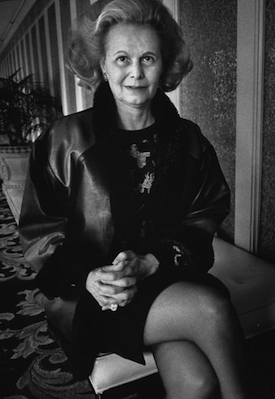
Joan Quigley, the astrologer who famously advised to former First Lady Nancy Reagan, died Oct. 21. She was 87 years old.

November 1988 photo of Joan Quigley by Tom Levy / SFC

Photo of Joan Quigley taken Nov. 15, 1988, by Tom Levy for the San Francisco Chronicle

A celebrity astrologer until her role at the White House was revealed in 1988 by White House Chief of Staff Donald Regan, Quigley’s story offered the public a rare glimpse into the real work of an actual astrologer.

More than that, as Eric noted in an email, “She is the most notorious astrologer of our lifetimes. Her name is actually known.”

Hired by Mrs. Reagan in March 1981 to protect her husband from any further assassination attempts, Quigley seems to have done precisely that, on the principles of electional astrology: using the President’s birth data, she helped to schedule meetings and travel for the most auspicious times.

In a very real way, she was hired to keep Pres. Reagan alive; had he not very nearly been assassinated, we would not know who Quigley was.

She likely was key in softening Reagan’s attitude toward Mikhail Gorbachev prior to the 1985 Geneva summit. As Eric noted in Planet Waves FM last week, even if her influence here was very slight, even if she postponed the horrors of nuclear war for five minutes, this act alone fully justified her position.

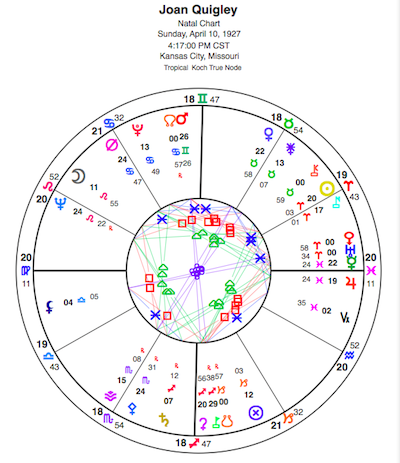
Quigley’s natal chart features a Uranus-Eris conjunction square the Nodes, all on the Aries Point; an indication that her career would probably be more influential than that of a simple socialite. She graduated from Vassar College with a degree in art history, and decided to study astrology while at college due to her mother’s interest in the art.

She became a regular guest on Merv Griffin’s talk show in the 1970s, and through this contact she was introduced to Nancy Reagan. On hearing that Quigley might have been able to prevent the attack on the President had she been studying the relevant charts, Mrs. Reagan hired the astrologer on a monthly retainer. This arrangement lasted until Donald Regan published his book. In the fallout from these revelations, and after apparently being implored by Mrs. Reagan not to disclose her White House ties to the press, Quigley was swiftly dropped.

People differ in their opinions of her influence on Reagan’s policies. Certainly, she was not the first astrologer known to the Reagans; they had previously consulted Jeane Dixon and Carroll Righter. Reagan’s 1967 inauguration as governor was documented to have been timed awkwardly at 12:10 am; some speculated that this was on an astrologer’s advice. The Moon of the resulting chart was almost precisely on the Ascendant, which under usual horary rules would indeed be auspicious for its subject.

The media responded to the news with ridicule, following the Western social trend of treating astrologers as charlatans. The Federation of American Scientists noted their own disdain, saying they were “gravely disturbed.” No matter how effective or harmless Joan’s work actually was, to take this line automatically seems to have been common sense.

Joan Quigley's natal chart. View larger size here; view glyph key here.

Joan Quigley’s natal chart. View larger size here; view glyph key here.

Quigley’s natal chart certainly has the qualities of an astrologer in the making. With Virgo on the Ascendant and a Gemini MC, this is a Mercurial chart, and Mercury is positioned neatly on the Descendant, conjunct Jupiter.

With the added benefit of intuitive Pisces, this indicates a good listener and communicator, someone who can easily absorb the ideas of others, and address them in their own language.

A Pisces Descendant also carries the probability of idealism relating to other people, and might well capture symbolically the inspiration she felt in relation to Reagan’s horoscope, citing his “magical inner will.” The Leo Moon perhaps flavors this tendency somewhat by giving her a natural respect for leadership.

The sheer number of objects on the Aries Point — to the degree — including the Nodes, which are heralds of the soul path, is very suggestive of Quigley’s potential to act on the world stage. Pholus tightly conjunct the South Node implies that occurrences familiar and easy to Joan would be exponentially magnified in their effects; note that her employment by Mrs. Reagan, when discovered by the public, caused a furor that is somehow wholly out of step with her actual day-to-day role.

There is also an intriguing opposition between Venus-Juno in Taurus and Vesta-Pallas in Scorpio, which may shed some light on the fact that Miss Quigley (not Ms., according to her preference) never married, and could perhaps be said to have been devoted to her profession. Venus in the 9th house of higher purpose and philosophy is telling in itself, but the configuration as a whole is remarkable. It would seem there was a conscious decision not to marry; she devoted herself instead to her work — a choice for which all survivors of the Cold War may be in her debt.

“At the time, they were thinking of the Russians as gangsters. I told Nancy that Gorbachev was a different kind of leader, and that he would share a vision with Reagan.”
Joan Quigley

The Midseason Taurus Full Moon

Thursday’s Taurus Full Moon at 5:23pm EST (22:23 UT) will not be an eclipse. Even so, the event will be something more than the midpoint of a lunation (or lunar cycle from one New Moon to the next) that all Full Moons represent. Thursday’s Full Moon also marks the midpoint of a season.

len-wallick-logo

Both realistically and symbolically, the position of the Sun determines what season it is, and what point in the season you are experiencing.

There are many ways to measure the position of the Sun, but the tropical zodiac (what we use in Western astrology, and here on Planet Waves) is among the most convenient and reliable.

When the symbolic Sun entered tropical Libra on Sept. 22 (or 23, depending on your time zone), the actual Sun was appearing directly overhead at Earth’s equator. It was thus an equinox.

The Libra equinox represented the beginning of autumn in the Northern Hemisphere, and the initiation of spring in the Southern Hemisphere, but took place for everybody on Earth at once. For many of you, however, the seasonal change was not immediately apparent in actual experience at the time of the Libra equinox.

By now, however, nearly everybody in the northern temperate zones knows from actual experience that it’s definitely not summer anymore. Those in temperate zones South of the equator have also by now seen evidence that winter is over for them.

That’s the power of the midpoint (or what some call the ‘cross-quarter’) between season changes. What starts at an equinox (when the symbolic Sun enters cardinal Libra, or cardinal Aries) or a solstice (with solar ingress to cardinal Cancer or cardinal Capricorn) reaches a peak of expression, and a turning point about six weeks later.

For tropical astrologers that peak comes when the Sun reaches the midpoints of a fixed sign (Taurus, Leo, Scorpio or Aquarius). So called because the Sun in a fixed sign corresponds in practical experience with a seasonal pattern being fixed into place, after being subtly initiated when the Sun first entered the immediately previous cardinal sign.

It is not every month, or even every year, that any Full Moon will take place while the opposing Sun at the midpoint of a fixed sign. When something does not happen very often, astrologers take notice — especially when the two brightest lights in the sky reach the midpoint of their respective cycles at the same time.

It is as if a point is being made, in italics, and underlined for emphasis when the Sun and Moon deliver the same symbolic message at the same time. In this case, the message corresponds closely to political cycles in the U.S. with today being the so-called midterm elections for the national legislature. Midterm elections occur halfway between presidential elections.

It means we are at the midpoint of President Obama’s second and final four-year term of elected service. Because of how government works (or fails to work) in the U.S., the results of today’s midterm elections will largely determine what the last two years of the current presidential term will amount to.

Yet the Sun and Moon cannot be construed to correspond with the politics of any one nation. The two ‘greater lights’ can, however, be correlated with you, because the midpoint of a season happens at the same time for everybody on Earth, as does a Full Moon.

Hence the point being made by Thursday’s Taurus Full Moon must implicitly be global, at most integrating U.S. politics into a bigger picture.

The point being made by the opposed luminaries (Sun and Moon) on Thursday would be about a bigger picture including all, and excluding none. Implied would be cycles of all kinds, and how at least some of those cycles are reaching their midpoint simultaneously.

The big picture would necessarily include decision making, and possibly even side taking. From those decisions, possibly a determination of what the next two weeks of the lunar cycle, the next six weeks of the current season, and perhaps even the remainder of a longer period now halfway done could amount to.

It is as if you will be voting by what you do, or don’t do on Thursday — not as a citizen of any nation, but as a human being. A human being who is aware of how the Sun and Moon appear to move, and how (when the luminaries move in rare synchronicity) something of your own experience is implicitly synchronized with every other being on Earth.

It would be convenient if the Sun and Moon were more explicit about what’s up with the profusely illuminated confluence of their midpoints, but that’s not the way the universe works. The cosmos goes about its business showing, but not telling, to those who choose to observe and correlate.

Now that you are aware of what the luminaries will be doing on Thursday, you might want to observe and correlate yourself. What are your needs? What do you want? What has reached its peak or midpoint for you? What will your own choices and actions amount to?

Whatever the answer to those questions, imagine others asking and answering the same questions at the same time. Then, think about what the cumulative result would amount to, especially if everybody did the same as you at the same time.

From that contemplation alone, something truly significant could come on the other side of the midpoint the Sun, Moon and all of us will, one way or another, implicitly be reaching together on Thursday. Vote your conscience.

Offered In Service

Len is available for astrology readings. You can contact him at lenwallick [at] gmail [dot] com.

Let’s Take a Walk

By Amanda Moreno

Something I’m truly passionate about is the ways in which astrology can be used to inform spirituality. In so many ways, astrology seems uniquely poised to be a transformational tool for the collective, particularly due to its unique ability to help individuals create a spirituality that resonates for their own experience within a more cosmic and collective framework.

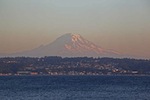
350+Moreno_logo_rainier-60831Regardless of whether an increase in individualization within our culture is harmful, the fact of the matter is that it’s happening. Astrology provides a way to tap into meaning making within a context that is ‘true’ for every being (and non-being) at the same time. The stars are reflecting their light for us all.

One of my favorite ways to learn about my own chart and the way the archetypes constellate through me at all levels is to do a little practice I call “walking around my chart.” I use it when I need help with transits, or when I feel like I have a blind spot. Sometimes I just use it for fun — never a boring moment in my household!

For example, one summer day a few years back I decided to sit in front of my altar and visualize my chart to see what called to me. I ended up sitting right on my 5th house Sagittarian Neptune, which also happens to square both my Saturn in the 2nd house in Virgo and Venus in the 8th in Pisces. That Neptune has always been a blind spot for me (go figure), and so I was curious to see what would happen.

On a bit of a tangential note — I once participated in an Astrodrama session in which this particular T-square of mine was acted out by three individuals. I’ve participated in Astrodrama in several different ways, but the gist of it is that you have individuals act out a specific configuration, let the archetypal fields open up, and see what happens.

In this case, Neptune just kind of stood by dazed and laughing while Saturn lamented to Venus about the ways he was trying to keep it all grounded, practical and safe. Venus tried to pay attention and appease, but would then go off on some exuberant monologue, usually about an intense need for transcendent sex. I learned a lot about that opposition in that session, including an undying love for Venus in the 8th in Pisces, but Neptune has been more slowly revealed.

Back to the walk around my chart. As I sat there, I began to notice different areas of my body tensing up, and I decided to lean into some pain in my shoulder. Suddenly an image of my dad, who died when I was six, came to mind. He came across more clearly than I’d ever seen him before, and I suddenly saw my six-year-old self come running from the edge of my awareness, towards him, laughing and excited to see him as she jumped into his arms.

As the two of them hugged, I began to cry and became aware of two things. First, just how deeply I felt the loss of unconditional love when my father died. Second, that he has been here with me this whole time, and will continue to be, and that that unconditional fatherly love I’d been missing exists within me, whether I choose to see that as a psychological phenomenon or a spiritual one. And really, is there any difference?

Of course, interpretations can be taken in many directions, and as I reflected on the experience I realized new layers of that T-square, such as a greater understanding of the ways in which I idealize men (5th house Neptune, Venus in Pisces) and the depths of disillusionment the loss provoked.

I just wanted to share that fun (well, at least it can be) little exercise this week, and take a little break from the deeper introspection. Besides, I’ve also come to realize that T-squares have an outlet — the house and sign opposing the squared planet. In this instance, that’d be the 11th house and Gemini. So something about sharing the experience in words with my tribe makes a whole lot of sense.

The Weekend Tarot Reading — Sunday, November 2, 2014

By Sarah Taylor

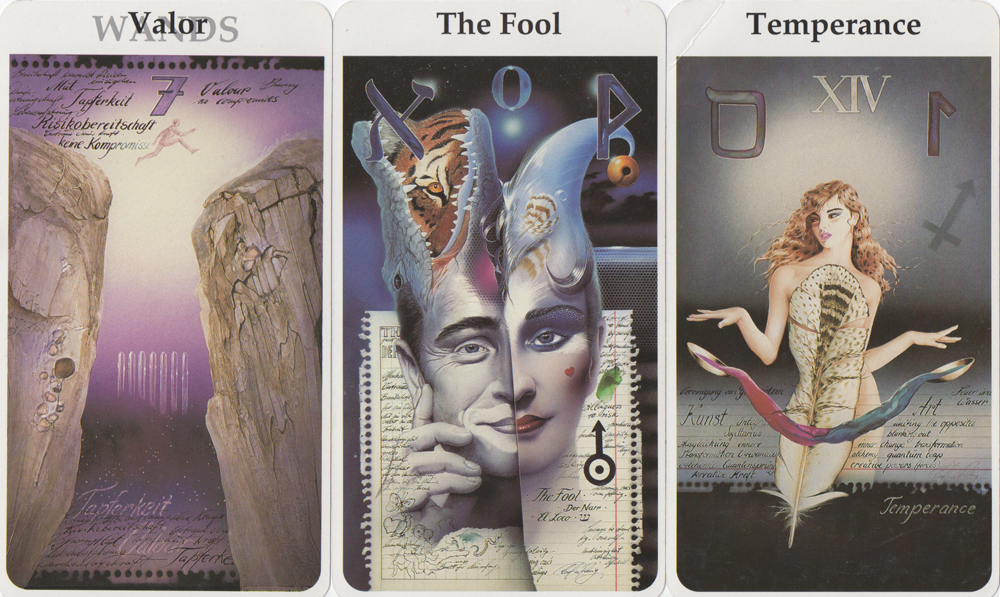
This is a reading of two halves: two halves in each card. Let’s explore how these two-halved cards are able to dance together to form a whole that, if not resolved, is an ongoing balance of opposites.

The further paradox of this balancing game is that it is an ‘all-or-nothing’ commitment; you are either fully in, or fully out. What is clear, though, is no matter your decision, it is going to ask for a giant step into the unknown.

seven_wands_fool_temperance_rohrig_sm

Seven of Wands, The Fool, Temperance from the Röhrig Tarot deck, created by Carl-W. Röhrig. Click on the image for a larger version.

What strikes me first is the relationship between the Seven of Wands — or Valor — and The Fool. When I first looked at the two cards, I realised that the figure in the Seven of Wands is enacting what it is that the figure of the Fool seems to be about to do in many of the more traditional depictions of The Fool: taking a leap off a cliff, towards and into the mystery.

The very little English writing on the Seven of Wands offers us this:

Bravery,” “no compromises

And the two go hand-in-hand. To propel yourself forward over a chasm describing the unknown and into a different place is an act of bravery. It is also an act without compromise, because to do it part-way means to fall into the chasm itself, and to do it not at all means to stay where you are. What does this mean? Essentially there are three choices in front of you: to stay where you are; to offer conditional commitment, which puts you in a no-man’s-land, where there is a sense of psychic loss that asks for a renewed period of excavation; or to leap, fully, across that no-man’s-land and into a new land, where nothing is guaranteed save for the fact that you know that you have no idea what you are committing to.

The card, however, suggests that it is an action worth considering. It asks of you “valor,” and in The Fool’s Journey it is that bravery that informs the first step of The Fool along a path that, yes, will test him and will bring him new adventures, but which will also bring him the opportunity to follow the call of his Soul. And if there is a calling that is worth following more — if your desire is to live fully, to know yourself better, to expand your sense of what is possible — then it is eluding me right now.

And so the hero/heroine leaps — and so leaps into the world, and the state, of The Fool.

I love this beautiful Fool in the Röhrig deck. Masculine and feminine — and yet both edgy in their own rights: the masculine black and white with a clown mouth, the feminine decorative, heart on cheek. Together, they seek to find a balance with the resources that they have. Neither together nor apart do they form what we might consider to be a ‘conventional’ whole. And why should they? As humans stepping out on our own odysseys, we are beautifully, intricately, delicately, compellingly flawed.

We are two sides seeking union among the riches of our idiosyncrasies, our complexes, unpredictability, and magic. And yet we are heroes and heroines, and all in between.

Courage to stand by oneself,” “independence,” “Creativity,” “great potential,” “possibility,” “frankness,” “freedom,” “possibility for quantum leap,” “following one’s own feeling,” …

willingness to risk.”

The willingness to risk. That is The Fool in four words. He is the initiator, the instigator — very often at the hands of his own innocence or ignorance. But it isn’t willful or stupid ignorance; it is simply because he cannot know. How could he know what he is letting himself in for? Why, then he wouldn’t be The Fool!

We are Fools when we eschew convention and the well-worn path and strike out on our own, no matter the consequences that we are warned to take heed of — to fear, even. And, when we are holding to the spirit of adventure that The Fool embodies, we do this not as an act of rebellion. We do it as an unbridled act of Self-definition.

The final card underlines this further, and also brings in a stabilising factor. Again, we have similar qualities in the written descriptors:

inner change,” “transformation,” “quantum leap,” “creative powers (forces).”

Alongside these, though, there are “uniting the opposites,” and “blanking out.”

Temperance describes the process of alchemy that happens when we learn to unite two opposites — in this case the elements of fire and water (“Feuer und Wasser“). One possible outcome of this is that we cancel both elements out. This is a fine art we are talking about here; it takes the courage of The Fool, and the precision of one — such as you — who is devoted to the craft of one’s life. It is when you are able to unite opposites that you create the kind of reaction that gives you a new substance that had previously been unavailable to you.

You have created your own inner gold.

This is your Great Work calling to you, and you have everything you need to bring forth what serves you. What it asks of you is courage — to move into the unknown with a decisiveness that takes you all the way there — and the ability to work with what feels like two forces at odds with each other but which, when brought together in just the right way, bring you something you never thought possible.

So, there you are, standing on the precipice. It might not, after all, be the abyss that you thought it was. And — wonder of all wonders — you get to find out for yourself.

Astrology/Elemental correspondences: Seven of Wands (Mars in Leo), The Fool (Uranus), Temperance (Sagittarius)

If you want to experiment with tarot cards and don’t have any, we provide a free tarot spread generator using the Celtic Wings spread, which is based on the traditional Celtic Cross spread.This article explains how to use the spread.

Unbroken Chain: Samhain, Halloween and Scorpio

These darkening days of autumn are a mysterious time, marking the waning year and filled with a sense of the inevitable. Those who follow astrology know this is the season of Scorpio, the sign associated with the death and transformation that leads to change, renewal and regeneration of life. At the center of this season is Halloween, the modern version of the ancient Celtic holiday Samhain (pronounced sa-wen).

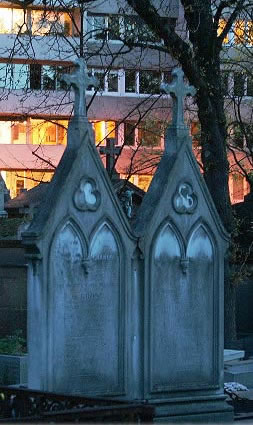
Matching designer graves at Pere Lachaise, not too far from where Jim Morrison is buried, on Day of the Dead 2005. Photo by Eric Francis.

It may seem like a coincidence that the scary costumes, candle-lit walks to old cemeteries and, for the faithful, the vigils inviting the spirits of ancestors home for All-Hallow’s Eve align with the astrological sign of the mysteries of death. But when you consider, in the words of Donna Henes in her book Celestially Auspicious Occasions, that Halloween’s symbols — “the ghosts, masks, fires and food — are the same as they were thousands of years ago in ancient Egypt,” it’s clear that Scorpio is part of an unbroken chain of tradition through cultures worldwide.

From the temples on the Nile millennia before the birth of Jesus, through the rise of the Christian movement with its co-opting of local religion, its crusades and inquisitions; from ancient Aztec cultures to Mexico, Spain and Portugal of recent centuries, and even through to modern-day marketing culture, the traditions of Halloween carry a common signature, an identifying mark. Even skeptics who are paying attention must make note that there is something inherent and natural about this time of year for these symbols to arise from the collective consciousness in so many cultures.

In astrology, the “death” symbolism of Scorpio aligns with the tradition of welcoming the spirits of the dead on what the Christians later called All Soul’s Night. The grim reaper appears in the season of the final harvest. Historically, this was the time of year when final preparations were being made for the winter that lay ahead by harvesting anything that was left in the fields. In addition, the ancients assessed their livestock and decided which animals were to be slaughtered and preserved for the food that would be eaten during the many cold months to come. The Celts knew that they could only sustain the smallest of herds in the coming months.

It is important to understand that this was a very serious time. In many climates, particularly Ireland, from where most of our Halloween traditions originate, winters were cold and harsh, and the mortality rate was very high. Medicines were made with herbs for the inevitable illnesses to come. Nobody knew for sure who would make it through the long winter, which was, in the harsh climates, a time when many lives ended.

It is no wonder, then, that the opposite Celtic holiday, Beltane, or May Day, is a celebration of fertility and sex, for it was understood that the more joyous and passionate was Beltane, the more fruitful the harvest of the following autumn, and the greater the chances of life being sustained through the following winter. As modern society continues to conquer nature, one may say that these obvious facts of life are departing from our awareness. But the prevalence of Halloween and its images is reassuring.

Traditionally, October 31, Samhain, is a time for communing with the dead, the time of year when it is believed that the veils between the worlds are the thinnest. One tradition is called a “Dumb” or “Silent Supper.” Ceremonies are performed in honor of those we love that have passed, and we set a place at the table for the departed with offerings of bread and wine so that the dead may feast, eating in silence and remembering loved ones.

All of this is consistent with the familiar astrological themes of Scorpio, which we associate with psychic powers and communicating with the dead. Indeed, traditionally, this season was also the time of casting divination on the question of marriage, an attribute connected with Scorpio and the corresponding Eighth House and theme of sexual consummation. In the oldest astrology textbook in English, William Lilly suggests that the Eighth House is the house of “death and dowry.”

The scorpion symbolism of this sign has been related to sex through the act of the scorpion’s sting, which is a pessimistic interpretation. Yet “in Mesopotamian mythology,” says the Astrology Encyclopedia by James R. Lewis, “scorpion men guarded the gates of the underworld, which is the original reason Scorpio became associated with death.” The snake sheds its skin; all things must change; the cycle of birth and death continues throughout the life of the Earth in an unbroken chain of life and tradition of which Halloween, Samhain or All Hallow’s Eve is a defining moment worldwide.

Writes the Wiccan mystic Starhawk, “We are not separate from each other, from the broader world around us. We are one with the Goddess, with the God. As the cone of power rises, as the season changes, we arouse the power within, the power to heal, the power to change our society, the power to renew the Earth.”

Additional Research: Jenny Singer and Carol Burkhart

Dias de los Muertos

By Jeanne Treadway

La Catrina is the reigning queen of Dias de los Muertos, the Mexican fiesta honoring the dead. Finely dressed in an upper-class Victorian style, an oversized, feathered and flowered hat perched primly on her skull, elegant but skeletal, La Catrina was popularized by Jose Guadalupe Posada in his political lampoons of the corrupt regime of Porfirio Díaz. Her role, then and now, is simple: She reminds us that rich or poor, famed or unknown, we all eventually become skeletons.
dd

Dias de los Muertos is celebrated throughout Mexico and parts of the Southwest United States. Traditions vary but generally November 1, known in the Catholic world as All Saints Day, honors dead children and is frequently called Dia de los Angelitos (Day of the Little Angels). All Souls Day, November 2, honors all ancestors. Some communities use October 28 to pay tribute to those who died a violent death, while October 29 can be a day to honor the unbaptized, and October 30 often serves as a day of remembering lonely souls. All celebrations include building ornate altars, extended family gatherings, bountiful feasting, storytelling, and meticulous decoration of cemeteries.

HISTORY

Many cultures honor their dead with annual rituals and celebrations; often thousands of years old, these ceremonies frequently occur around the new year. On their Lunar New Year, Asians explode tons of fireworks, burn costly shrines created to honor ancestors, and parade dragons noisily through streets. Memorial Day in the United States is a somber occasion and leans toward the militaristic; rituals include draping red, white, and blue bunting everywhere, planting flags, and intoning long lists of those who died in service to the armed forces. Celts build enormous bonfires on their new year’s eve, October 31, known as Samhain, and commune with their dead while the veil between the worlds of the living and the dead is at its thinnest.

Early Christian history is often vexingly convoluted and that is the case here. The original All Saints Day appears to have been celebrated May 13, 609 (maybe 610) by Pope Boniface IV when he rededicated the Pantheon in Rome to Santa Maria and all martyrs. May 13 coincides with the final day of Lemuria, a Roman three-day ritual honoring ancestral spirits. All members of a community attended a feast on that date and ritually forgave each other’s past transgressions. Sometime during his reign (731-741), Pope Gregory III moved the date to November 1. It seems that the hierarchy of the early church had difficulty altering the pagan traditions of early Christians, because records show that both Pope Gregory IV (827-844) and Pope Gregory VII (1073-85) were forced to again mandate November 1 as feast day of All Saints.

Then, circa C.E. 1000, Saint Odilo, the abbot of Cluny, decreed that on November 2 all Cluniacs would offer special prayers for Christian souls expiating their sins in purgatory. The Benedictines and Carthusians followed suit and shortly thereafter the Catholic Church officially added November 2 to its all-star lineup of holy days.

Before the Spanish conquest of the American continents, the cultures of Meso-America, especially the Nahua (Toltec, Aztec, Tlaxcaltec, Chichimec, Tecpanec and others from the Valley of Mexico), remembered their dead in a month-long celebration that centered around the return of the Monarch butterfly, a symbol of the returning souls of the dead. The 3000-year-old festival specifically honored the dynamic duality of life; rather than an end, death was simply a continuation of life to the Meso-Americans. Mictecacihuatl, a goddess believed to have died at birth and known as the Lady of the Dead, presided over the ceremonies.

Catholic Spaniards rigorously attacked this frightful celebration with its skulls and skeletons, dancing and feasting, which in their European sensibilities was an unholy mockery of death. Using techniques learned from subalterning indigenous holy days for more than a millennium, the Catholics moved the fiesta from August to their November timeframe and whittled it down from a month to two days. They were never quite able to complete the transformation to a somber, religious ceremony spent in prayer, for Dias de los Muertos is a far cry from anything resembling serious Catholic mourning.

TRADITIONS

Dias de los Muertos has a complex history and because of this regional celebrations vary significantly. Some Mexicans begin this holy period on the evening of October 31. Others observe November 1 solely. Some communities extend the ritual for as long as a week. Key elements, though, appear in virtually all Mexican rituals: the ofrenda or altar, feasting, cempasuchiles (yellow marigolds), calaveras (skulls), incense (usually copal, a tree resin), pan de muerto (bread decorated with powdered sugar bones), and gravesite grooming.

Traditional Hispanic cementarios (cemeteries) and descansos (little crosses marking the site of someone’s death) are regularly tended. Family members visit gravesites on all significant anniversaries, including days of birth, death, and marriage, and adorn the headstone with flowers, repaint the ornate fence surrounding the plot, and commune with their dead by telling stories and praying. In Animal Dreams, Barbara Kingsolver richly paints a vision of one such carefully tended cemetery:

One of the graves, a great-uncle of J.T.’s named Vigilancio Domingos, was completely bordered with ancient-looking tequila bottles, buried nose down … It was a remarkable aesthetic — I don’t mean just Uncle Vigilancio, but the whole. Some graves had shrines with niches peopled by saints; some looked like botanical gardens of paper and silk; others had the initials of loved ones spelled out on the mound in white stones. The unifying principle was that the simplest thing was done with the greatest care. It was a comfort to see this attention lavished on the dead. In these families you would never stop being loved.

Dias de los Muertos is a time for thorough cleaning and decoration of all gravesites. Old and young, everyone in the family attends the dead on these days and the event is festive, often resembling a large community picnic. Much of one day is spent caring for those interred; those graves with no living family in attendance will receive as conscientious care as any other site during Dias de los Muertos. Again, Kingsolver gives a delicious glimpse of the atmosphere:

Little girls and boys played “make-up,” standing on tiptoe with their eyes closed and their arms at their sides, fingers splayed in anticipation, while a grownup used a marigold as a powder puff, patting cheeks and eyelids with golden pollen. Golden children ran wild over a field of dead great-grandmothers and great-grandfathers, and the bones must have wanted to rise up and knock together and rattle with joy.

Elaborate ofrendas are created in virtually every home preparatory for these feast days. Traditional altars are three-tiered and covered in white cloth. Creativity flits and tumbles in the embellishment of these shrines. Decorations may include toys for the children who have died, piñatas, balloons, tequila for the adults, cigarettes if the dead one smoked, enchiladas and tamales for everyone, living and dead. Certainly photographs of the beloved dead will grace the altar, as will candles. Besides the calacas (wooden skulls) and skeletons that bedeck the family’s ofrenda, pan de muerto and sugar skulls, with each family member’s name scripted across the forehead, lay ready to be consumed.

Cascades of purple, white, and pink papeles picados (tissue paper decorations) stream around the three tiers. These colors are specific because, for the Mexicans, purple embodies pain, sorrow, and suffering; white stands for hope and renewal; and pink represents life, happiness and celebration. Flowers in abundance, especially the cempasuchiles (yellow marigolds), greet the returning spirits and are often spread from the altar toward the cemetery. Marigolds are known as the flower with four-hundred lives and symbolize death to Meso-Americans. Copal incense (an aromatic resin regarded as holy) attracts the spirits of the dead and welcomes them to the festivities being held in their honor. The favorite music of the dead plays throughout the day, while family members dance and reminisce.

Dias de los Muertos is a communal and convivial celebration. To illustrate, in The Day of the Dead and Other Mortal Reflections, F. Gonzalez-Crussi retells a story of visiting the department of pathology at the General Hospital of Mexico City. He is working with the British Broadcasting Corporation (BBC) on a documentary that has become an exploration of death and the human rituals surrounding it. Film crew and pathologists cram into the hallways of the hospital while an elaborate ofrenda is created during Dias de los Muertos festivities. Poems are recited, ancestors are remembered, and stories are recounted.

Imagine the other half of the scene: Outside the hospital, fireworks explode; parades stream towards cemeteries; thousands of children dance with skeletons of every imaginable construction; adults wearing calacas (wooden skulls) cavort, teasing children and scaring dogs; extravagant picnics abound, moving from street to cementario; singing and storytelling combine in flamboyant and outlandish dramas. Only in Mexico would one find such juxtaposition of death and life.

ART

Toymaking and calaveras are thoroughly interwoven with this fiesta. Most of the images associated today with Dias de los Muertos were originally stylized by Juan Guadalupe Posada (1852-1913) in his satiric posters, etchings, and lithographs. Mexicans have traditionally called Lady Death by such names as La Flaca (skinny), La Pelona (baldy), or La Huesa (bony). Posada’s Calavera de la Catrina (fancy lady) drew on this tradition and has since become an ubiquitous icon. She was Posada’s pointed reminder to the wealthy — even you shall die, nevermind your mink stoles and ostrich-plumed hats. Now, grinning skeletons grace every conceivable material; even papeles picados sport Posada-like calaveras.

Posada’s political art was scathing and bold. He satirized the most powerful and violent people of his time. For example, one of his pieces, Calavera Huertista, portrays the brutal General Huerta. A catalogue to an exhibit at the Art Institute of Chicago in 1944 describes this piece: “Into it he poured all his hatred as a free man of the tyrant whom he portrayed as a repugnant tarantula with the tail of a scorpion, insatiably devouring other skulls.” Posada’s art appeared throughout Mexico, was easily accessible to all social strata, and was usually accompanied by rhymed verse that derided the politicians and Church of that era.

Oaxaca, a state in the southern peninsula of Mexico, is renowned for its toymaking. Whimsy reaches high art here and Oaxacan animal figures are recognized by collectors and museums throughout the Americas. A hedgehog may be covered with toothpicks to represent its spines, painted with ten colors, dotted with glitter, and wearing a wolf’s grin. Cats and dogs appear with extreme tails and ears, frogs with stilt-like legs, fish with each scale a variant of one or two pigments. Skeletons are an important addition to the Oaxacan Dias de los Muertos fiesta and portray every imaginable role: the Nativity, mariachis, priests, bullfighters, nurses, street sweepers, taxidrivers, favorite actors and musicians, political figures. Inexpensive calavera puppets are made of plywood and string and are adored by children.

Somehow it is simply hilarious to witness preposterous skeletons dancing through every phase of life. This laughter at the antics of death serves as the undercurrent for this varied and intricate fiesta called Dias de los Muertos.++

SOURCES

Gonzalez-Crussi, F., The Day of the Dead and Other Mortal Reflections, Harcourt Brace & Company, New York, 1993.

Kingsolver, Barbara, Animal Dreams, HarperPerennial, New York, 1991.

The Day of the Dead, Bobbi Salinas-Norman.
http://www.peoplesguide.com/1pages/chapts/viva/dodead/bobbi/dodbobi.html

Day of the Dead or El Dia de los Muertos – Oaxaca. – BY MARIA DIAZ in Mexico Connect — Mexico’s monthly ezine / magazine.
http://www.mexconnect.com/mex_/travel/mdiaz/mdmuertos.html

The Dead Come to Life in Mexican Folk Art, Mary Jane Gagnier Mendoza.
http://www.mexconnect.com/mex_/travel/mjmendoza/mjmdiadelasmuertos.html

Indigenous People Wouldn’t Let ‘Day of the Dead’ Die, Carlos Miller, The Arizona Republic, ezine.
http://www.azcentral.com/ent/dead/history/

LOS DIAS DE LOS MUERTOS (The Days of the Dead), Judy King, ON MEXICO
CONNECT, the premium Ezine and Web Site.
http://www.mexconnect.com/mex_/travel/jking/jkdayofthedead.html

Posada; Printmaker to the Mexican People, catalogue for An Exhibition
Lent By the Direccion General de Educacion Estetica, Mexico to the Art
Institute of Chicago, 1944.
http://xerxesbooks.com/cats/mexi871.mv