Category Archives: Welcome

Millennials’ Relationships: Can you minor in intimacy?

Perhaps you’ve heard the news about Millennials and their relationships: between technology and other factors in their upbringing, it’s getting harder and harder for twenty-somethings to develop intimate relationships of any significant length of time. We don’t even have to be talking about marriage, per se: just the kind of face-to-face interaction that could count as dating or ‘courting’ has fallen by the wayside.

Illustration by Lauren Rolwing for The NYT

Illustration by Lauren Rolwing for The NYT

It’s one of the many facets of Millennial life Eric will be tackling in his upcoming Millennials Reading. And it’s a subject others are beginning to take up with some urgency.

Among the factors at play are: ‘hookup culture’, which prioritizes no-strings, short-term sexual interactions; emphasis on career-building and ‘being an individual’; and the supremacy of texting and social media over meeting face to face for a conversation — and undoubtedly more, such as media representations of sex and the proliferation of Internet porn. All of that apparently combines with the paradox that these young people, despite being aware of the reality of their parents’ marriages (somewhere around half are divorced), still hold an idealized version of marriage so high (it must be to a ‘soul mate’) that the bar may be unattainable.

The net result may be that higher education needs to take on the task of teaching this generation how to love, how to allow vulnerability and therefore intimacy. This is one of the conclusions made by Andrew Reiner, a professor of writing at Towson University, in his February 2014 New York Times article.

Speaking about colleges now holding workshops on such topics as “How to Be in Love,” Reiner writes, “When Dr. [Theresa] Benson, [assistant director of the counseling center at the University of Illinois], says that ‘students may not be learning the interpersonal skills to communicate face to face,’ she may be couching this trend a bit too tentatively. That there is even a need for these workshops speaks volumes: The most elemental skills of romantic intimacy are going the way of cursive handwriting.”

Reiner also notes that, “During class discussions, my students often admit to hoping that relationships will simply unfold through hooking up. ‘After all,’ one student recently said, ‘nobody wants to have The Talk’” the dreaded confrontation that clarifies romantic hopes and expectations. ‘You come off as too needy.'”

If you can’t talk, how can you relate? And if you can’t relate — even remotely intimately — where does that leave you?

Consider also a piece from the Millennial trenches. Sarah Hartman, a 24-year-old writing over at Thought Catalog, has put together her list of “7 Reasons Why Relationships Are Hard For Millennials.” Here’s item number seven from her list:

7. Romantic notions are scary and forward.

People are so afraid of appearing clingy, too forward, or too sappy, that it seems notions of romance are circling the drain. Growing up, it seemed that every movie and TV show depicted a first date as having a guy show up at the door with flowers and a cute smile. Now the norm is a text of, “here” as he waits outside. For some reason, men of my generation seem to have associated romance with sappy clinginess, and have eschewed both. Hand holding, asking to kiss, or just kissing a girl is a rarity. Of the past four first dates I’ve had, only one asked to hold my hand. The rest just felt like hanging out with a friend of a friend after the mutual friend left the room. So much for sexual tension.

Indeed, how does one emit, allow, receive or even recognize sexual tension if the door to in-person communication is guarded by the ultimate commandment of, “Thou shalt not look like you are interested”? How do you teach your voice to speak your heart when your heart is seen as an impediment or handicap, and your voice has been sublimated to your fingers? Something tells me alternative healers are going to be doing a lot of work on throat chakras and heart chakras in the coming years.

Cosmological Disenchantment and Feeding the Stars

This article can be read in full on the Cosmophilia website, where you’ll find Eric’s grand-slam readings for this year. You’re invited to comment here or on the Cosmo site. — Amanda P.

by Chad Woodward

Astrology can bring enchantment and connection back into everyday experience, helping us to reinvigorate the familiar axiom, “As above, so below.” Long before the advent of the scientific method, when only seven planets were acknowledged by ancient astronomers, human beings had derived this simple understanding of the universe that still pertains to this day.

Photo by Alan Fitzsimmons / ESO/A under Creative Commons.

Photo by Alan Fitzsimmons / ESO/A under Creative Commons.

This ancient hermetic axiom tells us something truly profound about our existence in such a delightfully simple way. It tells us that everything is connected, that the universe is a reflection of consciousness, and that the state of the external world communicates — it gives us messages and signs.

Astrology is just a sophisticated evolution of reading tea leaves, but the premise is still the same. The universe speaks to us. While our modern mechanistic worldview would snicker at such a notion, tainted by what astrologer and historian Richard Tarnas calls cosmological disenchantment, some part of us can’t help but feel a resonance with that truth. Why not? Why do we need to explain astrology through a concrete mechanistic principle for it to have validity?

This is not to say that such an explanation will never emerge or that it’s irrelevant to the conversation, but what’s wrong with entertaining the notion that the universe is a reflection of all existence? Modern science has pretty much come to the conclusion that matter is made up of empty space — that what we experience is pure energy. When Einstein proposed Relativity, he presented a new modern axiom: time is relative to motion. The stars that we perceive are in vibrational accord with our very cells. If true, the universe that we experience is one being, moving in an incomprehensible cosmic unity.

And so we’re back to what the ancients knew all along. When you ponder this, your existence makes perfect sense. You are an expression of that infinite cosmic dance. You are a piece of all existence, and your perceived separateness is an illusion relative to your speed of motion.

What’s so beautiful about life is that every nuance is significant because it’s an expression of the entire universe. Every seemingly petty and mundane experience has a deeper, metaphysical meaning beyond what it appears to be. If time is relative to motion, then we can surmise that human beings, encased in these fleshy bodies and inundated by fears, dreams, hopes and desires, have chosen for some reason to slow down, to stop and smell the roses and take in all the stars.

When I think about that, I smile inside. It makes the pain, suffering, joy and happiness all the more valuable. When I think about why I’m here, I just remember that I’ve chosen to slow down, to take in the now and glimpse the intimate moments of time and space — those moments that have such value for soul growth and the acquisition of understanding.

I didn’t always feel that way, and I still don’t on some days. I’ve always felt detached from the world and life itself. Astrology has brought me so much understanding about myself. So clearly and poetically astrology reveals my existential plight illustrated in the harmonics inherent to the universe. For whatever reason, I chose this experience. I’m here and I’ve decided that while I’m here I’m going to make the best of it.

Continue reading here.

Science backs Obama on gay conversion therapy ban

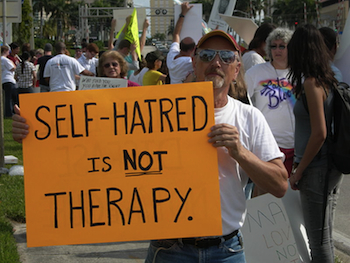
President Obama last week declared his support of a ban on gay conversion therapy for minors, a psychotherapeutic practice that attempts to change LGBTQ sexual orientations to heterosexuality using a variety of physical and psychological methods. The President’s statement (released by senior White House adviser Valerie Jarrett) was a response to a We the People petition seeking to ban the so-called therapies.

 Photo by Daniel Tobias via flickr / Wikimedia Commons

Photo by Daniel Tobias via flickr / Wikimedia Commons

As the April 10 article from LiveScience (reprinted below) points out, “Gay conversion therapy — which its supporters claim can change the orientation of gay, lesbian and transgender people — has a long track record of not working, according to a review of the scientific literature published by the American Psychological Association (APA).”

That Obama would take this stand and, “have science on his side,” as the article puts it, sounds positive. But that assumes one should need science to take a stand on what, at essence, is an inhumane practice. Why is science the only measure those in authority should be able to use with validity in this instance?

Along those lines, what does mental disorder look like, anyway, and why only consider the mental? Why the necessity for an ideal psychological arrangement? These questions and more came up in a Planet Waves staff email thread today; you’re invited to read the President’s statement and the article below and add your voice to the conversation.

Why Gay Conversion Therapy Is Harmful

by Tia Ghose, LiveScience Staff Writer   |   April 10, 2015 02:36pm ET

The Obama administration recently declared its support of a ban on minors receiving a controversial form of psychotherapy known as gay conversion therapy (also called LGBTQ conversion therapy). In supporting the ban, the president may have science on his side.

“The overwhelming scientific evidence demonstrates that conversion therapy, especially when it is practiced on young people, is neither medically nor ethically appropriate and can cause substantial harm,” Valerie Jarrett, a senior adviser to President Barack Obama, said in a statement.

Gay conversion therapy — which its supporters claim can change the orientation of gay, lesbian and transgender people — has a long track record of not working, according to a review of the scientific literature published by the American Psychological Association (APA).

What’s more, research suggests the treatment can worsen feelings of self-hatred and anxiety, because it encourages people to fight or hate a sexual orientation that can’t be changed. [5 Surprising Facts About Gay Conversion Therapy]

Ineffective treatment

The proposed national ban, known as Leelah’s Law, was named after a transgender teen, Leelah Alcorn, who committed suicide in December 2014 after receiving treatment from therapists she said were biased and hostile toward her identity. Currently, licensed therapists cannot provide conversion therapy to minors in California, New Jersey or the District of Columbia, but the practice remains legal elsewhere in the country.

But is there scientific evidence to support a national ban on the practice?

Because being gay is not considered a mental disorder, most psychological organizations don’t endorse treatments to change sexual orientation, which may be influenced by a person’s genes. Research suggests that gay conversion therapy does not produce long-lasting sexual-orientation change in people who undergo it. In 2009, an American Psychological Association task force conducted a review of studies on gay conversion therapy between 1963 and 2007. They found that sexual-orientation change was uncommon; participants continued to be attracted to members of their own sex and not to those of the opposite sex.

In addition, because the therapy isn’t approved by any psychological organizations, there are no guidelines on how to conduct it, and no standard metrics of success.

Historically, psychologists used tactics such as aversion therapy — a method reminiscent of the one used in “A Clockwork Orange.” In aversion therapy, gay people were exposed to a negative stimulus (such as being shocked, given nausea drugs or imagining such exposures) while viewing same-sex erotic material. A few studies found this could dampen sexual responsiveness to same-sex erotica but did nothing to change sexual orientation, according to “Homosexuality: Research Implications for Public Policy” (Sage Publications Inc., 1991).

Fueling self-hatred

Nowadays, many gay conversion therapies use talk therapy and tie same-sex attraction to familial dysfunction — an overbearing mother or an uninvolved father, for instance.

The senior media editor at the Huffington Post, Gabriel Arana, chronicled his experience with gay conversion therapy in a 2013 piece for The American Prospect. His gay conversion therapist pinned Arana’s same-sex attraction on the fact “that I felt inadequate because I had not had sufficient male affirmation in childhood.”

But according to the APA, scientists don’t agree on what causes someone to be gay. Some early studies hint that genetics or the regulation of certain genes may play a role in determining sexual orientation and, at the least, indicate that being gay is not a “choice,” science suggests.

The APA report also revealed some evidence that gay conversion therapies increased the risk of negative outcomes, including loss of sexual feeling, anxiety, depression and suicidal feelings. In early aversive-therapy techniques, many people dropped out of treatment, the report found. High dropout rates can be an indication that many people found the treatment too harmful to continue.

According to the APA review, people who underwent modern talk-based gay conversion therapy also reported being harmed by it.

For instance, Samuel Brinton, a nuclear scientist who works on energy policy in Washington, D.C., reported seeing ex-gay therapists for years during his teen years, when his religious parents found out about his orientation.

One of those therapists told Brinton he was the last gay man on Earth and that, because “all gay men had AIDS,” the 13-year-old Brinton did as well, he said in an interview with LGBTQ Nation.

The therapist also told him his chances of getting into heaven were “shrinking every day.” Doctors also put copper coils around his wrists and blasted them with heat whenever he was shown pictures of men holding hands, he reported. During the course of the treatment, Brinton attempted suicide several times, according to the news report.

Follow Tia Ghose on Twitterand Google+. Follow Live Science @livescience, Facebook & Google+. Originally published on Live Science.