Author Archives: Planet Waves

Memorial: Joan Quigley, Astrologer to the Reagans

Editor’s Note: As it’s the day after Election Day in the U.S., it seems a fitting time to run this tribute to the late Joan Quigley, who famously advised Nancy and Ronald Reagan during this presidency. — Amanda

By Amy Elliot

Joan Quigley, the astrologer who famously advised to former First Lady Nancy Reagan, died Oct. 21. She was 87 years old.

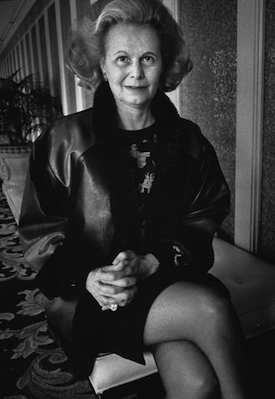
November 1988 photo of Joan Quigley by Tom Levy / SFC

Photo of Joan Quigley taken Nov. 15, 1988, by Tom Levy for the San Francisco Chronicle

A celebrity astrologer until her role at the White House was revealed in 1988 by White House Chief of Staff Donald Regan, Quigley’s story offered the public a rare glimpse into the real work of an actual astrologer.

More than that, as Eric noted in an email, “She is the most notorious astrologer of our lifetimes. Her name is actually known.”

Hired by Mrs. Reagan in March 1981 to protect her husband from any further assassination attempts, Quigley seems to have done precisely that, on the principles of electional astrology: using the President’s birth data, she helped to schedule meetings and travel for the most auspicious times.

In a very real way, she was hired to keep Pres. Reagan alive; had he not very nearly been assassinated, we would not know who Quigley was.

She likely was key in softening Reagan’s attitude toward Mikhail Gorbachev prior to the 1985 Geneva summit. As Eric noted in Planet Waves FM last week, even if her influence here was very slight, even if she postponed the horrors of nuclear war for five minutes, this act alone fully justified her position.

Quigley’s natal chart features a Uranus-Eris conjunction square the Nodes, all on the Aries Point; an indication that her career would probably be more influential than that of a simple socialite. She graduated from Vassar College with a degree in art history, and decided to study astrology while at college due to her mother’s interest in the art.

She became a regular guest on Merv Griffin’s talk show in the 1970s, and through this contact she was introduced to Nancy Reagan. On hearing that Quigley might have been able to prevent the attack on the President had she been studying the relevant charts, Mrs. Reagan hired the astrologer on a monthly retainer. This arrangement lasted until Donald Regan published his book. In the fallout from these revelations, and after apparently being implored by Mrs. Reagan not to disclose her White House ties to the press, Quigley was swiftly dropped.

People differ in their opinions of her influence on Reagan’s policies. Certainly, she was not the first astrologer known to the Reagans; they had previously consulted Jeane Dixon and Carroll Righter. Reagan’s 1967 inauguration as governor was documented to have been timed awkwardly at 12:10 am; some speculated that this was on an astrologer’s advice. The Moon of the resulting chart was almost precisely on the Ascendant, which under usual horary rules would indeed be auspicious for its subject.

The media responded to the news with ridicule, following the Western social trend of treating astrologers as charlatans. The Federation of American Scientists noted their own disdain, saying they were “gravely disturbed.” No matter how effective or harmless Joan’s work actually was, to take this line automatically seems to have been common sense.

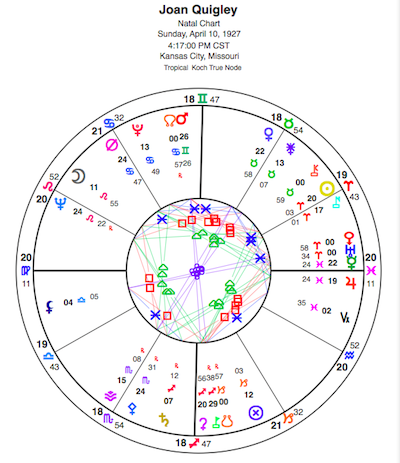
Joan Quigley's natal chart. View larger size here; view glyph key here.

Joan Quigley’s natal chart. View larger size here; view glyph key here.

Quigley’s natal chart certainly has the qualities of an astrologer in the making. With Virgo on the Ascendant and a Gemini MC, this is a Mercurial chart, and Mercury is positioned neatly on the Descendant, conjunct Jupiter.

With the added benefit of intuitive Pisces, this indicates a good listener and communicator, someone who can easily absorb the ideas of others, and address them in their own language.

A Pisces Descendant also carries the probability of idealism relating to other people, and might well capture symbolically the inspiration she felt in relation to Reagan’s horoscope, citing his “magical inner will.” The Leo Moon perhaps flavors this tendency somewhat by giving her a natural respect for leadership.

The sheer number of objects on the Aries Point — to the degree — including the Nodes, which are heralds of the soul path, is very suggestive of Quigley’s potential to act on the world stage. Pholus tightly conjunct the South Node implies that occurrences familiar and easy to Joan would be exponentially magnified in their effects; note that her employment by Mrs. Reagan, when discovered by the public, caused a furor that is somehow wholly out of step with her actual day-to-day role.

There is also an intriguing opposition between Venus-Juno in Taurus and Vesta-Pallas in Scorpio, which may shed some light on the fact that Miss Quigley (not Ms., according to her preference) never married, and could perhaps be said to have been devoted to her profession. Venus in the 9th house of higher purpose and philosophy is telling in itself, but the configuration as a whole is remarkable. It would seem there was a conscious decision not to marry; she devoted herself instead to her work — a choice for which all survivors of the Cold War may be in her debt.

“At the time, they were thinking of the Russians as gangsters. I told Nancy that Gorbachev was a different kind of leader, and that he would share a vision with Reagan.”
— Joan Quigley

Planet Waves Daily Oracle for Wednesday, Nov. 5, 2014

Today’s Oracle takes us to the Gemini weekly for July 30, 2004

275+web-new-oracle

You have approached the events of the past four months in a systematic way. Far from limiting your freedom, your methodical approach has allowed you to take initiative on several important matters in your life. Over the next few days, as Venus in your sign makes its final opposition to the Galactic Core, you’re obviously seeing the possibilities in a much different way than usual. At this point the vital ingredient is seeing them from the largest possible viewpoint, and not limiting yourself with details that you don’t know about for sure. Keep working systematically — from the general to the specific. You’ll be exactly who you’re becoming.

The Daily Oracle offers a horoscope selected randomly by our Intelligent Archive Oracle program, unique to Planet Waves. It’s also a database of my horoscopes going back to the late 1990s. You can use the Intelligent Archive Oracle to answer questions and give you ideas for how to handle problems and situations you cannot see through. This feature is available to our All Access and Core Community members. See this link for more information.

Planet Waves Daily Oracle for Tuesday, Nov. 4, 2014

Today’s Oracle takes us to the Sagittarius monthly for May 1, 2004

275+web-new-oracle

Relationships now come to the forefront of your life like never before. It may seem like you’re being confronted, challenged, or met directly full-on by a certain individual who may possess you with an intensity unusual even for you. What you may not see is the extent to which, though genuinely unique and independent, they are also reflecting your own light back to you. The message of this relationship is that you are not separate from your relationships. What your human encounters contain is made up of what you are. You may not recognize it when you see it in another form, such as someone outside yourself that you need, desire or by whom you are deeply fascinated. The act of surrender being asked of you now is to allow those who meet you their original voice, motives and choices.

The Daily Oracle offers a horoscope selected randomly by our Intelligent Archive Oracle program, unique to Planet Waves. It’s also a database of my horoscopes going back to the late 1990s. You can use the Intelligent Archive Oracle to answer questions and give you ideas for how to handle problems and situations you cannot see through. This feature is available to our All Access and Core Community members. See this link for more information.

Planet Waves Daily Oracle for Monday, Nov. 3, 2014

Today’s Oracle takes us to the Sagittarius monthly for June 1, 2006

275+web-new-oracle

Before you wear yourself out trying to hammer out an issue of right and wrong, you might want to let it work out for itself. At least make sure you allocate a fairly long time to find a solution, like a month, for instance. This will help you take the pressure off the situation, which is likely to assist because there’s already too much of that going around. No matter how much this matter seems to be pressing on a household situation or threatening your emotional comfort, the astrology says don’t push back. Rather, yield and follow the flow to the gentlest way through the territory.

The Daily Oracle offers a horoscope selected randomly by our Intelligent Archive Oracle program, unique to Planet Waves. It’s also a database of my horoscopes going back to the late 1990s. You can use the Intelligent Archive Oracle to answer questions and give you ideas for how to handle problems and situations you cannot see through. This feature is available to our All Access and Core Community members. See this link for more information.

Let’s Take a Walk

By Amanda Moreno

Something I’m truly passionate about is the ways in which astrology can be used to inform spirituality. In so many ways, astrology seems uniquely poised to be a transformational tool for the collective, particularly due to its unique ability to help individuals create a spirituality that resonates for their own experience within a more cosmic and collective framework.

350+Moreno_logo_rainier-60831Regardless of whether an increase in individualization within our culture is harmful, the fact of the matter is that it’s happening. Astrology provides a way to tap into meaning making within a context that is ‘true’ for every being (and non-being) at the same time. The stars are reflecting their light for us all.

One of my favorite ways to learn about my own chart and the way the archetypes constellate through me at all levels is to do a little practice I call “walking around my chart.” I use it when I need help with transits, or when I feel like I have a blind spot. Sometimes I just use it for fun — never a boring moment in my household!

For example, one summer day a few years back I decided to sit in front of my altar and visualize my chart to see what called to me. I ended up sitting right on my 5th house Sagittarian Neptune, which also happens to square both my Saturn in the 2nd house in Virgo and Venus in the 8th in Pisces. That Neptune has always been a blind spot for me (go figure), and so I was curious to see what would happen.

On a bit of a tangential note — I once participated in an Astrodrama session in which this particular T-square of mine was acted out by three individuals. I’ve participated in Astrodrama in several different ways, but the gist of it is that you have individuals act out a specific configuration, let the archetypal fields open up, and see what happens.

In this case, Neptune just kind of stood by dazed and laughing while Saturn lamented to Venus about the ways he was trying to keep it all grounded, practical and safe. Venus tried to pay attention and appease, but would then go off on some exuberant monologue, usually about an intense need for transcendent sex. I learned a lot about that opposition in that session, including an undying love for Venus in the 8th in Pisces, but Neptune has been more slowly revealed.

Back to the walk around my chart. As I sat there, I began to notice different areas of my body tensing up, and I decided to lean into some pain in my shoulder. Suddenly an image of my dad, who died when I was six, came to mind. He came across more clearly than I’d ever seen him before, and I suddenly saw my six-year-old self come running from the edge of my awareness, towards him, laughing and excited to see him as she jumped into his arms.

As the two of them hugged, I began to cry and became aware of two things. First, just how deeply I felt the loss of unconditional love when my father died. Second, that he has been here with me this whole time, and will continue to be, and that that unconditional fatherly love I’d been missing exists within me, whether I choose to see that as a psychological phenomenon or a spiritual one. And really, is there any difference?

Of course, interpretations can be taken in many directions, and as I reflected on the experience I realized new layers of that T-square, such as a greater understanding of the ways in which I idealize men (5th house Neptune, Venus in Pisces) and the depths of disillusionment the loss provoked.

I just wanted to share that fun (well, at least it can be) little exercise this week, and take a little break from the deeper introspection. Besides, I’ve also come to realize that T-squares have an outlet — the house and sign opposing the squared planet. In this instance, that’d be the 11th house and Gemini. So something about sharing the experience in words with my tribe makes a whole lot of sense.

Planet Waves Daily Oracle for Sunday, Nov. 2, 2014

Today’s Oracle takes us to the Taurus monthly for August 1, 2001

275+web-new-oracle

If you have not noticed yet, life will require some adjustments to make the most of the influx of energy, people, and opportunities that have suddenly transformed your world. The main adjustment is spatial. You need more space, and not just in your physical world, but also in your belief systems. Far too many of your notions are true only on the abstract level. But several will work extraordinarily well in the here-and-now physical world, and you need to find out which those are, and let the rest go. The cost of maintaining false beliefs will be the loss of such tremendous potential you cannot even imagine it, but the reward for believing what is true is a life that is finally rich with feeling and abundance — something you’ve worked and waited for over many years. One clue: your most valuable idea is likely to come from somebody else. Please don’t let that bother you. It’s high time you learned to accept nurturing and good ideas are a form of care and love.

The Daily Oracle offers a horoscope selected randomly by our Intelligent Archive Oracle program, unique to Planet Waves. It’s also a database of my horoscopes going back to the late 1990s. You can use the Intelligent Archive Oracle to answer questions and give you ideas for how to handle problems and situations you cannot see through. This feature is available to our All Access and Core Community members. See this link for more information.

Dias de los Muertos

By Jeanne Treadway

La Catrina is the reigning queen of Dias de los Muertos, the Mexican fiesta honoring the dead. Finely dressed in an upper-class Victorian style, an oversized, feathered and flowered hat perched primly on her skull, elegant but skeletal, La Catrina was popularized by Jose Guadalupe Posada in his political lampoons of the corrupt regime of Porfirio Díaz. Her role, then and now, is simple: She reminds us that rich or poor, famed or unknown, we all eventually become skeletons.
dd

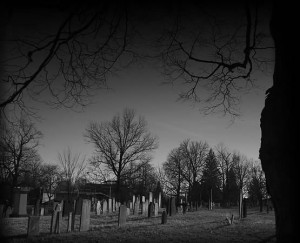
Dias de los Muertos is celebrated throughout Mexico and parts of the Southwest United States. Traditions vary but generally November 1, known in the Catholic world as All Saints Day, honors dead children and is frequently called Dia de los Angelitos (Day of the Little Angels). All Souls Day, November 2, honors all ancestors. Some communities use October 28 to pay tribute to those who died a violent death, while October 29 can be a day to honor the unbaptized, and October 30 often serves as a day of remembering lonely souls. All celebrations include building ornate altars, extended family gatherings, bountiful feasting, storytelling, and meticulous decoration of cemeteries.

HISTORY

Many cultures honor their dead with annual rituals and celebrations; often thousands of years old, these ceremonies frequently occur around the new year. On their Lunar New Year, Asians explode tons of fireworks, burn costly shrines created to honor ancestors, and parade dragons noisily through streets. Memorial Day in the United States is a somber occasion and leans toward the militaristic; rituals include draping red, white, and blue bunting everywhere, planting flags, and intoning long lists of those who died in service to the armed forces. Celts build enormous bonfires on their new year’s eve, October 31, known as Samhain, and commune with their dead while the veil between the worlds of the living and the dead is at its thinnest.

Early Christian history is often vexingly convoluted and that is the case here. The original All Saints Day appears to have been celebrated May 13, 609 (maybe 610) by Pope Boniface IV when he rededicated the Pantheon in Rome to Santa Maria and all martyrs. May 13 coincides with the final day of Lemuria, a Roman three-day ritual honoring ancestral spirits. All members of a community attended a feast on that date and ritually forgave each other’s past transgressions. Sometime during his reign (731-741), Pope Gregory III moved the date to November 1. It seems that the hierarchy of the early church had difficulty altering the pagan traditions of early Christians, because records show that both Pope Gregory IV (827-844) and Pope Gregory VII (1073-85) were forced to again mandate November 1 as feast day of All Saints.

Then, circa C.E. 1000, Saint Odilo, the abbot of Cluny, decreed that on November 2 all Cluniacs would offer special prayers for Christian souls expiating their sins in purgatory. The Benedictines and Carthusians followed suit and shortly thereafter the Catholic Church officially added November 2 to its all-star lineup of holy days.

Before the Spanish conquest of the American continents, the cultures of Meso-America, especially the Nahua (Toltec, Aztec, Tlaxcaltec, Chichimec, Tecpanec and others from the Valley of Mexico), remembered their dead in a month-long celebration that centered around the return of the Monarch butterfly, a symbol of the returning souls of the dead. The 3000-year-old festival specifically honored the dynamic duality of life; rather than an end, death was simply a continuation of life to the Meso-Americans. Mictecacihuatl, a goddess believed to have died at birth and known as the Lady of the Dead, presided over the ceremonies.

Catholic Spaniards rigorously attacked this frightful celebration with its skulls and skeletons, dancing and feasting, which in their European sensibilities was an unholy mockery of death. Using techniques learned from subalterning indigenous holy days for more than a millennium, the Catholics moved the fiesta from August to their November timeframe and whittled it down from a month to two days. They were never quite able to complete the transformation to a somber, religious ceremony spent in prayer, for Dias de los Muertos is a far cry from anything resembling serious Catholic mourning.

TRADITIONS

Dias de los Muertos has a complex history and because of this regional celebrations vary significantly. Some Mexicans begin this holy period on the evening of October 31. Others observe November 1 solely. Some communities extend the ritual for as long as a week. Key elements, though, appear in virtually all Mexican rituals: the ofrenda or altar, feasting, cempasuchiles (yellow marigolds), calaveras (skulls), incense (usually copal, a tree resin), pan de muerto (bread decorated with powdered sugar bones), and gravesite grooming.

Traditional Hispanic cementarios (cemeteries) and descansos (little crosses marking the site of someone’s death) are regularly tended. Family members visit gravesites on all significant anniversaries, including days of birth, death, and marriage, and adorn the headstone with flowers, repaint the ornate fence surrounding the plot, and commune with their dead by telling stories and praying. In Animal Dreams, Barbara Kingsolver richly paints a vision of one such carefully tended cemetery:

One of the graves, a great-uncle of J.T.’s named Vigilancio Domingos, was completely bordered with ancient-looking tequila bottles, buried nose down … It was a remarkable aesthetic — I don’t mean just Uncle Vigilancio, but the whole. Some graves had shrines with niches peopled by saints; some looked like botanical gardens of paper and silk; others had the initials of loved ones spelled out on the mound in white stones. The unifying principle was that the simplest thing was done with the greatest care. It was a comfort to see this attention lavished on the dead. In these families you would never stop being loved.

Dias de los Muertos is a time for thorough cleaning and decoration of all gravesites. Old and young, everyone in the family attends the dead on these days and the event is festive, often resembling a large community picnic. Much of one day is spent caring for those interred; those graves with no living family in attendance will receive as conscientious care as any other site during Dias de los Muertos. Again, Kingsolver gives a delicious glimpse of the atmosphere:

Little girls and boys played “make-up,” standing on tiptoe with their eyes closed and their arms at their sides, fingers splayed in anticipation, while a grownup used a marigold as a powder puff, patting cheeks and eyelids with golden pollen. Golden children ran wild over a field of dead great-grandmothers and great-grandfathers, and the bones must have wanted to rise up and knock together and rattle with joy.

Elaborate ofrendas are created in virtually every home preparatory for these feast days. Traditional altars are three-tiered and covered in white cloth. Creativity flits and tumbles in the embellishment of these shrines. Decorations may include toys for the children who have died, piñatas, balloons, tequila for the adults, cigarettes if the dead one smoked, enchiladas and tamales for everyone, living and dead. Certainly photographs of the beloved dead will grace the altar, as will candles. Besides the calacas (wooden skulls) and skeletons that bedeck the family’s ofrenda, pan de muerto and sugar skulls, with each family member’s name scripted across the forehead, lay ready to be consumed.

Cascades of purple, white, and pink papeles picados (tissue paper decorations) stream around the three tiers. These colors are specific because, for the Mexicans, purple embodies pain, sorrow, and suffering; white stands for hope and renewal; and pink represents life, happiness and celebration. Flowers in abundance, especially the cempasuchiles (yellow marigolds), greet the returning spirits and are often spread from the altar toward the cemetery. Marigolds are known as the flower with four-hundred lives and symbolize death to Meso-Americans. Copal incense (an aromatic resin regarded as holy) attracts the spirits of the dead and welcomes them to the festivities being held in their honor. The favorite music of the dead plays throughout the day, while family members dance and reminisce.

Dias de los Muertos is a communal and convivial celebration. To illustrate, in The Day of the Dead and Other Mortal Reflections, F. Gonzalez-Crussi retells a story of visiting the department of pathology at the General Hospital of Mexico City. He is working with the British Broadcasting Corporation (BBC) on a documentary that has become an exploration of death and the human rituals surrounding it. Film crew and pathologists cram into the hallways of the hospital while an elaborate ofrenda is created during Dias de los Muertos festivities. Poems are recited, ancestors are remembered, and stories are recounted.

Imagine the other half of the scene: Outside the hospital, fireworks explode; parades stream towards cemeteries; thousands of children dance with skeletons of every imaginable construction; adults wearing calacas (wooden skulls) cavort, teasing children and scaring dogs; extravagant picnics abound, moving from street to cementario; singing and storytelling combine in flamboyant and outlandish dramas. Only in Mexico would one find such juxtaposition of death and life.

ART

Toymaking and calaveras are thoroughly interwoven with this fiesta. Most of the images associated today with Dias de los Muertos were originally stylized by Juan Guadalupe Posada (1852-1913) in his satiric posters, etchings, and lithographs. Mexicans have traditionally called Lady Death by such names as La Flaca (skinny), La Pelona (baldy), or La Huesa (bony). Posada’s Calavera de la Catrina (fancy lady) drew on this tradition and has since become an ubiquitous icon. She was Posada’s pointed reminder to the wealthy — even you shall die, nevermind your mink stoles and ostrich-plumed hats. Now, grinning skeletons grace every conceivable material; even papeles picados sport Posada-like calaveras.

Posada’s political art was scathing and bold. He satirized the most powerful and violent people of his time. For example, one of his pieces, Calavera Huertista, portrays the brutal General Huerta. A catalogue to an exhibit at the Art Institute of Chicago in 1944 describes this piece: “Into it he poured all his hatred as a free man of the tyrant whom he portrayed as a repugnant tarantula with the tail of a scorpion, insatiably devouring other skulls.” Posada’s art appeared throughout Mexico, was easily accessible to all social strata, and was usually accompanied by rhymed verse that derided the politicians and Church of that era.

Oaxaca, a state in the southern peninsula of Mexico, is renowned for its toymaking. Whimsy reaches high art here and Oaxacan animal figures are recognized by collectors and museums throughout the Americas. A hedgehog may be covered with toothpicks to represent its spines, painted with ten colors, dotted with glitter, and wearing a wolf’s grin. Cats and dogs appear with extreme tails and ears, frogs with stilt-like legs, fish with each scale a variant of one or two pigments. Skeletons are an important addition to the Oaxacan Dias de los Muertos fiesta and portray every imaginable role: the Nativity, mariachis, priests, bullfighters, nurses, street sweepers, taxidrivers, favorite actors and musicians, political figures. Inexpensive calavera puppets are made of plywood and string and are adored by children.

Somehow it is simply hilarious to witness preposterous skeletons dancing through every phase of life. This laughter at the antics of death serves as the undercurrent for this varied and intricate fiesta called Dias de los Muertos.++

SOURCES

Gonzalez-Crussi, F., The Day of the Dead and Other Mortal Reflections, Harcourt Brace & Company, New York, 1993.

Kingsolver, Barbara, Animal Dreams, HarperPerennial, New York, 1991.

The Day of the Dead, Bobbi Salinas-Norman.
http://www.peoplesguide.com/1pages/chapts/viva/dodead/bobbi/dodbobi.html

Day of the Dead or El Dia de los Muertos – Oaxaca. – BY MARIA DIAZ in Mexico Connect — Mexico’s monthly ezine / magazine.
http://www.mexconnect.com/mex_/travel/mdiaz/mdmuertos.html

The Dead Come to Life in Mexican Folk Art, Mary Jane Gagnier Mendoza.
http://www.mexconnect.com/mex_/travel/mjmendoza/mjmdiadelasmuertos.html

Indigenous People Wouldn’t Let ‘Day of the Dead’ Die, Carlos Miller, The Arizona Republic, ezine.
http://www.azcentral.com/ent/dead/history/

LOS DIAS DE LOS MUERTOS (The Days of the Dead), Judy King, ON MEXICO
CONNECT, the premium Ezine and Web Site.
http://www.mexconnect.com/mex_/travel/jking/jkdayofthedead.html

Posada; Printmaker to the Mexican People, catalogue for An Exhibition
Lent By the Direccion General de Educacion Estetica, Mexico to the Art
Institute of Chicago, 1944.
http://xerxesbooks.com/cats/mexi871.mv