Author Archives: Planet Waves

Archive Pick: A woman, risen from the sea

Editor’s Note: In this excellent lead essay from the May 14, 2010, members’ issue, Eric offers a list things you can do if you want to facilitate the process of self-actualization. At the time that he wrote this, he was looking ahead to a Jupiter-Uranus conjunction; now, the Uranus-Eris conjunction of June 2016 is pushing (or glossing over) another layer of identity awareness. — Amanda P.

Dear Friend and Reader:

The other day I got curious about the term ‘self-actualization’, which I hadn’t heard for years. The first time I encountered it as a kid (in the ’70s, when people seemed to talk about this stuff more than we do today) I intuitively knew what it meant. To me, it was about the process of becoming real, that is, of becoming fully human.
Planet Waves
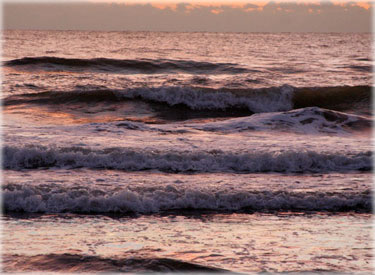
Mediterranean Sea, from a series called Daybreak in the Path of Annularity, in Valencia, Spain, 2005. Photo by Eric Francis.

When I looked it up, I learned the term was invented by Kurt Goldstein (1878-1965), a German neurologist and psychiatrist. Kurt was one of the first theorists in the Gestalt Therapy movement, and one of the original modern holistic thinkers. His clinical work involved studying the relationship between the mind and the brain, in brain trauma patients; Gestalt puts emphasis on the mind-body connection. Holistic theories emphasize unity and integration as expressed through our natural human tendency to grow and mature.

It was Abraham Maslow (1908-1970) who put the concept into popular language. It was at the top of his famous ‘hierarchy of needs’, that pyramid published in a 1943 paper that you had to memorize in psych class. It starts with basic biological needs beginning with touch, food, breathing and sex as the foundation of existence. It extends upward toward safety, love, belonging, self-esteem and finally, at the top, we have self-actualization. This includes creativity, spontaneity, problem solving, acceptance of facts, and morality.

I will take an editor’s liberty and update that last one to ‘ethics’, since this applies a more flexible approach to difficult questions. I will add mortality, since that’s a key element in consciousness of one’s full humanity. And I would check one other thing: these days it takes a good bit of creativity and problem solving (an advanced need, in his theory) to meet the fundamental needs at the bottom level. We can at least thank Maslow for getting the term self-actualization into our hands, and for reminding us that psychology starts with biology.

He had one other idea that I like: if you want to understand how healthy people function, study them, and not pathological cases. So that is what he did.
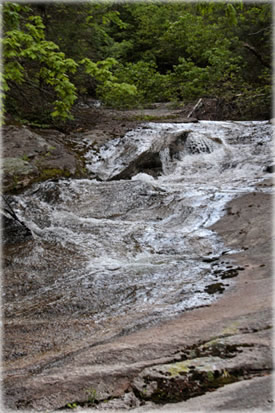
Planet Waves
Water paints the rock on the Grandmother Land in Ulster County, New York, hours before the Taurus New Moon. Photo by Eric Francis.

Maslow also emphasized the innate curiosity in humans (which is true for nearly every other animal, by the way). He honored self-actualization as a drive or motivation that he believed fuelled all our other endeavors. For him, it was the prime mover — this, not survival. Maslow’s concept was about embracing human potential, and he was one of the fathers of a movement by that name.

Which brings me to the extraordinary astrology of June 2010: the Jupiter-Uranus conjunction in Aries. If any aspect says self-actualization, this is the one. The ‘self’ piece is Aries, the sign of ‘I am’, the key that turns the ignition of consciousness. We each have Aries in our chart somewhere, and where we have it is one zone where we tend to be driven by self-actualization: to waking up and being real.

Jupiter is a planet that is rich with potential. It’s like this cosmic bank account we have, from which we can draw down wisdom and envision wider possibilities. Where Jupiter is we seek expansion and learning; we seek to enrich our minds. And as I write, Jupiter is heading for Aries, where it will arrive on June 6. Jupiter comes back to Aries every 12 years. The energy feels like the Chinese Year of the Dragon: vibrant and daring.

Uranus is a planet that likes to precipitate potential; its job is to actualize. If spontaneity and curiosity are part of being self-actualized, then Uranus is the spark plug. It doesn’t really care what it takes or what has to happen to make something real. Uranus follows no special rules, which is why it’s involved in changing the known order of reality. That includes leaps forward in creativity, thought and imagination; with inventions; and with revolutions of various kinds. Uranus, which has an 84-year orbit, arrives in Aries on May 27, resetting its cosmic cycle.

On June 8, the two form an exact conjunction on something called the Aries Point. This is the first degree of the Western zodiac, which begins with the sign Aries. It’s the position of the Sun on the first day of [Northern Hemisphere] spring, and it’s also called the vernal point. It acts just like a focus of energy that links up what we think of as the ‘personal’ realm and the ‘collective’ realm. When we experience events that are on the Aries Point (such as this conjunction) or square or opposite the Aries Point, the world seems to go wild, and we can get drawn into the drama. Big events, which often seem negative, can involve this point — for example, the Sept. 11 incident or the Asian tsunami; or Woodstock, or the Moon landing. It is one of the most predictable things in a chart, in terms of this kind of response in physical reality. In a word, it is big.

Planet Waves
Photo by Eric Francis.

In recent years we’ve had a lot of Aries Point activity, and we’re about to have more. Recent events include Pluto ingressing Capricorn (square the Aries Point) and Saturn in the process of changing signs to Libra (opposite the Aries Point). This has already stirred up a lot of energy: lately (however you define lately) it’s been one jarring event after the next trying to get our attention. And now the Aries Point activity shows up directly in Aries, as these two mighty factors align directly in the first degree of the zodiac. While that first degree has the ‘political as personal’ feeling, that nexus of individual and collective life, it’s also about personal awakening.

There’s a method of astrology that gives a visual symbol to each of the 360 degrees of the zodiac. These are called the Sabian symbols, and if you’re new to astrology I invite you to check out this gift. My favorite version is in an easily available book called An Astrological Madala by Dane Rudhyar. The degrees were channeled randomly by a clairvoyant working with an astrologer, such that the symbol for each degree was channeled without the clairvoyant knowing which degree she was channeling, and in random order. The first degree of the zodiac came out with the symbol: A woman just risen from the sea. A seal is embracing her.

This image evokes the birth of Venus, and the emergence of humanity from the sea of life, or the sea, literally. It implies individual awareness distinguishing itself from the unconscious, or the mind’s awareness emerging from the emotions. The implication is that the sentient environment that surrounds us (such as a seal) is waiting for us when we arrive on the planet.
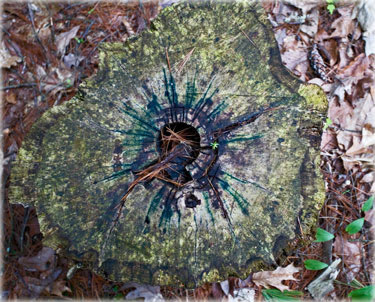
Planet Waves
Photo by Eric Francis.

More than this symbol is behind the obvious power of the Aries Point, though I think it’s a great illustration of its potential — and that potential is what the Jupiter-Uranus conjunction is helping us make real, right now. It’s doing so in the midst of a world that once again seems to be spinning off its axis. In a Mercury retrograde that spans between early April and late May (including all the prep and follow-up phases of process), we got a glimpse into how fragile the world is, and how closely connected its levels of reality are.

In those few weeks (counting only up until publication time) we experienced a volcano that disrupted air traffic across Scandinavia and Europe, which effect rippled out across the planet, rearranging lives and stranding people in remote parts of the world; an undersea oil volcano (still out of control, with no end in sight, compounded by hundreds of thousands of gallons of grease-dissolving solvent being dumped into the Gulf of Mexico), a bitterly fought election in the UK, massive flooding in Tennessee and other states, tornadoes in Oklahoma, banking fraud by Goldman Sachs exposed (which demonstrated that they helped orchestrate the recession, for profit), a debt crisis flooding across Europe with a trillion euro bailout committed to during the retrograde!, a 1,000-point dive in the stock market that nobody can figure out, and an attempted terrorist attack in New York City. After spending nearly a trillion dollars on wars in Afghanistan and Iraq, the new al Qaeda we’re supposed to worry about turns out to be our old friend Pakistan.

These events all have that Aries Point feeling — and we haven’t even reached the conjunction yet. Which brings me back to self-actualization. These are all wake-up calls. They are the public version: we are getting plenty of them in our personal lives as well, and I’m here to tell you there are many connections, all of which are guiding us to take a unified view of existence. And by some accounts this is starting to happen; though there are many signs of slumber, there are many other signs of awakening.
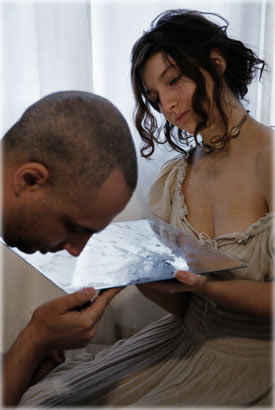
Planet Waves
Fae and Eric. Photo by Dani.

I have a few ideas for what we can actually do, if we want to facilitate the process of self-actualization.

1. Know thyself. Part of getting to know yourself may involve admitting you don’t know yourself. I suggest you open up, allow or invite your curiosity about your true work, your authentic sexual and relational orientation, and other information about what you think you’re doing on the planet at this time. If you haven’t already figured out that this is an extraordinary and unusual time to be alive, keep getting to know thyself. This includes knowing what you want.

2. Relationship starts with self. Our relationship to our self , which is existence, is what we see animated and expressed in our relationships with others. Therefore, cultivate a deeper relationship with your self. You can discover, through this, how many different levels you exist on. Dreams are a meaningful, helpful and easy way to tap into what is sometimes called the unconscious. They always have a message for us, and usually that message presents a solution to a challenge, or a window into who we really are.

3. Relationship is the foundation of community. Part of what is holding humanity back at this time is a need to rethink our fundamental bonds with others, which are the basic patterns of existence that ripple out into the world. Most literate people know that there are a great diversity of ways to explore relationships — but we tend to limit ourselves to a very few. Exploring outside orthodox modes of relationship helps us weave community and have a more complex sense of who we are, and what we mean to others and what they mean to us. Get to know your neighbors, including the critters and the businesses that are near your home. If you love someone, give yourself permission to love them, no matter what the ‘rules’ say you should do. Learn how not to be a slave to guilt, but rather one who lives in service of love.

4. Know what you eat. A revolution is underway on the meaning of food. As we reach the end of the petroleum supply, all of our concepts of food and the production of food will need to be rearranged, and even as we’re blitzed by hamburger ads, we’re well into this process. Most of what is called food is neither nourishing nor sustainable, and it’s nearly all made from or with petroleum. The first step in the process of change is getting to know exactly what you’re eating, whatever it happens to be at the time — including knowing who produces it.

5. Know your body’s special needs, including nutritional needs. Every specimen of humanity is different, and you need to know the ways in which you’re different. This includes discerning food sensitivities, knowing the way you’re influenced by your environment, and how your physical nature influences your psychology.

6. Know your technology. We live in a haze of technology but we are largely ignorant of how it works, what we can really do with it, and its effect on our minds and bodies. For the most part we don’t understand the power we hold in our hands. Make sure that you are in the creative role; that you are creating your technology rather than letting it create you.

7. Be yourself. We humans tend to spend a lot of energy trying to convince people of what we are, which gets in the way of being who we are. Save your time, money and soul and simply be yourself, tell the truth and notice the results that you get, in the long run as well as the short.

8. Life is a camping trip. We are visitors on this planet, and though it’s our temporary home, we live at the mercy of the environment. Remember that in a sense you are always outside, always in relationship to your surroundings.

9. Choose what you want. You know what you want — and remember that the power to decide is one of our few true freedoms. To do this you will likely have to understand the nature of guilt, which sends you the opposite signal. Guilt and desire are mutually exclusive.

10. Your actions have consequences, and our actions as humanity have consequences. We have lived for a long time thinking that they do not. Karma is really as simple as being aware of your participation in the experience of cause and effect.

11. Keep your vibration high. World events, by accident or design, are having the effect of lowering the vibration of many people, even if they’re not addicted to negativity. It may be challenging to both maintain awareness of world events and keep a positive focus despite them, but welcome to the greatest challenge of our moment. As big as any problem seems, global or individual, our potential is infinitely higher, and the way we get there is by feeling good, aware and embracing of our true desire.

Yours & truly,
Eric Francis

Planet Waves Daily Oracle for Sunday, May 15, 2016

spring-reading-2016banner

The Spring Reading is now published. Order all 12 signs here or choose your individual signs here for immediate access. You may listen to a free audio introduction here.


Today’s Oracle takes us to the Capricorn weekly for Aug. 9, 2004.

oracle-main

So what that you are traditional to the core? Join the great tradition known as brilliant innovation, or better yet, lead the revolution. If you can define the problem, I assure you that your creative problem solving ability, your skill as an inventor and your verbal talents will all reveal themselves to know no borders, limits or handicaps. One of these days, anyway, you will face up to your talents, and I am counting on it being yesterday because, honey, I believe in Capricorn; I believe, all the way.

The Daily Oracle offers a horoscope selected randomly by our Intelligent Archive Oracle program, unique to Planet Waves. It’s also a database of my horoscopes going back to the late 1990s. You can use the Intelligent Archive Oracle to answer questions and give you ideas for how to handle problems and situations you cannot see through. This feature is available to our Galaxy, Backstage and Core Community members. See this link for more information.

Planet Waves Daily Oracle for Saturday, May 14, 2016

spring-reading-2016banner

The Spring Reading is now published. Order all 12 signs here or choose your individual signs here for immediate access. You may listen to a free audio introduction here.


Today’s Oracle takes us to the Virgo monthly for May 2005.

oracle-main

Extraordinarily supportive stabilizing aspects this month will help balance out equally shocking ones. There will be no predicting certain people and certain situations but you have finally developed a degree of stability and peace of mind that will see you through just about anything. And to say the least you’re in for some surprises: most of them on the human level with most of these involving people and their feelings for you. You do have your options open and there is nothing at all that says you need to make a final decision. There is no such thing anyway.

The Daily Oracle offers a horoscope selected randomly by our Intelligent Archive Oracle program, unique to Planet Waves. It’s also a database of my horoscopes going back to the late 1990s. You can use the Intelligent Archive Oracle to answer questions and give you ideas for how to handle problems and situations you cannot see through. This feature is available to our Galaxy, Backstage and Core Community members. See this link for more information.

Archive Pick: It’s True — Mike Brown (Hearts) Astrologers

Editor’s Note: I was looking for an article by Eric featuring Sedna, since the Sun makes its annual conjunction to that complex minor planet on Sunday, when I found this delightful trio of essays/letters by Eric and astronomer Mike Brown. Brown is part of the Caltech team that recently determined the existence of Planet Nine. The pieces below first published in the Feb. 1, 2008 members’ edition. — Amanda P.

Dear Friend and Reader:

MIKE BROWN is one of the great astronomers of our day. I say this because he and his team have made some of the most significant discoveries in recent astronomical history — in particular, Eris and Sedna. Yet what is more, he has a gift for giving planets names that are bold, original and astutely call attention to crucial world issues. Read those links on Eris and Sedna and you’ll see what I mean.

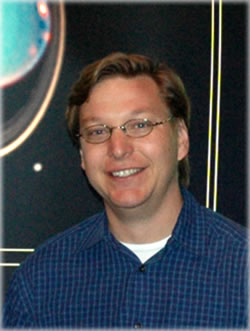
Photo: Mike Brown poses with Uranus, the first planet discovered by science. Photo courtesy of Wikipedia.

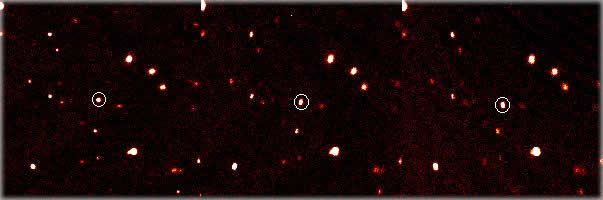
His team’s 2005 discovery of Eris turned the world of planetary astronomy upside down the next year, when the International Astronomical Union (the IAU, the scientists who officially control names and categories of planets) defined the word “planet” for the first time. This was the meeting in Prague that we made such a fuss about (here is a link to one article, and another to refresh your memory, and here is the Wall Street Journal’s coverage featuring yours truly).

In Small World Stories, I joked that Kirsti Melto (a minor planet astrologer you read regularly on these pages) and I feel that Mike is an astrologer but doesn’t know it yet. I say this because he is connected to the archetypal world through his work as a scientist, and that work involves planets and mythological figures. He is in tune with the times — the first job of an astrologer.

I knew he loved astrologers. As we noted in the dedication to The Spiral Door, he looked at his watch the moment he discovered Eris, because he knew astrologers would ask the time.

He even told this to The New York Times! It is difficult to overstate what a bold thing that is to say. At the very least, it reveals he’s a maverick with a great sense of humor. At best, he reveals himself as someone who, in Gemini fashion, is open to both sides of the story and thus has an actual interest in the truth.

Then last weekend, he came out with the article you’re about to read below. It is extraordinary because, unlike most of his colleagues, he does not immediately assume that astrologers are all a bunch of scammers. This is an unfortunate prejudice that I’ve encountered too often, but then astrology does its part to earn this reputation — a topic for another article.

Mike has an interesting concept of how astrology works. He describes it as a kind of story that we follow, which he regards as a form of fiction. This s precisely how I describe it in the Planet Waves terms of service — personally applicable mythical fiction. He prefaces his comments by saying he does not accept that the planets have “control” over our lives. In this sense, he’s in accord with the majority of honest Western astrologers, whose work emphasizes choice and not fate.

He sees the common ground we share. He has an open mind, and is open to a dialog. This is rare, and if you believe in history, it is historic. Here’s his essay, with my reply published below. May his words not only ring through the centuries, but also open a door to a discussion that we, as in astrologers and astronomers, need to have right now.

It's True -- Mike Brown Loves Astrologers

Three pictures that shook the solar system. Discovery images of the dwarf planet Eris, which led astronomers to reorganize their concept of the solar system in the summer of 2006. The three images were taken 1-1/2 hours apart on the night of Oct. 21, 2003. Eris can be seen very slowly moving across the sky over the course of three hours. Photos by Mike Brown.


I (Heart) Astrologers


By MIKE BROWN
Professor of Planetary Astronomy
Caltech University

PLEASE DON’T tell any of my fellow astronomers, but I love astrologers. Really I do.

Don’t get me wrong. I have absolutely no belief whatsoever in the proposition that the positions of planets or stars or moons or anything else that is moving across the sky has or ever has had any sort of control over your life, your actions, or your choices. Zero. Really.

So if I don’t believe in what I must assume would have to be considered a central precept of astrology, how can I possibly claim to love the practitioners? Let me count the ways.

Astrologers care about the sky and the positions of the stars and the moon. I care about the sky and the positions of the stars and the moon. Astrologers try to understand patterns in the orbits and motions of the planets and determine their meaning. I try to understand patterns in the orbits and motions of the planets and determine their meaning. In a broad sense, we do many of the same things; it’s just that our methods are different.

Astrology and astronomy are brothers with roots deeper than just the first five letters. Until perhaps the Enlightenment they were inseparable. Copernicus, who made one of the greatest conceptual leaps in human history, pulling the earth out of the center of the universe and replacing it with the sun, was a dedicated astrologer, calculating astrological charts with as much fervor as trying to understand the paths of the planets. It’s not hard to understand why he would feel that some connection should be there. I don’ t think anyone can watch the rhythms and pulses of the movements of the planets and sun and moon and not somehow get a gut feeling that there is somehow meaning in all of that beauty, precision, and symmetry.

But from their common upbringing, the brothers split in adulthood. They each retained their common interest in the sky, but with thoroughly different ways of looking at it. Astronomy moved to the purely objective realm of descriptive and predictive reality. It moved to science. And a wondrous science it is. I can go outside tonight and look up to see the bright glowing star Betelgeuse, the red orb in the upper corner of constellation Orion, and then I can tell you a pretty good version of the entire story of its birth in a cloud of gas and dust, its long existence as a smaller and cooler star with hydrogen atoms fusing together in the deep interior, and its recent expansion to form ball of gas the size of the orbit of Mars. That we have been able to determine this story at all, simply from looking at the feeble light from these little points in the sky, is as improbable as it is incredible. When I see Betelgeuse at night and stop to think these thoughts I am left in awe.

It's True -- Mike Brown Loves Astrologers

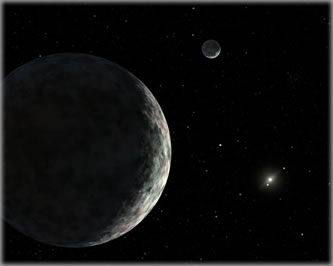
Artists concept of the view from Eris with Dysnomia in the background, looking back towards the distant Sun. Credit: Robert Hurt (IPAC).

So what can astrology offer that can even come close to matching? It can’t tell me anything, I don’t think, about my history or my future or my personality or my pitfalls. Or about anyone else’s. Isn’t it therefore worthless, or even potentially dangerous? I don’t think so. Astrology is the brother who kept the fascination with the sky but rather than growing an interest in science kept its interest in humanity. Scientific astronomy, for all of its awe-inspiring, mind expanding, and just simply amazing discoveries, leaves people and their consciousness out of the picture. Astronomy involves people looking up at the heavens, but the heavens are never looking back. Astrology, in contrast, never removed that connection between the sky and the people.

But but but, you protest, there is no connection between the sky and the people. The heavens do not, in fact, look back. And, while you are scientifically correct, you are culturally incorrect. You are thinking literally, but you need to think literarily. Good astrology can be like good literature. Good literature builds a world that is not the real world but teaches us more about ourselves than we would ever learn by simply staring in the mirror. No real King Lear ever had a trio of daughters to split his kingdom amongst, nor wandered insane on the heath, but do we disdain Shakespeare for writing about it? No, we read, and we think about children and parents, we think about truth and loyalty, and scheming, and we learn more about ourselves and our world. We’re left enriched by stories that are not true.

Again, I have to plead: don’t get me wrong. I’m certainly not saying that all astrology is equivalent to Shakespeare, but neither is all of the rest of the fiction writing out there. The in-flight magazine that I currently have in front of me has both a short story and an astrology page. I would rate them equal quality examples of their genres.

Here’s a snippet of my in-flight horoscope (I’m a Gemini, perhaps explaining my ability to accept the dual nature of astronomy/astrology) for the month of January:

As your attention is consumed by an array of projects, you may spread yourself too thin. Remember to stop and take a breath, if for no other reason than to garner some perspective.

OK. I don’t need an astrologer to tell me that, but it’s hard not to read it and, why, yes, stop and take a breath and garner a little perspective. It’s not such a bad idea.

A quick perusal of the short story, a few pages earlier, gives a remarkably similar take home message, spread out, instead, over about three pages. After reading both of these I am now convinced: I think I will stop and garner some perspective, at least if I can finish a few of these other projects first.

So where are the Shakespeares of astrology? I will admit to not knowing if they exist at all. My astrological reading is only passive; occasionally someone will send me something and in a spare moment I will pick it up and I just might find it a bit intriguing. Here, for example, are some thoughts about Eris by Henry Seltzer, writing in The Mountain Astrologer:

The astrology of Eris seems to be related to the no-holds-barred fight for continued existence that is fundamental in all natural processes, and to taking a stand for what one believes, even if violence is involved. As the sister of Mars, the God of War, Eris willingly sought the battle. There is a side of nature that is quite harsh, a struggle for survival; this struggle is an essential part of the human condition as well, for we are still half animal. Nature can be viewed in a rosy light, as it was in the hippie era of the Sixties, Bambi innocently drinking from a little stream. But underlying this beauty is the possibility of sudden death at any moment, since all of nature’s children need to eat. Eris is related to this principle of violence as a natural component of existence and to the concept of the female warrior that embodies it, especially the feminist struggle for rights in a patriarchal society.

As a general discussion of the national psyche circa late 2007 this passage is not at all bad. It covers the war in Iraq, global warming, and the Hillary Clinton candidacy all in the discussion of one name. It certainly does not require literal belief that the naming of an object in the sky is the actual cause of any of the things discussed.

But what is the point of astrology if you chose to read it figuratively rather than literally? Again, you could ask the same question of King Lear. You could ask the same question of the Bible. And you wouldn’t. To ask it is to miss the point entirely.

Here’s a question you should ask though: why tolerate the existence of astrology, with the danger that people might actually take it literally, with the danger that it might confuse and distort science, with the fear that real cause and effect will become confused, when real literature abounds? Why read pithy but relatively generic snippets of advice and pretend they are somehow connected to a particular constellation along the zodiac? Why read more extended essays purporting to be an in-depth analysis of how a recently discovered ball of rock and ice far from the earth affects all of humanity? The answer? There is no reason. I personally prefer my literature to be of higher quality, to make me think and feel more. Feel free to follow my lead. But if you do chose to read it, read it for the reason that I can’t help but love it. Astrology is not just figurative literature about humanity. Astrology cares about the sky. The astrologers who occasionally correspond with me love to hear about new solar system discoveries, figure out orbital relationships and patterns, and speculate about what else might be out there and how everything fits together. I do all of these things, too. I then take these thoughts and move on to think literally about their scientific implications. The astrologers take these thoughts and move on to think figuratively about what these mean for humans. But we, astronomers and astrologers, start in the same spot, with an intense interest in the sky. To me, that matters.

Astronomy and astrology are brothers. Brothers don’t always do the same things or make the same choices. But when they maintain their initial ties to where they came from, their connection cannot help but stay strong. What is not to love?

My Reply to Mike Brown

Sunday morning Jan. 27, Mike wrote to me and asked if I liked his essay. I initially wrote a response in 10 minutes before an early-morning photo session. Here is my refined response, which I have edited a bit for detail, clarity and point of view.

Mir or rather Mr. Mike Brown!

Kirsti Melto sent your essay to me last night, as excited as a little kid. First of all, I am moved that you took up the subject. You admit astrology exists and that you have heard of it, etc. :-))

I love your essay — for many reasons, including the fact that (like Phaedrus, in the Dialogs of Socrates) you get the discussion going.

It's True -- Mike Brown Loves Astrologers

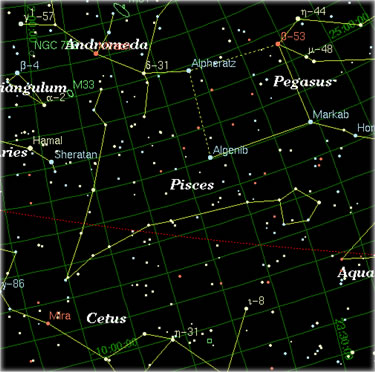
Constellation Pisces image created with XEphem Software.

Is it not ridiculous that science does not at least credit astrologers with providing continuity, and with beginning the search in the days LOOONGGG before the existence of science? Science was born of the Enlightenment, just a few hundred years ago. Astrology is thousands of years old. Many names used by science were bestowed in ancient days by astrology. Let’s be friends!

I had planned a reply, at least in concept. Here is a sketch.

Both astronomy and astrology are intellectual maps of consciousness. It matters not that most astrologers skip the telescope and the science of it (minor planet astrologers though tend to know as much about the science as many astronomers, I have noticed).

The GESTALT of it all is that we are both responding to the times in which we are alive. We agree on one thing in exactly the same language: that to astrologers, the planets and their symbols (whether the name or the orbital elements) METAPHORS. They are not usually viewed as a “cause” — certainly not with something like Quaoar. In our official definition of astrology, Planet Waves describes it as a kind of personally applicable mythical fiction.

What we have in common is the search for truth and meaning — and the sky.

Vis a vis the quality of astrological literature — that depends entirely on the writer, Mike. I regret that there are not too many good astrology writers, which tends to inform the world that we are all typing rather than typing, to borrow from Truman Capote. The astrology you get is as good as the astrologer you get. It is not easy to convey the complexity of an astrological chart into clear writing. It takes dedication. Because many so-called astrologers are bottom trawlers feeding on human misery, not the quest for knowledge, it’s not really necessary to go too deep into the ideas in order to get the attention necessary to maintain a business.

The search for meaning extends through recorded history. The sky — the greatest mystery we can actually look at and see with our eyes — is going to be the first place most people with any sensitivity begin that search. And there, astrologers and astronomers are not brothers, but twins. Or, as one of your readers posted to your website, “Instead of looking at the two as brothers, I prefer to see astrology as the very old mother that gave birth to scientific astronomy only two or three hundred years ago.”

For my part, I wish that astrology would pay more attention to what you and your colleagues are doing (it’s still lagging terribly), and fall in love with the science and history of these planets. I for one am deeply moved to be alive, and to be an astrologer, in this incredible time of discovery.

The dance along the artery
The circulation of the lymph
Are figured in the drift of stars
Ascend to summer in the tree
We move above the moving tree
In light upon the figured leaf
And hear upon the sodden floor
Below, the boarhound and the boar
Pursue their pattern as before
But reconciled among the stars.

— T. S. Eliot
Burnt Norton from Four Quartets

Yours & truly
Eric Francis

P.S. I was up in Woodstock the other night talking to some guys, herbalists and scholar types, young and fiery, and one of them said — this whole thing of looking at the stars so carefully was started for navigational purposes, by mariners. Woooosh! I felt like I understood all at once, and I can’t believe I forgot that bit of history/lore! It was a practical thing. They had to get from place to place, and the stars were there, and they noticed the planets drifting among them like actors on the cosmic stage.

Then, with time on their hands and because everyone loves a good story, they started seeing dramas in the stars, and the myths of the zodiac were born…as facets of human consciousness, within the pool of psychic and intellectual creation. This is one of the gifts we inherit from antiquity.

Science came a long thousands of years later and “made sense” of what they were seeing, deconstructing it in the process. To our discussion, science brings the rational meaning, the facts, and theories; and astrology brings, or starts the discussion off, with the philosophy, the story, the process of getting from one place to another, in our ships or in our minds.

Democracy Now! — Friday, May 13, 2016

spring-reading-2016banner

The Spring Reading is now published. Order all 12 signs here or choose your individual signs here for immediate access. You may listen to a free audio introduction here.

demnow160513

Dilma Rousseff, defiant in the face of her suspension. image: video still

Brazil’s vice president, Michel Temer, has assumed power after Dilma Rousseff was suspended pending impeachment proceedings. He is a member of the opposition party. Despite the suspension being over corruption charges, Temer himself was ordered to pay a fine last week after it was found he’d exceeded campaign funds. Rousseff said there was “no justification for an impeachment” and called the move a coup.

There has been renewed violence around Aleppo, Syria, where around 300 people were killed over the last two weeks. Another hospital has been bombed. Syrian scholar Yasser Munif spoke to Amy Goodman.

We are honored to offer this broadcast as part of our affiliation with the Pacifica Network. Find out where the Democracy Now! crew is visiting next during the show’s 100-city tour, celebrating 20 years on the air.

Danielle Voirin’s Photo of the Day for 05.13.16

A relationship carved in stone at the Louvre.

A relationship carved in stone at the Louvre.

Paris-based photographer Danielle Voirin travels the world and documents her experiences in photographs. She takes street photography and photojournalism a shade beyond even art, to the level of mysticism. You may see more of her work on her website DanielleVoirin.com, or her alt website, DaniVoirin.com.

spring-reading-2016banner

The Spring Reading is now published. Order all 12 signs here or choose your individual signs here for immediate access. You may listen to a free audio introduction here.

Planet Waves Daily Oracle for Friday, May 13, 2016

spring-reading-2016banner

The Spring Reading is now published. Order all 12 signs here or choose your individual signs here for immediate access. You may listen to a free audio introduction here.


Today’s Oracle takes us to the Virgo weekly for May 20, 2005.

oracle-main

You have ambitions, you have goals, you have desires and you have a calling. You also have your insecurities just like everyone. But those insecurities are just one or two voices on an inner committee that constitutes your mind. So the question is how do you make sure you take the other voices into account? The answer is you listen and you trust. And to borrow from A Course in Miracles, at a certain point you will learn to doubt your doubt in yourself. You might want to take that up as a project right now because you’re well positioned to get exactly what you want.

The Daily Oracle offers a horoscope selected randomly by our Intelligent Archive Oracle program, unique to Planet Waves. It’s also a database of my horoscopes going back to the late 1990s. You can use the Intelligent Archive Oracle to answer questions and give you ideas for how to handle problems and situations you cannot see through. This feature is available to our Galaxy, Backstage and Core Community members. See this link for more information.

Danielle Voirin’s Photo of the Day for 05.12.16

Three useful fingers, beckoning at the Louvre.

Three useful fingers, beckoning at the Louvre.

Paris-based photographer Danielle Voirin travels the world and documents her experiences in photographs. She takes street photography and photojournalism a shade beyond even art, to the level of mysticism. You may see more of her work on her website DanielleVoirin.com, or her alt website, DaniVoirin.com.

spring-reading-2016banner

The Spring Reading is now published. Order all 12 signs here or choose your individual signs here for immediate access. You may listen to a free audio introduction here.