Category Archives: Columnist

Danielle Voirin’s Photo of the Day for 05.18.15

Boys playing on a 150 year-old Ficus macrophyla tree in the Giardino Garibaldi, Palermo, Sicily.  This extraordinary tree drops long, thin tangled roots down from its branches that, when reaching the ground, replant themselves, creating multiple trunks that support its expansion.

Boys playing on a 150 year-old Ficus macrophyla tree in the Giardino Garibaldi, Palermo, Sicily. This extraordinary tree drops long, thin tangled roots down from its branches that, when reaching the ground, replant themselves, creating multiple trunks that support its expansion.

Paris-based photographer Danielle Voirin travels the world and documents her experiences in photographs. She takes street photography and photojournalism a shade beyond even art, to the level of mysticism. You may see more of her work on her website DanielleVoirin.com, or her alt website, DaniVoirin.com.

Spinsters and Crones…or the Re-emergence of the Healing Wise Women of the 21st Century

Note: Amanda Moreno expects to be back with her column next weekend. In the meantime, Here’s the first part of another of our Featured Articles from Cosmophilia: You Belong Here. You may read the piece in its entirety here; comments are welcome below and on the Cosmophilia website. — Amanda P.

by Elizabeth Routledge

I turned fifty in 2012, some months before the prophecies for ‘The End of The World’ (as we knew it), were due to kick in. Being the hopeful type I felt excited at the prospect of a paradigm shift and my part in it. The world and mainstream media, however, painted a different picture: as a woman of ‘a certain age’ I was approaching invisibility and impending retirement.

Photo by Eric Francis

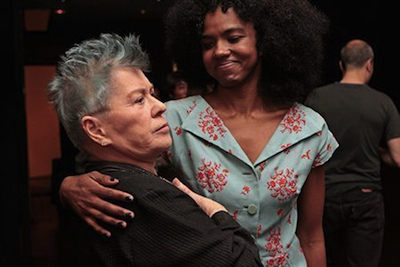
Betty Dodson and younger friend; Photo by Eric Francis

The endless rampant consumerism, ecological suicide and perpetual war seemed to go on its not-so-merry way.

In a world that worships youth and the next new thing I could succumb to feeling irrelevant. Yet I keep coming across vital older and elderly women who are wise, inspiring and contributing positively to the story of our world.

One, numerologist Gail Minogue, claims that:

offstage, waiting for the spotlight, are the middle-aged women…Everything is cyclical. We have not visited the importance of middle-aged women for about 200 years so we have little reference to this phenomena. This phase of power for this group will last until 2044 (starting 2024) so it is a long run and will have women in their 40s, 50s, 60s and 70s running the financial systems, the political systems, the social and cultural systems and the general well-being of our society.

If she is right, then women need to get ready to (re)claim power and authority, not as monstrous ‘Maggie Thatchers’ (i.e., taking on ‘masculine’ attributes) but as leaders, curators, storytellers, filmmakers, CEOs, mentors, elders and paradigm-bridgers who can inspire and nurture future generations.

The Good Book says that without vision the people perish, but the current vision of parasitic corporations, sociopathic puppeteer politicians, mindless military/police, and a populace without privacy or freedom is not one that serves humanity, but a disparate elite who fail to realize that we are all connected. These visionaries may well be the Women of Chiron, the wounded healers who have lived forgiveness and been transformed by pain.

There are too many women who lose their vision and sense of purpose as they age. I know many who would have once been called ‘spinsters’, some desiring to be in a relationship, others glad not to be, but all questioning their place in the world. We need to be reminded of how much we have to offer, and not be seduced by marketing that would have us compare and compete and compel us to carve up our faces into the neotenous masks of plastic surgery. It is a futile resistance. The media constantly exacerbates our fears of being discarded because we are no longer childbearing, no longer desirable, and therefore of very little value.

But we have much to offer. We do belong here. We must begin to recognize the beauty of the lines and scars that tell our stories. We must begin again to value life experience, wisdom and character. We must champion the elders and their wisdom — before it is too late.

The older woman particularly needs to think bigger and bolder, to dream again, and place a new value on who she is and why she is here. “… The future belongs to a very different kind of person with a very different kind of mind — creators and empathizers, pattern recognizers … These people — artists, inventors, designers, storytellers, caregivers, consolers, big-picture thinkers … The Conceptual Age,” writes Daniel Pink, in A Whole New Mind: Why Right-Brainers Will Rule The Future.

Surely that includes the experienced female, humbled by life, yet full of empathy and understanding?

Continue reading here.

Say vagina ‘til you don’t giggle

By Kathi Linehan

“She’s here!” announced one of the boys. I smiled and put my fingers to my lips indicating he should shush, because Mr. P was teaching in the front of the room. All the 5th graders began fidgeting at their desks, some casting furtive glances at me, some smiling, but all of them noticeably activated.

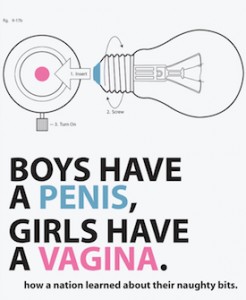
Graphic supposedly created for a 2004 special presentation by PBS and Oregon Public Broadcasting about the history of sex ed in public schools.

Graphic supposedly created for a 2004 special presentation by PBS and Oregon Public Broadcasting about the history of sex ed in public schools. Sadly, according to an OPB spokesperson reached by phone, no such program ever aired.

Like a rite of spring, it was time for the separate girls’ Reproductive Health class with Nurse Kathi.

Do you remember yours? Was it a nurse talking with you, maybe a gym teacher, or ‘the movie’ like it was for me in the ‘60s? Did you, or could you, say vagina or penis in class? Back then it was called Sex Ed, but we are more politically correct with our title now — if a child lives in a state that even allows a factual presentation about the changes of puberty.

I was lucky enough to be working in New Mexico, one of the 22 states in the U.S. that mandate sex education, at a K-8 school of primarily middle-class kids. As their school nurse, I was deemed by the Public Education Department as best suited to teach 4th through 8th graders about their body changes. I was especially grateful that this was NOT one of the three states that mandate only negative information about same-sex relationships. I could only imagine the feelings of anxiety, shame or isolation such a presentation could cause for any gay or lesbian students, or those with gay or lesbian parents.

Knowing that he had lost the students in this 5th grade class (one of three), the teacher instructed the boys to go to Mrs. K’s room across the hall and the girls to stay with me. One of the boys said jeeringly to a girl, “Have fun!” as he walked by me to exit; I couldn’t resist cheerily saying to him, “See you boys at 2:00.”

The smile fell off his face, as if he had forgotten that his boys-only class followed the girls’. Had he enjoyed embarrassing her about the thought of learning about her body, and then realized he was embarrassed as well?

I cherished my hour with this age group of girls. In 4th grade the girls watched a cartoon movie with me and I showed them how to put a sanitary pad on underwear, as some of them would need to know that at age 9, but that was about all they could handle. But by age 10 to 11, hormones can burst forth like daffodils in spring, and they are eager and ready for real information.

They want to understand why that boy is pushing them on the playground, or they feel a ‘zing’ with someone who, until then, had just been a friend. Hormones are powerful and at this age the attractions of puberty can come out ‘sideways’. They aren’t equipped to handle the feelings; they want to be close or touch someone, but are often misdirected in their attempts.

The students had been taught in previous life-skills classes that they were in control of their bodies, and with that personal responsibility they learned that yes means yes, and no means no. It was my role to reinforce the concept, especially now that they were older and could soon be in an increasing number of situations where they may not have a parent or adult readily available to intervene. These girls weren’t dating yet, but a parent might drive a group of them to the movie theater, and knowing some of these girls, I could be assured they would text a group of boys to meet them there.

We talked about what they could do when another person pushed them at recess. They had the ready answer of “Tell an adult,” like the yard-duty staff or their teacher, which was how these conflicts were usually handled in the school setting — focused on finding a resolution with the involved students. But, if they weren’t at school, how they could advocate for themselves by saying, “I don’t like you pushing me (or touching me) that way, and I want you to stop now”?

Being able to let someone else know what is not okay at that age could only grow into a great skill to have as an adult, and hopefully lead to healthy relationships. And what if that assertion was followed by a question such as “Why were you pushing me?” I can imagine a moment of introspection, followed by the honest answer of “Well, because I like you.” I may be a dreamer, but I was planting seeds of hope for a new generation in which transparency about feelings could be the norm.

We were just sitting and talking together, so when I pulled forward my flip chart to talk about their bodies and the changes of puberty, no one seemed overly concerned. But when I turned to the drawing with an internal view of ovaries, fallopian tubes, uterus and vagina to discuss the cycle of menstruation and used the word vagina, screams and laughter filled the room.

It wasn’t my first time teaching this class, so I just waited for it to subside. I pointed to my elbow and asked what body part that was, and they said, “elbow.” I pointed to my nose, and they said, “nose.” I pointed to the vagina on the picture, said “vagina,” and they lost it again.

Now I got to do my second favorite thing when teaching 5th grade girls’ reproductive health: to normalize the names of body parts related to the reproductive system and sexuality. I talked about growing up in America today and how in our culture the real names of our body parts related to sexuality are uncomfortable even for many adults to say. On top of that, each of them had family, cultural and perhaps religious values that could shape how they think about anything related to sex.

Just as a topic for pondering, I asked the students what it says about us as a society when we consider the number of euphemisms we have for male and female sexual anatomy.

This was recently demonstrated on The Daily Show when Jon Stewart was interviewing Dana Perino. She was talking about a picture of herself and her dog on the cover of a magazine.

This grown woman, a former White House press secretary accustomed to daily verbal parries with the most direct of reporters is also a current talk show host — therefore most likely familiar with the rules surrounding what words can and cannot be said on TV. Yet she was cringing as she tried to describe being questioned about her dog’s leg.

As Perino put it, the dog’s leg was “directly covering, you know what; the junk thing.”

When Stewart went on to clarify what she was referring to, her answer of “well, not that part, the other part,” was filled with as much trepidation. I really think she would have been just as uncomfortable had she not been on TV, and just talking with a friend.

In the classroom I explained that, for me, the reproductive system is no different from the respiratory or cardiac systems of the body, with organs that had names and functions. I reminded the girls that in addition to deciding what they would allow another person to do with them physically, no one could force them to say anything, either. I said that if they wanted to, there was something I’d like to try together that could help them.

I said, “Let’s all say the word vagina together until we can do it without giggling.” They agreed they could try, and we kept saying “vagina” together. At first the laughing was more uproarious than before, but by the 7th or 8th time, there were just giggles, and finally they could say it in a normal tone.

“Woohoo, you did it!” I praised them for trying that exercise. I’d posit that saying vagina without giggling is not only a step toward accepting our bodies, but necessary for learning to love our bodies — and ourselves.

The class continued and at the end I told them that if they had any more questions they could always talk with me in my office, or could talk with a parent or other trusted adult — that we are waiting for them to ask questions, because many times adults just don’t know how to bring up the subject of sexuality. I reminded them that talking with their friends is ok, too, but that their friends may not know any more than they do, and an adult might have better answers.

Of course, I wish I’d had more than only an hour with those girls, but I can find comfort in the knowledge that there are about 50 girls born in the year 2003 or so who can say the word ‘vagina’ without giggling. If only I could spend some time with Dana Perino so we could practice saying the word ‘penis.’

What about you? Have you had to work at saying ‘vagina’ or ‘penis’ without a giggle, without feeling awkward? Have you ever thought about why?

Personally, when I’m aware of a feeling or apprehension that does not seem situationally appropriate, it’s a signal to delve into my past to find the root cause. Generally, there has been a judgment or shaming that I have internalized that requires excavation. Brought to the surface, it can be examined and truth can shine its healing light. Given how taboo it is to speak of sex and genitalia with anything like relaxed candor, and how lacking the sex education is in most states, we might need backhoes to excavate the whole country.

Digging Out

By Judith Gayle | Political Waves

Things are seldom as they seem, especially if we’re skimming the surface of any event to decide its meaning. That’s where astrology comes in. Mars declared war on structure (Saturn) this week, first with a 7.3 aftershock in Nepal — toppling fragile buildings and causing more death — and days later, personifying chaos in the Amtrak wreckage. In the case of Nepal, a first quake in late April — taking more than 8,000 lives, causing major damage to infrastructure, and reducing ancient historical sites to rubble — didn’t rupture all the way to the surface, which created potential for additional quakes to relieve growing pressure. We know this because satellites are now able to assess movement and project patterns, targeting vulnerable areas.

275+Judith_Gayle

Due to hundreds of expected aftershocks, citizens have been terrified of remaining inside structurally compromised buildings, and thousands have stayed out on the streets. Because of the difficult mountainous terrain, relief efforts have been hit and miss for many, as helicopters fly into isolated areas to deliver supplies. A Marine Corps ‘copter carrying six Marines and two Nepalese soldiers was reported missing in the first wave of rescue effort and found crashed in a densely wooded area on Friday. In yet more tragedy, there were no survivors.

Death seems to have gained the upper hand in Nepal — along with areas in Tibet in April, and in India this week — and yet, defying all reason, a 101-year-old man was rescued, having survived being buried in the rubble for an entire week. So did a four-month old baby boy, dug out of his family’s collapsed home after almost two full days. No matter how dire the situation, life always finds a way, and you can take that to the bank.

Speaking of banks, NGO’s (charities) are begging for continued humanitarian aid, with Nepal’s Prime Minister urging additional “courage and patience” from international contributors. It has become a truism that with so many emergencies at hand, underfunded rescue efforts across the globe remain a constant worry. Remember the Christmas Tsunami of 2004? Hurricane Katrina in 2005? These initial shocking events came one after the next, prompting this nation to open their hearts, and their piggy banks, to help out.

We were still pretty innocent of what was coming, at that point. That was the Good Old Days before everyone caught on to the steady erosion of consumer protections bought by ALEC and cohorts, long before we realized the result of disastrous deregulation in the financial district, and just prior to the fiscal calamity that decades of voodoo economics trickled into. That was also before ‘disaster fatigue’ took over. Sadly, the requests for help come so often these days, we have to flip a coin to decide who is most needy. Still, the act of gifting is a metaphysical signal to the universe that you have enough to spare, which opens the energy of increase. We get by, so they say, with a little help from our friends, even if we never met them before. If you wish to contribute to Nepal’s on-going rescue effort, to help them dig out, here’s information about responsible donation in the area.

Regarding the Amtrak disaster outside of Philadelphia, Eric did his usual masterful job of decoding the astrology (and pointing out everyone’s favorite trickster, Mercury) in the subscription piece this week, and it appears that much of this situation can be traced to human error. Other factors contributed, however — some very political — and it’s worth taking a look at those because once again, structure, structure, infrastructure, oh my!

Since its inception in the 1970s as a federally-funded, for-profit corporation, Amtrak has been subject to the whims of infighting politicians, those on the left vying with the rail industry for money to fund their pet projects, those on the right slashing funds for any enterprise they consider ‘big government’. Not for the first time, experts are pointing out danger from a crumbling transportation infrastructure and spotty funding. Despite little or no effort to modernize the national rail system, ridership steadily increases, year by year. Like our for-profit postal service, Amtrak is the unfortunate step-child fed on scraps by a conservative party that wants none of it.

In 2008, following a major wreck attributed to human error, Congress mandated a rail safety system known as Positive Train Control (PTC), which, when put in place, would automatically monitor train speeds, critical distances between trains, and possible collisions. This week, the National Transportation Safety Board issued a statement saying that if PTC had been installed on that section of track in Philadelphia, the accident could not have occurred. Turns out PTC had recently been added to the section, but not fully tested or activated, one of those so-close-and-yet-so-far things that haunt survivors.

Although Amtrak 188 hit the corner that spelled disaster going twice the speed limit, analysis shows that the train speed increased in just the last few moments before the derailment at Frankford Junction, coming distressingly close to an oil tanker train, the kind that carries crude oil, known as ‘bomb trains.’ Things could have been so much worse!

First responders to these ever-increasing oil tanker emergencies, by the way, are the nation’s firefighters, and despite new federal safety measures, some 65 percent of firefighter groups say they have no specialized training in responding to this kind of hazardous material, especially highly toxic shale from the Bakken fields. They have asked for additional training, more information concerning the nature of the shipment, and of course, adequate funding to provide both. They needn’t hold their breath.

Indeed, Amtrak would commiserate in kind. On the day of the derailment, and within hours of the incident, Pubs on the House Appropriations Committee voted along party lines to cut Amtrak funding to less than half of what Obama had requested, from $1.14 billion to $251 million dollars.

Democrats on the panel attempted to raise the ante, but they were admonished by Idaho Pub, Mike Simpson, not to “… use this tragedy in that way. It was beneath you.” Yes, he said it, on record, for those with ears to hear. And the next day, Paul Ryan, House Ways & Means Chairman, assured FOX News viewers that Amtrak had been properly funded to implement the safety system mandate. Only it wasn’t.

The mandate required that PTC be fully functional in all passenger and freight trains by the end of 2015, but as with all things seemingly related to the good of the public, these things grind slowly. Funding has been inadequate to finish the job, resulting in delays that turned deadly in the very same section of Pennsylvania track that took the lives of 79 people in 1943. Ryan could hardly have missed that fact, since his old buddy (and my Boss Hog Senator) Roy Blunt put forth a bill only weeks ago requiring an extension of the PTC deadline to 2020.

But Gawd forbid we get off the Austerity Express anytime soon! Ryan warned again that there will be a tendency to ‘politicize’ rail-funding using this tragedy in a bleeding-heart lefty effort to spend more. Things like funding actual needs never seem to penetrate to Mr. Ryan’s heart-chakra, and his attitude seems to get worse with every article written about him. According to Think Progress, “Asked whether he thought rebuilding America’s infrastructure should be a priority, Ryan noted that the Highway Trust Fund goes bankrupt later this month but that he would not back tax increases for infrastructure improvement as “’we can do better by saving more money [and] being more efficient.’”

The Highway Trust Fund? Holy crap! Get out yer roller skates, kids — we may have to maneuver around all those pot holes with some fancy footwork! Now, to some of us — me, for instance — the Appropriations Committee voting against adequate money to fund Amtrak on the very afternoon of its worst derailment in more than 70 years seems just one more wink and nod at the plutocracy that doesn’t care if the nation has become an accident waiting to happen, that the trains run on time or even — so it seems — if they run at all. Insult to injury, John Boehner lost patience with a reporter who asked about the Dems’ accusation that funding cuts contributed to this incident by calling the question “stupid.”

“They started this yesterday: ‘It’s all about funding, it’s all about funding.’ Well, obviously it’s not about funding, the train was going twice the speed limit. Adequate funds were there, no money has been cut from rail safety and the House passed a bill earlier this spring to reauthorize Amtrak. It’s hard for me to imagine that people take the bait on some of the nonsense that gets spewed around here.”

Chuck Schumer, on point to replace Dem leader Harry Reid next year, called this response a denial of reality, to my mind typical of all we’ve come to expect of both John Boehner and the Republican Party. Dems may or may not want to upset their corporate overlords by tilting progressive, but they don’t insult my intelligence by pretending things aren’t so!

Even Louisiana Governor Bobby Jindal, who doesn’t appear to have all that many brain cells to rub together, pleaded with his party to stop behaving stupidly. And Rick Perry — who makes Dubya look brainy — has suggested that his state stop acting like paranoid children over the Pentagon’s war games in Texas, that they quit “being insane.” RICK PERRY managed to say something from the reality-sphere, bless his bony head! Yet John Boehner can’t imagine that people look at a sub-standard transportation system, improperly funded by self-absorbed politicians who seem totally committed to sending every dime in our coffers up the chain to the one percent who own them, and get upset? Which question is stupid, again?

This topic of infrastructure has been niggling at me for quite awhile, and came bubbling up like a bad case of agita when I read that the new 6.4 billion dollar eastern tower of the San Francisco Bay Bridge has indications of failed “anchor rod failure,” which is just about as serious as it sounds. And this is not new business. In 2013, 32 similar rods failed and were repaired at a cost of $45 million. This is shocking, not to menton chronic, ineptitude!

I can’t begin to tell you how many times I’ve traveled over that bridge in my lifetime, but not once — never — did I think it unsafe or unsound. Even during the Loma Prieta earthquake (6.9) in 1989, only one fifty-foot section of the bridge was damaged. It’s hard to think of it as anything other than rock solid, but apparently it’s not, and WTF! Even if we managed to muster the time, money and interest in doing critical repairs, why is it that — much like the still-flawed levees in New Orleans — we can’t seem to kick the corporate bottom-line out of the way to do right by the public trust?

But that doesn’t mean we CAN’T turn out extraordinary work, forward-thinking projects and top-of-the-heap infrastructure repair if we choose! There are great ideas out there, the public is behind such a massive project, and the world demands it — but WE, the People don’t demand it. Rachel Maddow told us this week that it’s almost as if the political system in this nation is designed to fail our infrastructure. Gathering the political will to make this happen will take a movement, the kind Bernie Sanders and Elizabeth Warren are suggesting.

Rachel and I are on the same page, regarding the shameful lapse in caring for the nation’s infrastructure, and certainly holding Congress culpable for this latest train accident, conductor error notwithstanding. As Rachel attests in this rant on upgrading trains and dragging our heels on entering a modern world, “trains in Spain travel an average of 154 miles per hour and those in Japan top out at over 200, Amtrak’s average speed is a sluggish 65 miles per hour.”

Evidently, Mr. Boehner, we no longer live in that exceptional fantasy world of yours! The good news? Just about everybody knows it but you. Over on the left, we’re talking about policy. On your side of the fence, you’re still spinning fantasy.

We’re digging out of the rubble left behind by Bush’s Folly and the Great Recession, by decline in infrastructure and government systems and obsolete ways of doing things. We’re digging out from a glut of disinformation, the bizarre fog of unreality and the overt attempt to take the nation and the world back into ages past. And even though it seems impossible to clear the debris no matter how hard we shovel, each problem carries its solution within it, ours to find.

As one who has always looked for, and found, the pony in the horse-shit, here’s my advice: first thing, you’ve got to call it like it is. Second? Look around to see who needs a helping hand, and offer it. Next? Pick up that shovel and put your back into it!

Danielle Voirin’s Photo of the Day for 05.15.15

The view from artist Matthew Rose's studio in the 14th district in Paris.  Whenever I fly back into Paris through Orly airport, if he's around I stop to play guitar and have a chat about art and politics, and eat whatever "glop" he has brewing on his stovetop.

The view from artist Matthew Rose’s studio in the 14th district in Paris. Whenever I fly back into Paris through Orly airport, if he’s around I stop to play guitar and have a chat about art and politics, and eat whatever “glop” he has brewing on his stovetop.

Paris-based photographer Danielle Voirin travels the world and documents her experiences in photographs. She takes street photography and photojournalism a shade beyond even art, to the level of mysticism. You may see more of her work on her website DanielleVoirin.com, or her alt website, DaniVoirin.com.

Close Enough in Time

It’s unusual for a New Moon and the beginning of a Mercury retrograde to take place within 24 hours of each other, but that is how next week is going to start. Shortly after 12:13 am EDT (4:13 UTC) Monday, the Moon will briefly share 26+ Taurus with the Sun. Soon after 9:49 pm EDT the same day (01:49 UTC Tuesday), Mercury’s apparent motion will reverse at 13+ Gemini.

len-wallick-logo

Taurus and Gemini are adjacent on the zodiac, which raises an interesting situation. When the luminaries (Sun and Moon) conjoin to define the upcoming Taurus New Moon, Mercury at its Gemini retrograde station will be more than 16 degrees away.

Even with the Moon moving at a rate of more than 14 degrees a day (which will be the case at the time of the Taurus New Moon), it would really be stretching astrology’s definitions to say Mercury will be part of the luminary conjunction.

For example, William Lilly (the great 17th Century English astrologer who promulgated many astrological guidelines still in use today) wavered between 15 and 17 degrees for the Sun’s widest plausible orb of influence, writing “I sometimes use the one and sometimes the other.”

Neither will the New Moon and Mercury at its pivot be far enough apart to be considered in any meaningful aspect other than conjunction. Yet, the two events will be close enough in time to be considered functionally concurrent. In essence, both will occur on the same day.

So maybe that’s how we should consider this unusual co-incidence of a New Moon and Mercury at a defining point. Instead of wrestling with degrees and geometry, perhaps we should consider the two events close enough in time to be indicative of something in combination.

Assuming a temporal perspective in relating the Taurus New Moon and Mercury’s retrograde station, it would be consistent to proceed with a temporal analysis. The period between one New Moon and another may be referred to as a ‘lunation’. It is a consistently regular, familiar and fundamental time frame of something less than 30 days. Lunations give rise to the nearly universal calendar sub-division known in English as a month (a word derived from the Moon).

Lunations are useful time frames. You can work with them. They are regular enough to set up schedules. They are long enough to show most trends and contain many changes, but also short enough to be of minimal challenge to recollection.

Mercury retrogrades are less well defined in terms of time. Yes, the actual period of retrograde motion is always in the neighborhood of three weeks long. Still, there is a demonstrable potential of events corresponding to retrogrades beginning when Mercury first enters the corridor (or ‘shadow phase’) of zodiac degrees it will ultimately retreat back through.

Additionally, a second shadow (or ‘echo’) phase commences after Mercury resumes direct motion to retrace that same corridor of retrograde degrees a third time. Finally, when retrogrades take place entirely within the bounds of a single sign (as is the case this year), one might consider Mercury’s entire tenure in that sign to have a retrograde cachet.

One thing for sure however, is that both the Taurus New Moon and Mercury’s station retrograde can fairly be construed to represent a beginning of some sort. So why not see it that way yourself? Why not start next week as if whatever you initiate has the potential to extend even further than a week if need be?

Perhaps that’s where you can begin deriving (rather than asking for) meaning from the unusual astrology of a New Moon concurrent with a Mercury retrograde station. You can seize it as an opportunity to initiate something you have been putting off. You can take it as a chance to give yourself as much time as you need to complete what you start, within the boundaries of reason astrology provides.

Most of all, you can bring astrology off the page or screen where it appears through symbols, charts and words. The cycles and timeframes delineated by the Sun, Moon and Mercury starting something together can become their reality for you.

That way, distant celestial objects can become close enough in time with you to be as much a part of your life as the people you share time with. Luminaries and planets may become as familiar as the places you spend your time. That way you may begin to bring both the greater and lesser lights of the sky quite literally down to Earth. Could be that’s part of the reason you are here. Why not begin next week as though that were true? 

Offered In Service

Len is available for astrology readings. You can contact him at lenwallick [at] gmail [dot] com.

Danielle Voirin’s Photo of the Day for 05.14.15

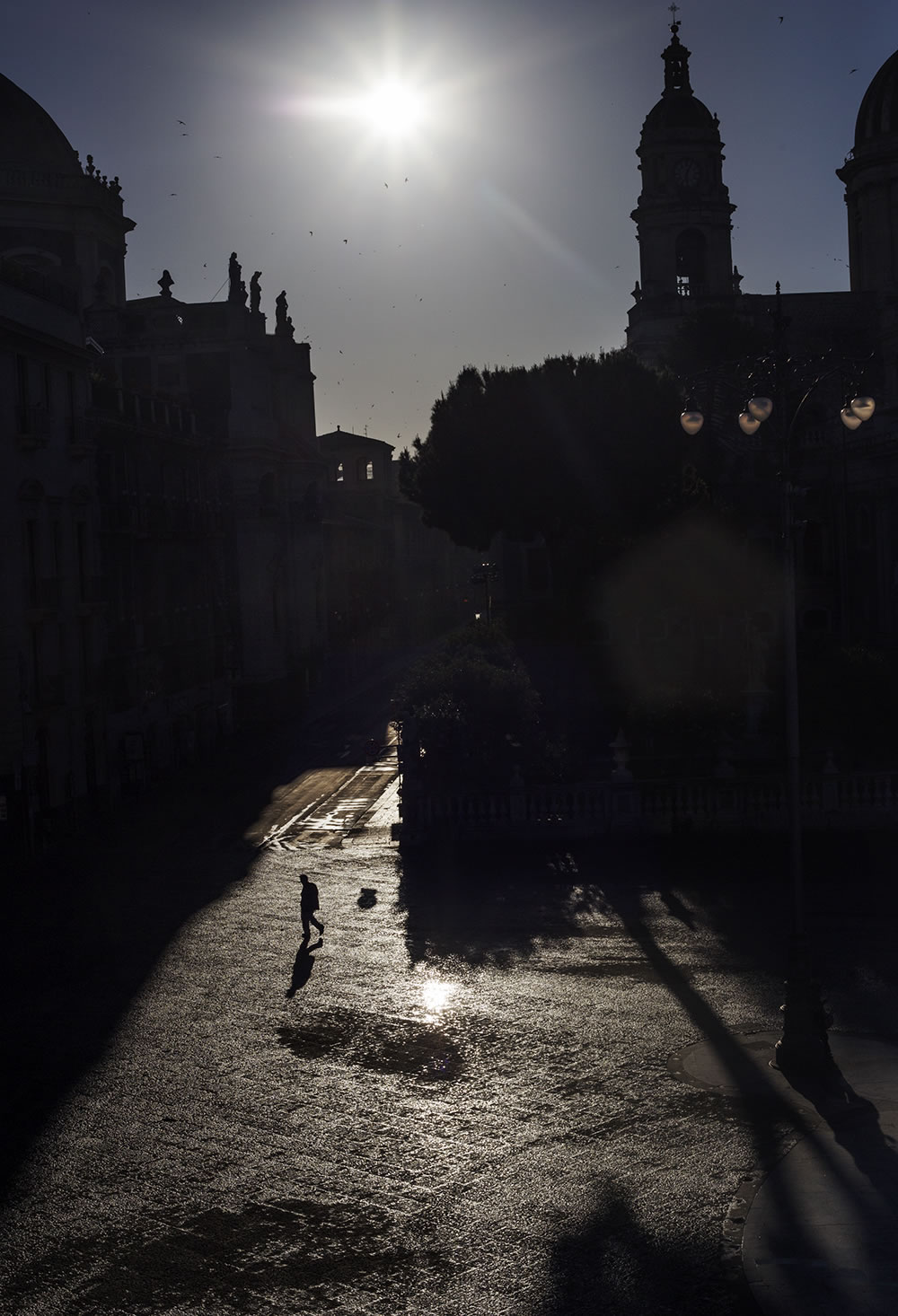
At 7am, through the Baroque shadows in the Piazza del Duomo in Catania, Sicily, the sun is already high and hot.

At 7am, through the Baroque shadows in the Piazza del Duomo in Catania, Sicily, the sun is already high and hot.

Paris-based photographer Danielle Voirin travels the world and documents her experiences in photographs. She takes street photography and photojournalism a shade beyond even art, to the level of mysticism. You may see more of her work on her website DanielleVoirin.com, or her alt website, DaniVoirin.com.

Room to be Wrong: Mars-Saturn, Mercury Retrograde

By Amanda Painter

In just four days, on May 18, Mercury stations retrograde in Gemini. This means we’re in the ‘storm’ phase: consider this your heads up to back up files and hard drives, and to stop to think more often than you don’t, as the days surrounding a Mercury station can be especially glitch-y. But Mercury is not the only planet in Gemini making itself known.

Photo by Amanda Painter.

Photo by Amanda Painter.

Mars arrived there Monday. It’s in an opposition to Saturn in Sagittarius that’s exact at 2:03 am EDT Friday, but you’ve likely already noticed its effects.

A good friend of mine recently described how much more flexible she has become in recent years. For most of her life, being ‘right’ was incredibly important to her; it was the thing that mattered most in any interpersonal conflict. She realized, however, that stubbornly insisting others see things her way causes deadlock; sometimes moving forward means allowing someone to be wrong, and working from there. Sometimes being happy means letting go of being ‘right’ in a disagreement.

Keep these dynamics in mind as you interact with others over the next couple days. Mars-Saturn oppositions can be challenging, because the planets involved represent opposite impulses. Mars represents compelling desire and the drive to take action (among other things); Saturn, in part, represents limits and containers. We need both to get anything done in life.

Think of Mars as your body’s muscles and Saturn as its bones, and you get a sense of how the interplay can work: your muscles need something to push and pull against to move your body; your bones not only provide the scaffolding for the muscles, but in turn need the muscles to expend their energy so that you don’t just lie rigidly on the floor.

Placement in the signs Gemini and Sagittarius flavors this relationship into a less physical, more mental/verbal expression. Mars in Gemini can have a quick, sharp tongue. It wants to make a point — and may even have a very good point to make. Saturn in Sagittarius makes for a big-picture, belief-oriented type of authority, though it can be proud and is unlikely to suffer affronts.

However, Saturn is currently retrograde. Whoever in your life is currently setting boundaries and making the rules is focused inward on themselves. As Eric described to me, Saturn retrograde in Sagittarius is saying, “I believe what I believe and you can’t change that.”

This feels maddening when you know you’re right about something and have all the details you need to argue your point and prove the other person wrong. But in the long run, can you really change what they believe? Ultimately, does it matter?

There can be times when it is critical to your survival or the wellbeing of others to speak your mind and convince another person to see things your way. But how often is that the case? This week, you can leave people room to be wrong — including yourself. As Mars continues through Gemini aspecting other planets and Mercury stirs up the mental plane over the next few weeks, knowing your own mind and what brings it peace — and some grace and flexibility — may come in handy.