Emma Court recently graduated from Cornell University. You can read her entire essay at The New York Times, but we’d love to have your comments here. For more insights into life for Millennials and the astrology they’re working with, check out Eric’s groundbreaking, multi-part Generations: Millennials Reading. — Amanda P.
By Emma Court
When a total stranger kissed me under the artificial lights of an airplane cabin somewhere above international waters, my first thought was of the Orthodox woman sitting to my left.
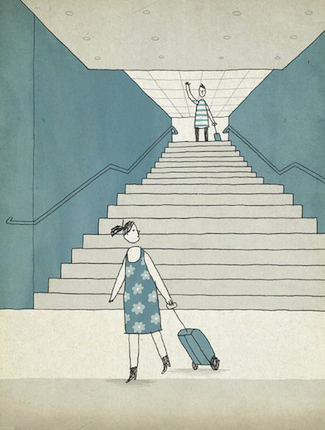
Illustration by Brian Rea for The New York Times.
I hoped she was asleep. It was a 12-hour flight from Tel Aviv to Newark, and I wanted to nap too, but how could I now?
The kiss, coming out of nowhere, had turned me into the heroine of a bad romance novel: heart fluttering, weak-kneed, every nerve electrified. Those blue fleece blankets had never been so sexy.
It was an overnight flight, and I had already crunched the simple calculus: If I slept, I’d be over the seven-hour time difference by the time we landed and ready to hop back into a new semester at college.
My highest hope for the trip, besides hours of sleep, had been that they would serve hummus at the in-flight dinner.
My stranger and I were returning from Birthright Israel trips with groups from our respective universities. Birthright Israel is a free 10-day trip to Israel for young Jewish-Americans, and I had wanted to go before I graduated. Last winter, before my final semester of college, I finally had.
Because there are so many young people on Birthright Israel trips, they’re often mocked as an attempt to spark a connection to Israel through the bedroom — and plenty of that had happened on my trip. But it hadn’t happened to me until that moment.
Spoiling the perfect narrative of two strangers meeting on an airplane, I admit that we had met before, just once, briefly, when I bumped into a friend from high school during a stop in Jerusalem.
One of her friends had been cute, I had remembered. And now here he was behind me as we boarded the airplane, then bending his tall frame into the aisle seat next to me. As he lifted his backpack into the overhead compartment, I marveled at my luck.
Between us sprang the kind of instant intimacy fostered by open personalities in tight quarters. We spoke in spurts about the gossip on our trips and what we had done during the days spent in Israel. We flirted. We kissed that first time. Then we kissed again.
Splitting a pair of headphones, we listened to the Red Hot Chili Peppers and Taylor Swift. We slept a little, poorly.
Born and raised in New York City, I found his life as a not-so-Jewish boy in North Carolina foreign and dazzling. He and his friends did things like take long hiking trips and, in preparation, dehydrate their food.
I liked how easy he was, how ready to talk. I liked his laugh and his dark eyes. He knew how to figure out where rainbows would appear in the sky and told me about the “Door to Hell” in Turkmenistan, a crater of natural gas that’s been on fire for more than 30 years.
It seemed torn from the back of a Nicholas Sparks paperback: A Southern science major from a small liberal arts school and a Northern humanities major from a huge pre-professional university meet in the skies over the Mediterranean. The heat between them is palpable.
But less romantic details persisted: I was a senior, about to start my second semester, with plans to head to Dallas after graduation. He was a sophomore, with the swaddling comfort of knowing where he’d be for the next few years.
But it didn’t matter anyway, did it? In 12 hours, we’d be back on paths that led us in opposite directions. This meeting was just a romantic interlude from our real lives. And if it did mean anything, we were college students; we knew how to pretend it didn’t.
Continue reading here.